Managing safety actively while moving through the landscape
Keeping kids safe on a hike comes down to managing supervision, spacing, and judgement consistently as conditions change along the track, rather than trying to control every step or remove all risk, which is not realistic anyway.
Most incidents involving children happen while walking, not at the trailhead or the destination, because distraction, uneven terrain, fatigue, and changing conditions can all reduce safety margins quickly once you are moving. That is why this guide focuses on actively managing safety on the move, rather than reacting once something has already gone wrong.
Supervision needs to match the terrain, not the distance
Supervision is not static, it needs to increase as terrain becomes steeper, narrower, or more complex.
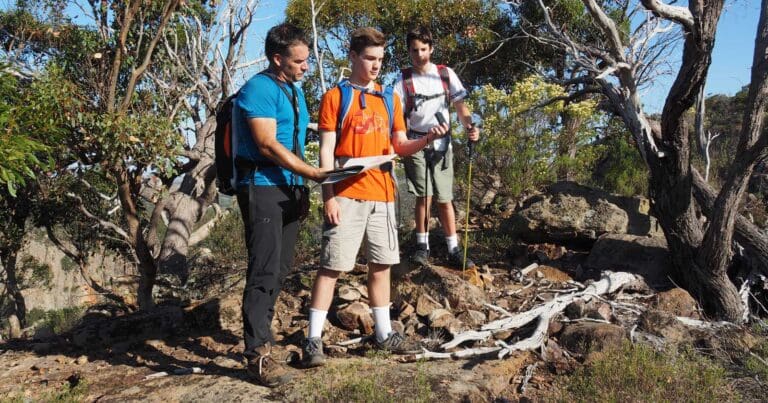
On wide, well-formed tracks, children can often move with more freedom, but near drop-offs, water crossings, slippery rock, or dense vegetation, adults need to stay closer and stay visually engaged, because that is exactly where a moment’s inattention matters most.
If a section of track demands constant vigilance just to manage the hazards, it may not be suitable for kids at all.
Maintain visual contact at all times
Children should stay within visual contact, not just shouting distance, because wind, vegetation, terrain, and distraction can all make voices unreliable exactly when you need them not to be.
Simple rules help:
- stop at junctions
- wait where the track is unclear
- stay within sight of an adult unless told otherwise
Explain these expectations before the hike begins, and reinforce them calmly on the track rather than only after they are broken.
Manage spacing deliberately
Spacing within a group matters, because kids walking too far ahead can miss turns or run into hazards without supervision, while kids falling too far behind can become fatigued or separated without anyone noticing straight away.
Position adults where they can:
- see the entire group where possible
- control pace
- respond quickly if someone stumbles or stops
Spacing should tighten automatically the moment the terrain gets more hazardous, not after something has already happened.
Teach awareness without transferring responsibility too early
Children can learn awareness and judgement, but adults remain responsible for the safety decisions themselves.
Encourage kids to notice:
- slippery surfaces
- loose rocks
- steep edges
- changing weather
Ask questions and talk through decisions with them, but do not place responsibility for safety onto the child, because learning happens through explanation and example, not by removing adult oversight.
Fatigue and hunger increase risk
Tired, hungry, or cold children are far more likely to trip, lose focus, or make a poor decision, which is why regular breaks, snacks, and drinks do more for attention and coordination than most people expect.
Addressing those small needs early is one of the most effective ways to prevent accidents on the trail.
Adjust plans as conditions change
Safety management continues throughout the hike, because weather shifts, fading daylight, and changes in energy all call for reassessment as the day goes on.
Be ready to slow down, shorten the walk, or turn back if conditions deteriorate. Making the conservative call early is what reduces the likelihood of an incident later in the day.
Explore related guides
- Hiking with young children (toddlers to primary age)
- Hiking with older kids and teenagers
- Hiking with Kids: Planning, Safety and Shared Responsibility
- Plan your hike like your life depends on it
- Trip Intentions and Rescue Planning for Hikers
- Keeping Kids Safe on the Trail
- PLB or Satellite Communicator?
- What Happens After You Activate a Personal Locator Beacon
- The Stages of Search and Rescue in Australia
- Signalling for Help When Lost or Injured on a Hike
- A Practical Guide to Survival Priorities
- What to do if you get lost hiking in Australia
- What to do when a group member becomes lost
- What to do if a child becomes separated on a hike





What’s your top tip for keeping kids safe while hiking? Any memorable experiences or lessons learned on the trail?
Trail Hiking Australia Make sure the kids layer up when you stop for the day – hypothermia can set in fast!
Wallaroo Adventure Store a wise suggestion. Nothing worse than being cold and miserable, or worse, hypothermic
Yes, and when you’re warm from hiking then stop, it’s easy to not pick up on cooling down fast