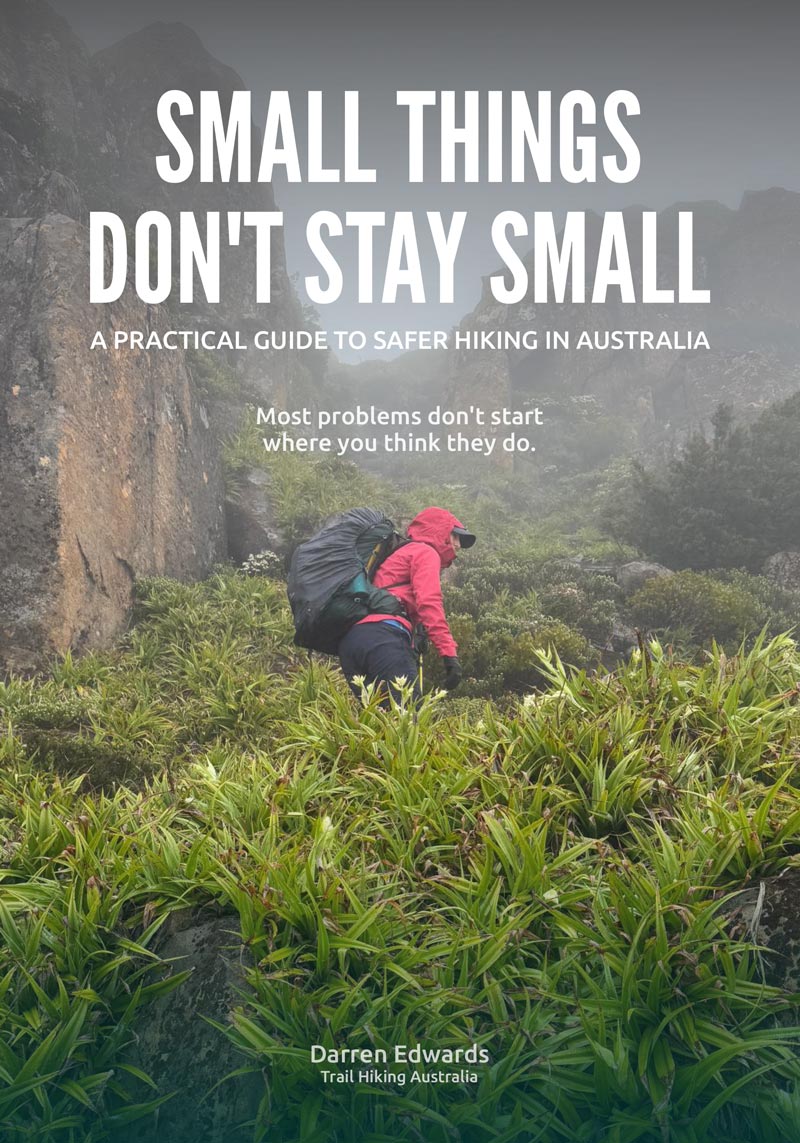



Small Things Don’t Stay Small
A practical guide to recognising the early signs of trouble before they become harder to manage.
Most hiking problems don’t begin when they feel serious. They begin earlier.
A pace that is a little slower than expected. A moment of uncertainty at a junction. Water disappearing faster than planned. A small discomfort that hasn’t gone away. A change in weather that doesn’t seem important yet.
Individually, these things are easy to dismiss. But they can interact, adding pressure to time, energy, movement, navigation and decision-making until a straightforward hike becomes much harder to manage.
Small Things Don’t Stay Small is about learning to recognise those early signals and act while the response is still simple.
Rather than giving you another list of hiking rules, it shows how small changes develop, how they affect other parts of a hike, and why responding early preserves more options.
Get the guide
Paperback and Kindle editions available at Amazon →
eBook edition available at Kobo →
eBook edition available at Google Play →
If you want to go deeper, explore the full Hiking Australia volumes →
What this book does
The central idea is simple: the earlier you recognise that something is changing, the easier it usually is to respond.
The book follows those changes through the different parts of a hike — choosing and planning a walk, movement and navigation, weather and environmental conditions, equipment, hazards, judgement, emergency preparedness and learning afterwards.
Small Things Don’t Stay Small:
- Helps you recognise changes in pace, energy, movement, attention and conditions before they become obvious problems
- Shows how one small issue can begin affecting time, fatigue, navigation and decision-making
- Explains why uncertainty, hesitation and discomfort are information rather than things to automatically push through
- Shows how early adjustments can preserve time, energy and available options
- Uses practical Deep Dive scenarios to trace how ordinary situations develop from early signal to eventual outcome
- Encourages you to review each hike so that what you notice becomes useful experience for the next one
This is not about becoming cautious about every little thing. It is about getting better at recognising which little things deserve your attention.
Who it is for
Small Things Don’t Stay Small is particularly useful for:
- People who are new to hiking and want to build good habits from the beginning
- Hikers starting to move beyond short, familiar walks
- Bushwalkers who want to become better at noticing when a hike is beginning to change
- People who have experienced a difficult hike and wondered when the situation actually started to go wrong
- Group members who want to recognise changes in other people as well as themselves
You don’t need advanced skills or years of experience. The book is about paying attention to ordinary things that happen on ordinary hikes, and understanding when they start to mean something more.
Where this fits
Most hikers recognise the obvious problem. The more useful skill is recognising what happened before it became obvious.
A slower pace may begin affecting timing. Reduced timing margin can shorten breaks. Shorter breaks can increase fatigue. Fatigue can affect navigation and judgement. None of those changes necessarily creates an emergency on its own, but together they can change the whole character of a hike.
Small Things Don’t Stay Small focuses closely on that process.
If you want a complete guide to hiking safely and confidently in Australia, The Capable Hiker brings preparation, equipment, navigation, trail judgement, emergencies and learning together in one book.
If you want to explore the broader preparation and decision-making system in greater depth, the two Hiking Australia volumes examine what happens Before You Go and On the Trail.
Small Things Don’t Stay Small has a narrower purpose: helping you become better at seeing the early signals that are easiest to miss and cheapest to act on.
Publication Details
First edition: 2026
Author: Darren Edwards
Publisher: Trail Hiking Australia
Published in: Melbourne, Australia
Paperback ISBN: 978-1-7646398-4-2
eBook ISBN: 978-1-7646398-5-9

All material on this website and in associated downloadable publications is protected by copyright and may not be reproduced, republished, or redistributed without prior written permission from Darren Edwards. For full details, please refer to the Terms of Use, Copyright and Title of Ownership information.


