Practical Ways to Reduce Risk and Get Home Safely
Feeling uneasy on a narrow track is not unusual. It can happen to anyone, but many women describe having to think about safety in ways others may never have to, and this question comes up again and again across hiking communities: what actually helps if you feel unsafe while walking alone?
I’m not interested in telling anyone what to do, questioning their instincts, or picking apart the fear itself. What I want to cover here is the practical side, the planning, the signalling, and the habits that reduce risk while hiking solo, particularly in bush and remote settings.
When something doesn’t feel right
Trusting your instincts matters. You don’t need proof that a situation is dangerous to decide it feels uncomfortable, and on narrow or overgrown tracks, where options can feel limited anyway, that discomfort tends to sit heavier than it would somewhere open.
If someone is too close behind you and it feels unsettling, there are non-confrontational ways to create space:
- Increasing distance where the track allows
- Letting someone pass when there is a genuinely safe, wider spot. Step off to the side, turn to face the track, and offer a firm “hello” if that feels comfortable. This acknowledges their presence and keeps them in your line of sight until they have moved on.
- Changing pace or direction if the terrain makes that possible
- Moving toward more open areas, junctions, or busier sections of track
There’s no single correct response here. What matters is creating space, time, and options for yourself.
Signalling and emergency tools that actually help
In bush settings, the tools worth carrying are the ones that help you be heard, located, or assisted, not anything built around confrontation. That’s a deliberate distinction, because a lot of gear marketed for personal safety assumes you’ll be fighting someone off at close range, and in remote bush that’s rarely the situation you’re actually in.
The options I’d point to:
- Whistles: A whistle carried on a pack strap or shoulder strap can be heard far further than a voice and requires very little effort to use. Make sure it is reachable without taking your pack off. Seconds matter when you need to draw attention.
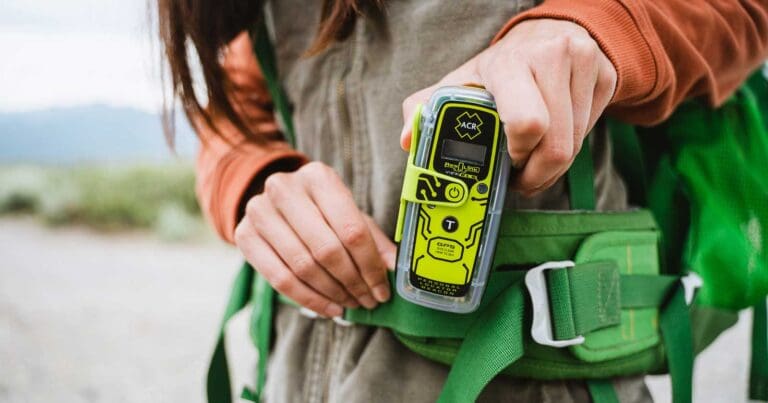
- Personal Locator Beacons (PLBs): A PLB is designed for situations where you need urgent assistance and have no mobile reception. It does not rely on phone signal and provides your location to emergency services.
- Satellite messengers or SOS-enabled watches: Devices with SOS or satellite tracking features can provide an additional layer of reassurance where reception is unreliable.
- Headlamps or torches: Visibility matters. Light can help you see what is around you and make you more visible to others.
These tools are about calling for help and being found, not managing a confrontation on your own, so carry them on your person rather than buried inside your pack. A PLB at the bottom of your bag does you no more good than one left at home if you can’t reach it in time.
Planning habits that reduce risk
Good planning does not eliminate risk, but it reduces the number of things that can go wrong at once, and it’s usually the part people skip because nothing about it feels urgent until it suddenly is.
Habits worth building into every solo walk:
- Sharing your planned route, start time, and expected finish time with someone you trust, and telling them exactly what to do if you don’t check in. For example, “If you haven’t heard from me by 6:00 pm, please call me, then contact emergency services.”
- Using live location sharing where possible
- Choosing routes that match your comfort level, experience, and the conditions on the day
- Prioritising daylight hours when visibility is better
- Avoiding distractions such as headphones so you stay aware of your surroundings
That level of detail in a check-in message is the whole point of it. A vague “I’ll be back sometime tonight” leaves whoever’s waiting for you without a clear moment to act. A specific time and a specific instruction gives them both. These habits aren’t about fear, they’re about giving yourself options if something does go wrong.
What not to rely on in bush settings
It’s completely understandable that people look to sprays, knives, or improvised weapons when they think about personal safety. Everyone has the right to feel safe and to protect themselves from harm.
That said, in remote or bush environments, these options often don’t work as reliably as people expect, and in some cases can increase risk rather than reduce it. Beyond the physical risks, carrying items intended as weapons can also carry legal complications in many regions, particularly in Australia.
Most sprays and handheld weapons require very close proximity, fast reactions, and fine motor control at exactly the moment adrenaline is highest and conditions may be uneven, dark, wet, or confined. There’s also a real risk that anything you carry as a weapon gets taken off you and used the other way.
That’s why bush safety, in my view, comes down less to confrontation and more to prevention, distance, visibility, and the ability to call for help. Tools and strategies that help you be seen, heard, located, or rescued are simply more dependable outdoors than anything built around physical engagement. This isn’t about telling anyone what they should or shouldn’t carry, it’s about being honest about which strategies actually hold up when the goal is getting home.
A shared responsibility on the trail
Safety in outdoor spaces isn’t only about what individuals carry or how they plan. It’s also shaped by how people move, speak, and behave around one another, particularly around someone walking alone. Small, considerate actions often matter most in moments where someone may already feel vulnerable.
Actions that make a real difference:
- Announcing your presence early if you are coming up behind someone
- Giving space on narrow tracks and at rest stops
- Asking before passing rather than closing in silently
- Reading cues and backing off if someone seems uncomfortable
Most people on the trail are respectful and well-intentioned, and being mindful of how your presence might be perceived is a small cost for making outdoor spaces feel more open to more people. Hold yourself and whoever you’re hiking with to that standard and the trail works better for everyone on it.
None of this is about being fearless or ready for every worst case, and solo walking safety really comes down to stacking the odds in your favour. Practical planning, reliable signalling, and shared awareness on the trail do more for that than anything else. If you want to go further into the cultural side of this, why the fear exists in the first place and what allyship actually looks like on the trail, that’s what The Uneven Trail: Women, Fear, and Freedom is for.



Have you ever felt uneasy on a solo hike? What little tricks do you use to boost your confidence out there?
I go out with a knowing that almost all violence against women occurs in the home by a known person. The chances of assault or violence on the trail is pretty much zero. Anytime m tending harm is not going to hike into remote areas to maybe come across a potential victim – these people won’t make any effort to go outside busy areas where they can be almost invisible in a crowd.
Fiona Cunningham That’s a really helpful perspective. Keeping the actual level of risk in proportion can make a big difference to how confidently we head out alone.
Interesting one.
The couple of times i have encountered a woman on the trail i have tried to be totally un threatening as possible.
Personally for myself, i don’t care.
Both times i actually almost made a decision NOT to make myself known to either of them as i had just come out of the bush where you would not expect anyone to appear from where i came from but thought that i would just make myself known by making a lot of noise so they could hear and see me.
I hate that i would even contemplate thinking that way but that is what the thoughts were.
This also goes for men as well but i don’t care if i look threatening. I still let people know I’m there.
Peter Jolly great awareness. Giving someone a little warning rather than suddenly appearing can make the encounter feel much more comfortable.
shouldn’t have to, but that’s where we are these days
I usually hike alone and I’ve only ever felt threatened by another person on a trail once. A man wearing nothing except red shorts appeared out of the bush miles from any hut on the Greenstone/Caples track. I’ve never ran across a 3 wire bridge so quick!
The hut warden that night explained that he was probably wild camping to avoid hut fees as so many do.
Tis Mel That would have had me moving quickly too! Even with an innocent explanation, someone suddenly appearing from the bush like that would be unsettling.
Great article to help people feel more confident. Thank you!