Waterproof jackets rarely fail in a dramatic moment. They decline gradually, often unnoticed, until one day the protection you assumed was reliable begins to feel heavy, clammy, and ineffective. In mild weather this is inconvenient. In cold wind, sustained rain, or alpine exposure, it becomes a safety issue.
A waterproof jacket isn’t just clothing. Its job is to preserve insulation, reduce evaporative heat loss, block wind chill, and maintain a stable microclimate around your body. When it underperforms, heat loss increases, fatigue accelerates, and decision-making begins to degrade. I want to explain how and why jackets fail, because understanding that lets you manage the decline predictably rather than discover it in deteriorating weather.
How Waterproof Jackets Actually Work
Most modern waterproof jackets rely on a layered construction. The outer face fabric provides durability and structure. Beneath it sits a waterproof membrane, often made from expanded PTFE or polyurethane, designed to block liquid water while letting water vapour escape. Inside, a lining protects the membrane from abrasion and contamination.
Breathability depends on a moisture gradient. Warm, moist air inside the jacket has to move into cooler, drier air outside. When that gradient weakens, such as in high humidity or sustained rainfall, moisture transfer slows. Sweat accumulates. The inside feels damp even though rain hasn’t penetrated.
That distinction matters. Not every damp jacket is leaking. Sometimes the jacket is simply overwhelmed by environmental conditions. But environmental limits are only one part of the story.
External Failure: Wet-Out and DWR Degradation
The most common perceived failure is wet-out.
The outer face fabric of a waterproof jacket is treated with a Durable Water Repellent coating, known as DWR. When it’s working properly, rain beads and rolls off the surface, much like water on a freshly waxed car. Over time, abrasion from pack straps, body oils, dirt, sunscreen, and UV exposure degrade this coating. Once compromised, the face fabric begins to absorb water and darken into heavy, saturated patches.
When wet-out happens, several things happen at once. The saturated fabric blocks vapour transfer, dramatically reducing breathability. Internal condensation increases. The jacket feels clammy and cold against the skin. Although the membrane beneath may still be intact, the performance of the whole jacket declines.
In prolonged Australian rain events, such as on exposed Tasmanian plateaus or during multi-day systems in the Victorian Alps, wet-out is often the reason hikers believe their jacket has failed outright. In reality, the membrane may still be functioning. The outer layer has simply lost its repellency.
A saturated shell increases conductive and evaporative heat loss, particularly when combined with wind. Your body has to work harder to maintain temperature stability, drawing on energy reserves that also support judgement and mobility.
Structural Failure: Membranes and Seam Tape
More serious decline occurs when the internal structure of the jacket deteriorates.
Waterproof membranes are thin, flexible layers bonded to fabric. Over years of use, repeated flexing, contamination, and heat exposure weaken the bond between layers. In hot Australian summers, leaving a jacket compressed in a vehicle can accelerate adhesive breakdown. Eventually, the membrane may separate from the face fabric, a process known as delamination.
Delamination often begins subtly. You may notice bubbling, flaking, or small areas where the inner lining appears loose. As separation spreads, water can bypass the membrane entirely. Unlike wet-out, which affects comfort and vapour movement, delamination results in genuine leakage.
Seam tape failure follows a similar pattern. Waterproof jackets rely on taped seams to seal stitch holes. Over time, especially around high-movement zones like shoulders and elbows, seam tape can lift or peel. Water entering through exposed stitching is often mistaken for random fabric failure, when it’s actually predictable adhesive fatigue.
Structural failures like these are more serious because once water penetrates insulation layers, loft collapses. In cool conditions, heat loss accelerates rapidly. At that point, the issue is no longer comfort but exposure.
Mechanical Wear: Abrasion and Australian Terrain
Mechanical wear is often underestimated. In many Australian environments, abrasion does more damage than rainfall.
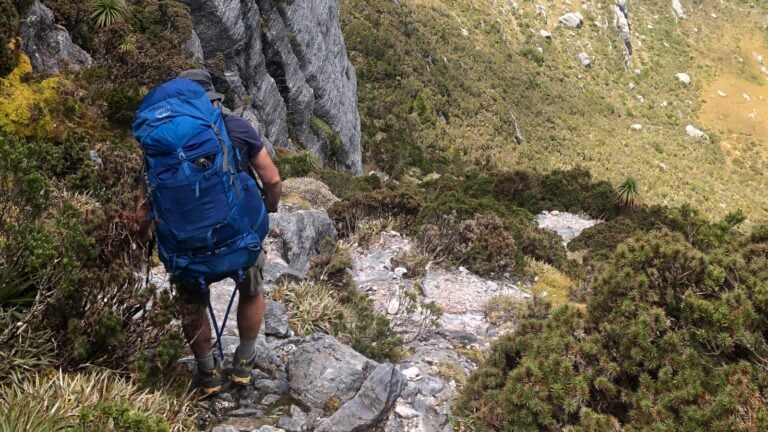
In the dense scrub of the Australian bush, where wait-a-while vines hook at fabric and abrasive sandstone edges brush against sleeves, repeated contact gradually thins outer fabrics. Backpack shoulder straps and hip belts create constant friction. Over thousands of steps, this wear degrades the face fabric and stresses the membrane beneath.
In arid landscapes, fine dust works into zips and fabric coatings. In alpine areas, cold temperatures stiffen materials, increasing stress at flex points. Over time, mechanical wear becomes the dominant driver of jacket decline.
When abrasion compromises the face fabric, both wet-out and membrane stress accelerate. These failures rarely occur in isolation. External, structural, and mechanical factors interact.
Recognising Early Warning Signs
Waterproof jackets give you visible cues before complete failure. A healthy jacket sheds rain immediately. Droplets bead and roll away, leaving the fabric visibly dry. A declining jacket darkens quickly in light rain, developing heavy, “wet-look” patches where water soaks in rather than repelling.
Persistent internal clamminess during moderate exertion may point to reduced breathability from wet-out. Peeling seam tape or bubbling inner fabric signals structural breakdown. If water entry becomes localised around seams or shoulders, seam failure is likely.
Addressing these early signs extends jacket life significantly. Cleaning the jacket with an appropriate technical wash can remove contaminants that inhibit DWR performance. Reactivating or reapplying DWR restores surface repellency. Inspecting seam tape lets you repair small lifting sections before widespread leakage develops, and I think this kind of preventive maintenance does far more for a jacket than replacing it mid-season.
Breathability Limits in Humid Conditions
Australia’s climate introduces another complexity: humidity. In tropical or subtropical conditions, the air outside may already be saturated with moisture. When humidity is high, vapour can’t escape efficiently regardless of membrane quality. The jacket traps internal moisture, and you feel damp no matter how good the fabric is.
In these conditions, pacing, ventilation, and layer management matter more than fabric rating. No waterproof-breathable membrane can overcome saturated air, and understanding that stops you blaming the jacket for something it was never going to solve.
When Jacket Failure Becomes a Safety Issue
A compromised waterproof shell has consequences beyond comfort. Reduced protection increases energy expenditure. Wet insulation reduces warmth. Fatigue grows. Slower pace reduces daylight margins. Decision-making becomes less conservative.
Exposure incidents rarely stem from a single dramatic event. They build from small declines that add up: a jacket that no longer performs as expected can quietly shift a manageable hike into a deteriorating scenario, especially in alpine wind or shoulder-season storms.
Recognising decline early keeps your options open.
Extending the Life of Your Jacket
To maintain reliability:
- Clean periodically using appropriate technical products
- Avoid regular detergent and fabric softener
- Reactivate or reapply DWR when water stops beading
- Inspect seam tape annually
- Store dry and loosely rather than compressed
These habits slow degradation and preserve performance under real-world conditions.
No waterproof jacket lasts forever. All membranes degrade. All DWR coatings wear away. Performance is finite, shaped by environment, maintenance, and how hard you use it. What I’m after is predictability: a well-maintained shell that protects against sustained rain and wind within its intended range, without expecting it to eliminate internal moisture during intense exertion in tropical humidity, or to function indefinitely without care. Membranes and coatings are consumable parts, not permanent ones, and understanding those limits removes the surprise. Removing the surprise is what actually strengthens decision-making out there.
If you’re unsure of your jacket’s condition, test it deliberately before committing to remote terrain. Watch how quickly water beads. Inspect the seams. Work out whether what you’re feeling is internal moisture or external leakage. Waterproof jackets don’t fail because rain is heavy. They fail because coatings degrade, adhesives weaken, fabrics abrade, and expectations outpace what the jacket was ever designed to do. Understanding these mechanisms is what keeps your protection layer dependable when conditions demand it most.
Explore related guides
- Maintaining and Restoring DWR Performance
- Choosing outer layers for hiking
- Layering clothing for hiking
- Hiking in cold weather
- Weather Guide for Hiking in Australia
- How to keep your hiking gear dry and organised
- Hiking Repair Kit Essentials
- Emergency shelter use and insulation
- A Practical Guide to Survival Priorities
- Environmental protection system for hiking