The skill of time and distance planning
Knowing how long a hike is likely to take is a fundamental planning skill. Poor time and distance estimates lead to rushed decision-making, late finishes, and increased safety risks, particularly when terrain, weather, or group ability are underestimated. This guide explains how to estimate hiking time realistically by accounting for distance, elevation, terrain, group dynamics, and rest breaks, helping you plan routes that are achievable and safe.
Why time and distance planning matters
Distance alone does not determine how long a hike will take. Surface conditions, elevation change, vegetation density, and navigation complexity all influence pace and fatigue. Even short hikes can take far longer than expected when they involve steep climbs, loose surfaces, river crossings, or slow travel through scrub. Accurate planning reduces pressure later in the day and improves decision-making on the trail.
Understand how terrain affects speed
Different terrain types have a significant impact on travel time. Consider how much of your route includes:
- Well-formed tracks: Faster and more predictable travel.
- Steep ascents: Slower pace and higher energy demand.
- Rock scrambling or boulder hopping: Requires careful movement and reduces speed.
- Scree or loose gravel: Unstable footing slows progress.
- River crossings: May require scouting and waiting for safe conditions.
- Sand, snow, or mud: Increases effort and fatigue.
- Dense vegetation: Significantly reduces forward progress.
Time estimates should always reflect the slowest terrain, not the easiest sections.
Use a baseline planning rule
A common starting point for estimating hiking time is Naismith’s Rule. It assumes that a reasonably fit adult can walk 5 kilometres per hour on flat ground, plus an additional hour for every 600 metres of elevation gain. This rule provides a baseline only. It does not account for difficult terrain, heavy packs, poor track conditions, or extended breaks. Treat it as a minimum estimate rather than a guaranteed outcome.
Account for ascents and descents
Elevation gain has a major impact on time and fatigue. Sustained climbs slow pace and increase energy use, while long descents place strain on joints and often require careful, controlled movement.
Refer to Hiking Uphill: Technique, Pacing and Safety and Hiking Downhill: Technique, Control and Knee Protection to better understand how terrain affects movement and time.
Plan around your group, not individuals
Group ability plays a major role in realistic time planning. A group will always move at the pace of its slowest member, particularly on climbs, technical sections, or later in the day when fatigue sets in. When planning, consider pack weight, experience level, and fitness across the entire group. Routes should be selected so that all participants can complete the hike without rushing or excessive fatigue.
Estimate pace realistically
As a general guide, an average group carrying overnight packs may expect:
- 1 km/h: Very steep or heavily vegetated terrain.
- 2 km/h: Steep climbs or sustained rock scrambling.
- 3 km/h: Steep descents or rough ground.
- 4 km/h: Steady walking on formed tracks.
- 5 km/h: Short periods of fast movement on easy ground.
Adjust estimates downward when conditions are hot, wet, or technically demanding, and later in the day as fatigue increases.
Build breaks into your plan
Breaks are part of movement time and should be planned, not treated as delays. Short, regular pauses help manage fatigue more effectively than infrequent long stops. As a guide:
- Short breaks: Five minutes every hour.
- Longer stops: Fifteen to twenty minutes for meals or extended rests.
Frequent short breaks keep muscles warm and maintain momentum, while long stops should be limited to avoid stiffness.
Allow generous daylight margins
Always plan to finish hikes well before dark. Allow extra time for navigation errors, slower progress, or unexpected obstacles. Finishing early provides flexibility to adjust plans safely if conditions change and reduces pressure to rush late in the day.
Use tools to refine your estimates
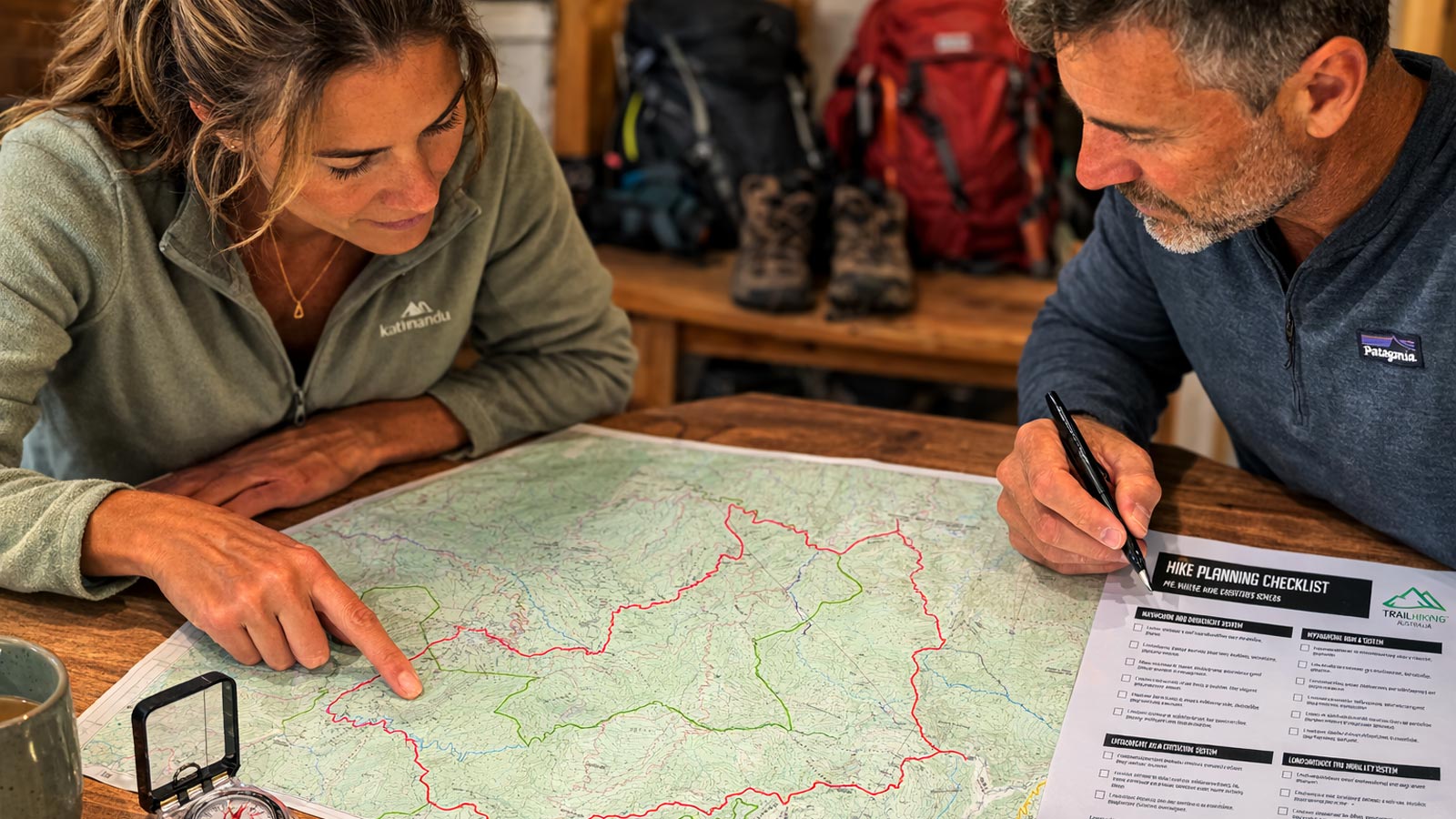
Hike planning involves more than simply choosing a trail. Distance, elevation gain, terrain, weather and daylight hours all influence how demanding a walk will be and how long it may take. Time and distance planning improves with experience, but calculators can help verify estimates and identify unrealistic plans.
Trail Hiking Australia provides a range of practical hiking planning calculators and tools designed to help hikers better understand the demands of a route before heading into the Australian bush. While these calculators cannot replace experience or good judgement in the field, they can help hikers make more informed decisions before committing to a route.
Plan Your Hike in Six Steps
The tools below help you assess whether a hike is achievable, understand terrain difficulty, estimate walking time, plan hydration, identify key risks, and determine what equipment to carry before heading out.
Good time and distance planning is about realism, not optimism. Distance, elevation, terrain, weather, and group ability all influence how long a hike will take. Conservative estimates, planned breaks, and generous daylight margins reduce pressure and support better judgement on the trail. Plan for the slowest terrain and the slowest hiker, reassess conditions as you go, and adjust early if required. Finishing safely is always more important than finishing on schedule.




This was an excellent article. Thanks.
I have to tell my husband that it isn’t a “race” laugh!!
What’s your go-to strategy for planning hiking trips? Do you have any tips for managing elevation gain and terrain?