Uphill walking is where I see hikers struggle the most. Steep climbs expose poor pacing, inefficient movement, and unrealistic expectations faster than any other part of a hike. Fitness matters, but I’d argue technique, posture, and decision-making matter just as much, especially on long or sustained ascents.
In this guide I want to cover how to hike uphill more efficiently and with less fatigue, so you conserve energy, reduce knee strain, and stay in control for the descent that follows.
Pace yourself from the first step
One of the most common mistakes I see on climbs is starting too fast. Uphill effort compounds quickly, and pushing hard early often means extended rest stops or a premature turnaround later on.
I set a pace I can maintain steadily rather than in bursts. You should be breathing harder, but still able to speak in short sentences. If you’re regularly stopping to recover, you’re probably going too hard. A slower, consistent pace is almost always more efficient than repeated surges followed by long rests, because the surges are what put you in the recovery hole in the first place.
Take shorter steps and manage the gradient
On steep terrain, I take shorter steps to reduce strain and improve balance. Placing your foot under your body rather than reaching forward, and letting the slope dictate your stride length, keeps you balanced instead of overreaching.
Where the trail allows it, I use switchbacks properly instead of cutting straight uphill. Zig-zagging on very steep sections reduces effort and lowers the stress on your knees and calves. Fighting the gradient directly is rarely sustainable over long distances.
Use your hips, not just your knees
Many hikers rely almost entirely on their quadriceps when climbing, which leads to early fatigue and sore knees. I find a more efficient approach is to step up through the hips instead.
As you place your foot, push upward by straightening the leg and engaging the hips, rather than pulling yourself forward with the knee. Weighting the heel once the foot is planted shifts effort into the larger muscle groups and away from the knees and calves. I think of it as standing up onto each step rather than hauling myself uphill.
This same principle helps protect the knees on the descent later in the day.
Maintain good posture on the climb
Posture plays a bigger role uphill than most people realise. I aim for a slight forward lean from the ankles, not the waist, while keeping my chest open and head up.
Hunching forward or bending excessively at the hips restricts your breathing and places unnecessary strain on the lower back, so I avoid it. An upright, balanced stance improves breathing efficiency and helps maintain rhythm on long climbs.
Breathe with your movement
Controlled breathing helps regulate effort and delay fatigue. I match my breathing to my pace, taking steady, deep breaths rather than short, shallow ones.
On steep climbs, breathing through the nose isn’t always practical, but focusing on slow, deliberate breaths helps prevent rushing and keeps effort sustainable over time.
Use poles and arms effectively
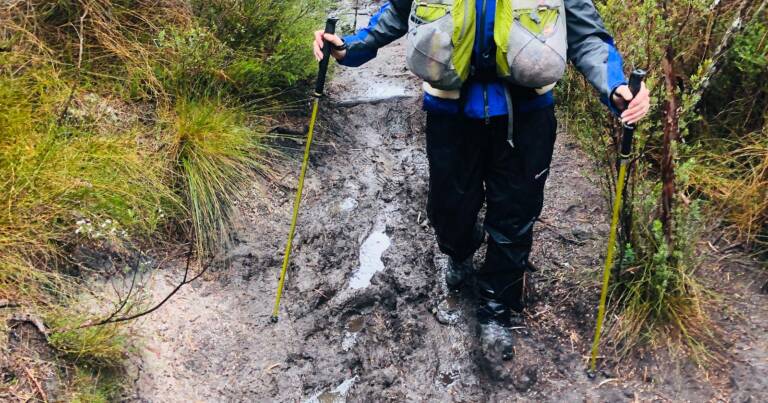
I find hiking poles significantly reduce load on the legs during sustained climbs. Used correctly, they provide balance, assist with rhythm, and help distribute effort across the upper body.
I plant poles slightly behind me and use them to assist with upward movement rather than pulling myself forward. Even without poles, natural arm swing helps with balance and momentum, particularly on uneven or rocky terrain.
Manage pack weight and fit
A poorly adjusted pack can make uphill walking far harder than it needs to be. Make sure the hip belt is supporting most of the load, with shoulder straps snug but not bearing full weight.
On steep ascents, I slightly loosen the shoulder straps to allow freer movement and reduce pressure on my upper body. Keeping pack weight realistic for the terrain and conditions makes a noticeable difference on long climbs.
Adjust technique for terrain and conditions
Uphill technique needs to adapt to the surface. Loose gravel, wet clay, rock slabs, and exposed roots all require careful foot placement and controlled movement.
In hot or exposed conditions, I manage effort conservatively. I start climbs early where possible, use shade breaks, and drink regularly, because heat and elevation gain together significantly increase fatigue and dehydration risk.
Take breaks before you need them
I’ve found short, regular pauses are more effective than long stops taken only after exhaustion sets in. Brief breaks let your heart rate settle while keeping muscles warm and ready to move again.
I use breaks to hydrate, refuel, and assess how I’m tracking against time, distance, and weather. Staying ahead of fatigue is what keeps your decision-making safe later in the hike.
Choose climbs appropriate to your experience
Not every uphill route suits every hiker. When I’m planning, I consider elevation gain, distance, surface conditions, and exposure, and increase the difficulty of climbs gradually as fitness and confidence improve.
Be realistic about turnaround times, especially when a climb is followed by a long descent. Uphill effort always needs to be balanced against what’s still ahead.
Stay focused on safety
Uphill sections often feel like the main challenge, but the fatigue you build up during the climb affects balance, coordination, and judgement later in the day. Always factor in the descent.
I stay on marked trails, monitor weather changes, carry navigation tools, and pack appropriate clothing, sun protection, and first aid supplies. If conditions deteriorate or progress slows significantly, turning back early is often the safest decision.
Good uphill hiking comes down to pacing, efficient movement, posture, and making smart decisions early. Shorter steps, steady effort, and using the body’s larger muscle groups are what actually conserve energy and reduce strain, not raw strength.
Efficient uphill walking helps reduce fatigue, but how you manage the descent matters just as much. Poor downhill technique is a common cause of knee pain and injury, especially once your legs are already tired, so it’s worth reading Hiking Downhill: Technique, Control and Knee Protection to protect your knees and stay in control on the way down.



What’s your go-to tip for staying energised while hiking uphill? Do you have any favourite techniques that help you tackle those tough inclines?
Trail Hiking Australia Switch siding. Change up breathing patterns for steady tempos. Left Right. Left Right. Right Left.
Run a cadence you can handle uphill. Pick up time on the downhills.
Murky Murk nice tips. Changing cadence and breathing can make a big difference on long climbs, and staying within a sustainable rhythm uphill really helps manage fatigue.
Many many years ago a Sherpa in Nepal told us to take small steps and to keep our feet fairly flat.
Russel Wells I think I would trust the advice from these guys.
Russel Wells Good tip. This activates the glutes – instead of stressing the lower back
Fitness. Highly recommended.
Lightness. Is next.
And sheer, unadulterated grit. Also recommended 😅
Murky Murk Absolutely. A bit of grit gets you through when the legs start to complain 😅
Trail Hiking Australia I know it’s good going when I have a full body rebellion 😅
Use your poles, but shorten them by 2-3 inches (so your forearms are below 90 degrees to your upper arms). Understand where the really big climb(s) (>4-500 mtrs+) are on your walk so you can take in a snack and some water about 1/2 hour before starting the climb and have it in your system. Give yourself time to make it to the top. Have a regular plan, like increasing the frequency of brief pauses. You might find you’ll be all the way back at 10 steps and pause!! Then you know it’s really steep. Set targets, like aim to just to the next corner, big tree or jump up.
Rob Gillespie great advice. Adjusting pole length and breaking steep sections into small, achievable targets really helps. I often try to eat well before the climb or once I’m at the top, just to avoid cooling down or having food repeat on me while heading up.
Small steps almost heel toe, keep your heels under your shoulders and lock your knees as you straighten up. Don’t stretch out and use more muscles than you have to.
Peter Jolly good advice. Keeping steps short and efficient really helps reduce fatigue on steep climbs, especially when the gradient drags on (like heading up Link 1).
I don’t use poles so cant comment on those.
The small steps feel weird at first but it makes life easy.
Peter Jolly I also second that and always suggest other hiker who try to conquer the hill asap. The first objective is to conserve your energy and small steps is the key to that.
I used to loathe uphill, really loathe it. Until I put all the advice that’s been mentioned above, it’s a non event (mostly!!) now. I think mindset plays a huge part. Knowing that it’s going to get tough, makes it less tough – if that makes sense?
Ali Ayers mindset makes a lot of sense. I remember times when I’ve looked at a hill and have dreaded it. It was a struggle to the top. So I try to say “yay, a hill” every time now and it makes it so much more enjoyable.
When climbing a steep slope every time you stop for a rest turn around and face downhill feet flat and pointing downhill to give your muscles a stretch.
And do the opposite when descending.
Walk mindfully.
Jeff Wardhaugh that’s a great tip
I take lots of photo opportunities ie; rest breaks.
Gee Young that’s a great idea. So important to create the perception you are stopping for a photo, and not because you need a rest.
Walk with your glutes! Don’t drag your legs up by the quadriceps, but use your glutes to push to straight. (Actually, ‘walk with your glutes’ works for downhill too, to save your knees from dropping into each step.)
Julie Fidler totally agree 👍
Julie Fidler that’s excellent advice. I think walking with your glutes is the best all-round advice for any terrain.
Julie Fidler Instructions unclear – I sat down on the trail and, while I felt better, I didn’t seem to get anywhere.
Julie Fidler the easiest description I’ve heard of how to do this, is to twist your hips in the direction of the leg you’re raising. So if you are raising up your right leg, twist your hips to the right, and so on.
As well as all the technical things mentioned above, I think of it like doing sets at the gym – get to that tree/turn etc and then pause for a break and enjoy the view
Ania Hampton totally agree. The linked article also mentions that brief breaks allow your heart rate to settle while keeping muscles warm and ready to move again.
Ania Hampton I prefer the endless pain, suffering and mental anguish of being unfit and unprepared.