As we get older, changes in strength, balance, recovery, vision or joint comfort can make some gear choices more consequential. Those changes vary enormously between individuals. A well-conditioned 65-year-old may cope with mediocre equipment better than an inexperienced 40-year-old, so none of what follows should be read as a description of what happens to everyone at a certain birthday.
Buying better gear doesn’t buy your way out of ageing, but the right equipment can genuinely reduce strain, improve stability, or buy you a margin of safety. This isn’t a list of things you must have. It’s a breakdown of what actually helps, what’s optional, and what no amount of gear will ever fix.
Gear almost every hiker needs
This first group isn’t age-specific. Every hiker, at any age, needs these basics sorted properly. Getting them right can matter more later on, because foot problems, dehydration or a minor fall may take longer to recover from or carry greater consequences.
Footwear. Fit matters more than brand or price. Reassess it rather than assuming the model or size that suited you several years ago still does, because feet change over time. Try footwear with your hiking socks on, allow room for swelling and for your foot sliding forward on descents, and test it on shorter walks before committing to a major trip. Hot spots and blisters may take longer to settle, so deal with fit problems early rather than expecting to walk through them.
Pack. A well-fitted pack should carry its load comfortably, without pressure points, excessive shoulder strain or instability. How much load sits on the hips versus the shoulders depends on the pack’s construction and the weight you’re carrying, so the test is whether it feels stable and comfortable over a full day, not whether it matches a rule about weight transfer.
Water. Carry enough for the conditions and the distance, and carry a way to treat more if you’re relying on natural sources. Requirements vary a lot between people and days, so there’s no single figure that works for everyone. Don’t rely on thirst alone, particularly in the heat. Dehydration can impair physical and cognitive performance, increasing fatigue and making sound decisions and stable movement more difficult.
Clothing. Layering that actually works: a moisture-wicking base, insulation you can add or remove, and a waterproof shell appropriate to the expected conditions. No shell stays waterproof forever, so it needs to be maintained and tested rather than assumed. Temperature regulation can become less efficient with age for some people, so the margin for being caught out in the wrong layer may be smaller than you expect.
Navigation. Carry a navigation method appropriate to the route, know how to use it, and have an independent backup. On many Australian walks a phone with offline mapping or a dedicated GPS is the practical primary tool, supported by a paper map and compass and a plan for battery management. On remote or complex terrain, both matter. The principle is redundancy and competence, not a ranking of paper over digital.
Emergency preparation. A first aid kit suited to the actual trip, a way to signal for help, and someone who knows your route and your expected return time. Standard advice for any hiker, and worth being more deliberate about when recovery from an incident may take longer.
Gear that may become more useful with age
None of this is compulsory. Plenty of hikers find real value in it over time, and plenty don’t need any of it.
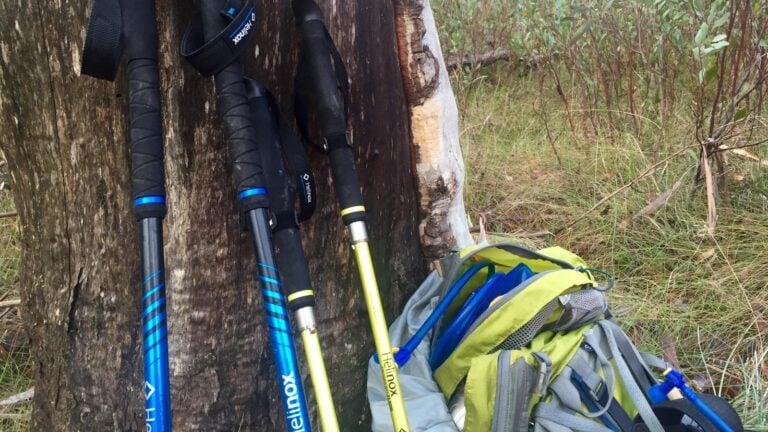
Trekking poles. For many older hikers, poles are one of the most noticeable comfort and stability upgrades available. They can reduce some lower-limb loading on descents, add extra points of contact on uneven or loose ground, and give you something to lean on when you’re tired. How much benefit you get depends on technique, terrain and having them adjusted properly. Many hikers notice reduced discomfort and greater confidence, particularly on long descents. If you’ve resisted poles because of how they look, that’s worth reconsidering on the strength of what they actually do.
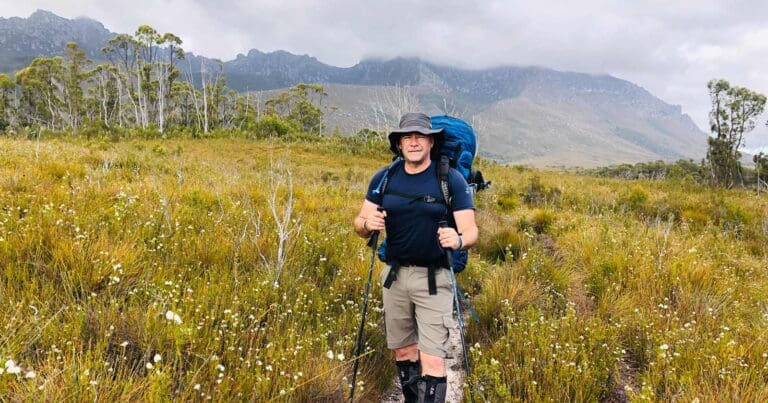
Poles can become a hazard when the terrain changes to scrambling, steep rock or dense bush and you need both hands free. Make sure they can be securely stowed without dangling around your hands or feet. On the Alta Via 2, and the Western Arthur Range, where the terrain changed frequently, we found the easiest solution was to secure our poles to the outside of each other’s packs so they could be stowed and retrieved quickly.
Easier-access packs. Packs with usable hip belt pockets, straightforward zip access and less fiddly clip systems reduce awkward twisting and reaching. This is about how the pack is operated, not just what it weighs or what the specs say.
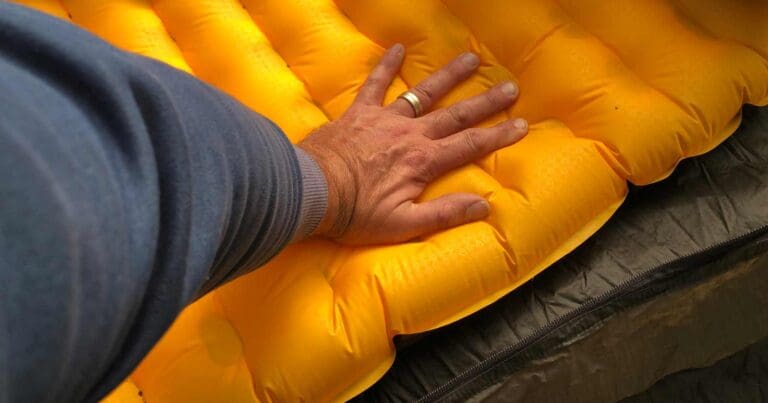
Seating pads. A seat pad provides insulation, dryness and comfort for people who can sit at ground level, and it means you can rest properly at breaks instead of avoiding a wet log or a cold rock. For anyone who finds lowering themselves down or standing back up difficult, a lightweight folding stool may be more useful, though it adds considerably more weight and bulk.
Spare visual aids. If you rely on reading glasses, prescription glasses or contact lenses, carry an appropriate spare. Reading a map, a first aid label or a medication dose at close range becomes a genuine problem without them. Losing a distance prescription is more consequential again, because it affects your ability to read the terrain in front of you.
Medication. Store medication in suitable, clearly labelled packaging, protected from moisture and crushing. Some medications need to stay in their original packaging, and some pill organisers separate tablets from their dispensing information, so this is worth thinking through rather than defaulting to a generic case. Carry enough for the planned trip plus a reasonable contingency for delay, based on your own requirements and medical advice. It’s also worth carrying a written medication list and emergency contact information somewhere accessible, so it can be found by someone else if you can’t hand it over yourself.
Lightweight equipment. As strength, joint tolerance or recovery changes, unnecessary pack weight tends to become more noticeable. This isn’t an argument for chasing the lightest gear on the market. It’s an argument for being honest about what you actually need on the trip in front of you, and leaving the rest at home.
Gear for particular conditions
Situational, not universal. The value is in knowing when to reach for it.
Braces. A brace may improve comfort or support for some diagnosed conditions, but it shouldn’t be used to conceal worsening pain or to compensate for a route that doesn’t suit you. This is worth a conversation with a physiotherapist rather than guessing at an off-the-shelf brace.
Waterproof footwear. Useful in prolonged cold, wet or boggy conditions, but not automatically the better choice. Waterproof membranes retain heat and moisture, and boots can dry very slowly once water gets in over the top. Gaiters reduce ingress from rain, mud and vegetation, but they don’t keep water out of a boot that has been submerged. Choose according to the expected conditions, the likelihood of creek crossings or water entering from above, and your own foot comfort.
Gloves. Cold or wet hands reduce dexterity and grip, along with your ability to operate poles, zips, navigation devices or emergency equipment. That matters to everyone, and it may matter more to some older hikers. A decent pair for cold or wet conditions is a small addition with a real payoff.
Heat management. This starts with route choice, checking the forecast, an early start, adequate water, shade and sun-protective clothing, including a wide-brimmed hat. Cooling towels and similar products may add comfort, but they don’t prevent heat illness and they don’t make unsuitable conditions safe. Heat tolerance can decline for some people with age, which makes the decisions further up that list more important, not the accessories at the bottom of it.
Satellite communication. A PLB provides a dedicated emergency distress signal. A satellite messenger may also allow two-way communication, tracking and non-emergency updates, depending on the device and the subscription. The right choice depends on the route, the remoteness and what you actually need to be able to communicate. Australian-coded PLBs must be registered with AMSA, and registration details need to stay current. AMSA’s current guidance says: If two-way communications are not available, then a distress beacon should be activated in situations of grave and imminent danger.
Either device is worth serious consideration for remote or solo walks. For anyone with a medical condition or mobility issue that could make self-rescue more difficult, the case becomes stronger. That ties the device to functional risk rather than to your age.
Communication equipment is only one part of emergency preparation. It doesn’t replace a trip plan, appropriate clothing, a first aid kit, navigation, or the ability to shelter and stay warm while you wait for assistance to arrive.
What equipment cannot solve
No amount of equipment fixes inadequate fitness. If your cardiovascular fitness or muscular endurance isn’t up to the trail you’ve chosen, better gear just delays the point where that becomes obvious, usually somewhere less convenient than the car park.
No gear fixes an unsuitable route. Choosing a walk that matches your current capability rather than the capability you’re hoping to have by summer is a decision no product can make for you.
No gear fixes poor weather decisions. A waterproof jacket doesn’t help if you’ve decided to push on into deteriorating conditions instead of turning back. Gear protects you within a decision. It doesn’t make the decision.
No gear fixes insufficient water. If you’ve under-planned for the conditions and the distance, a good bottle or bladder doesn’t create water that isn’t there.
No gear fixes weak navigation skills. A GPS shows your position. It can’t interpret the route, the terrain or the consequences of continuing, and someone who can’t do that for themselves is carrying confidence rather than capability.
No gear fixes an unrealistic turnaround time. A turnaround time isn’t a number you decide at the trailhead and forget. It has to be reassessed against daylight, pace, fatigue, weather and changing conditions as the day goes on. Within the Hiking Safety Systems Framework, that sits across route, time and decision management, and it interacts with everything else. Incidents rarely come down to one failure. They come from several weaknesses lining up.
Gear extends your margin. It doesn’t replace judgement, fitness or planning.
How to decide what applies to you
Most gear lists assume everything on them applies to everyone reading. This one doesn’t. Before adding anything, it’s worth working through a few questions:
- What discomfort or limitation actually affects my hiking right now?
- Is the real problem equipment, technique, fitness or route selection?
- Have I tested this on a shorter walk before relying on it?
- Does it introduce a new problem, such as weight, heat or complexity?
- What happens if it fails on the trail?
- Am I buying it because I need it, or because something has made me anxious?
That last one deserves a bit of attention. A fair amount of gear aimed at older hikers is sold on the basis of what might go wrong rather than what actually does. If you can’t name the problem the item solves, it probably isn’t solving one.
Where to spend and where to save
Spend on fit. Boots, packs and anything that sits against your body should fit properly. A sale is only good value when the item fits and suits the intended use, so price is the last question rather than the first.
Spend on reliability. Navigation tools, communication devices and anything you’re depending on in an emergency need to work when you need them. This isn’t the place to take a chance on an unknown budget option.
Save on low-consequence accessories. Basic stuff sacks, organisers and non-load-bearing accessories usually perform perfectly well without premium branding. Small accessory clips that aren’t being used for climbing, rescue or load-bearing purposes rarely need to be expensive, which is a very different thing from a climbing-rated carabiner. Dry bags sit on the line: a cheap one is fine for keeping clothing sorted inside a pack, and not fine for prolonged exposure or protecting electronics you’re relying on.
Save on fashionable upgrades. The latest colourway, the newest logo, the item that’s trending because an influencer posted about it. If a piece of gear is still doing its job, there’s rarely a good reason to replace it because something newer exists.
The useful rule underneath all of that is to spend according to the consequences of failure. Where the gear does real work, supporting your body, protecting you from exposure, or helping rescuers find you, buy well and look after it. Everywhere else, spend what it’s worth and put the difference into the walking.




Well i turn 61 this year.
Everything is the same as hiking in your 30’s -40’s, it’s the physical part that is the issue.
Luckily i have no issues at all.
The rest of it is applicable to every hiker out there.
Peter Jolly congrats, hope it’s a great year for you.
Thanks, always is mate.
Never a dull one.
My gear gets lighter the older I get.
Rob Margono
I pack for what i need and what I’m going to be doing on the day.
I have at least 5kilos of water for a start.
Peter Jolly if the context warrants a 5L water carry, so be it.
I’ve simply dialed in my gear. I don’t carry luxuries. I don’t pack my fears. I carry what I need to carry, and within reason, what I carry would be as light as possible.
My base weight for three seasons is just under 5kg, and this jumps to about 6.5kg for alpine winter trips. I’ve done homework, I’m confident I’m being safe and have contingency plans. And my knees and back and whatever else thank me.
Great piece. Can I just add a note of caution on trekking poles for less experienced older hikers: arrange your pack so you can easily stash your poles, then retrieve them without having to take your pack off.
As an old geezer, I don’t find them useful for my trekking style (yet!) but my companions often do; whether it’s a single pole or two, they love them. What I observe though is when conditions go from defined trail to scramble or bush-bash, this is often when you need handholds, yet I see the poles still being used and getting in the way, posing greater fall risk than if they were stashed and out of the way.
Not a big thing, but when you’re hours away from rescue, climbing up a relatively straightforward rocky slope adds risk with dangling poles getting in the way of hands and feet. Cheers old geezers!
Ben Marshall great suggestion, totally appreciate that, especially what to do with them when track conditions continually change. Julie and I are mostly always hiking together so we stash our poles on the outside of each other packs so they are easier to grab when you need them.
Yeah, that would work. If I used poles, I think I’d rig up a velcro system to slap pole against the sides of my pack and have them stick, but be easily retrieved.
Trail Hiking Australia Highly underrated way of stashing gear.
Having a buddy system of helping each other take out and put away gear without removing packs.
One SOP was to have common gear or your buddy’s gear stowed at the top, outside your pack or on the back of your harness.
That way they have quicker access to what they need.
Ben Marshall and then there is this…
https://www.facebook.com/share/1YBWMs6BzM/?mibextid=wwXIfr
Ben Marshall my current pack has a dedicated loop on the shoulder straps where I can also temporarily secure my poles. I probably wouldn’t use that for long term use, but it’s handy for the times you mention.
If that fix means you don’t have to slip your pack off, nice fix.