There’s no single number that works for every walk, and any rule that promises one is worth being suspicious of. How much water you actually need depends on how long the walk will take, how demanding the terrain is, what the weather’s doing, and how remote you are, and those four things interact rather than stack up as separate line items. Getting this wrong shows up as fatigue, poor judgement, slower movement and a real increase in injury risk, which is why it’s worth planning properly rather than guessing.
This sits within the Hydration and Fuel system of the Trail Hiking Australia Hiking Safety Systems, where water is treated as a safety-critical input, not a comfort item, because it directly supports cognition, temperature regulation and decision-making under load.
Why generic rules fail
Advice like “drink a litre an hour” sounds precise, but precision isn’t the same as accuracy here. Water needs vary enormously between individuals and between walks, and a rule built for an average case tells you almost nothing about your specific one. What actually matters is planning around how long the walk will realistically take, how exposed and demanding the terrain is, what the weather’s likely to do, how remote you’ll be, and whether the water sources you’re counting on are actually reliable. If your plan has you finishing with nothing left, you haven’t planned for the walk. You’ve planned for a perfect version of it with no room for anything to go wrong.
Time matters more than distance
A slow, steep or rough walk can demand significantly more water than a longer walk on flat, easy ground, because it’s time on your feet under load that drives water loss, not kilometres covered. Scrambling, sand, snow, heat and complex navigation all extend that time well beyond what the distance alone would suggest. The guidebook time is a starting point, not a plan. What matters is how long the walk could realistically take if something slows you down, and multi-day or longer walks need conservative planning built in from the start, especially where water sources are seasonal or can’t be relied on.
Terrain adds its own demand
Steep climbs, rough or sandy ground, scrambling, and a heavy pack all increase effort and sweat loss beyond what the raw distance implies. A short, physically demanding walk can call for more water than a long, easy one, which is exactly the kind of thing a fixed per-hour rule misses entirely. Plan around the actual effort the terrain requires, not just how far it covers.
Weather changes the picture even when it doesn’t feel like it
Heat, low humidity, wind and direct sun all increase fluid loss, often well before you’d notice it as thirst. Cool conditions are their own trap, since sweat evaporates fast and thirst cues drop off, which can mask dehydration that’s still genuinely happening. A day that feels mild isn’t a reason to carry less. It’s often exactly the condition that catches people out, because nothing about how they feel is warning them.
Remoteness changes what running out actually means
Where you’re walking matters as much as how far. On a route with limited exit points, poor phone reception, no nearby water and long stretches between track junctions, water stops being a comfort question and becomes a safety reserve, because it’s what covers you if you take a wrong turn, get injured, or simply run later than planned. The extra water you’re carrying in that situation isn’t for the hike going to plan. It’s for the version where it doesn’t.
Short walks aren’t exempt
It’s easy to underestimate water on a walk that’s short or familiar, and that’s usually where people get caught out. Heat, steep terrain, limited shade, or any real chance of delay are reasons to carry water on a two-hour walk just as much as a two-day one. Assuming you’ll be back at the car soon removes the exact margin you’d want if something did go wrong.
Finishing with water left is a sign the plan worked
It’s tempting to treat leftover water as wasted weight you didn’t need to carry, and water isn’t light. Each litre weighs approximately one kilogram, so carrying 6 to 8 litres on a hot or remote day adds 6 to 8 kilograms to what’s on your back. But finishing with some left is closer to the opposite of wasted. It means you planned conservatively and had a genuine buffer for delay, which is a sign the plan worked, not that it was oversized. Running out exactly at the end means there was no room for anything to have gone differently.
Treat natural water sources as uncertain
If part of the plan involves refilling along the way, treat any natural source as unconfirmed until you know otherwise. Seasonal reliability varies a lot, and a creek or tank that had water last time you walked the route isn’t a guarantee it will this time. Carry enough to reach the next confirmed source, and have a real backup if that source turns out to be dry. More detail on assessing this is in how to find water on a hike.
Dry camps need their own allowance
If you’re camping somewhere with no water source at all, a dry camp, plan for more than just the day’s walking. Carry enough to get you through the evening and the following morning as well: at least three to four litres a person on top of what the walk itself needs, to cover dinner, evening drinking, and breakfast before you reach the next source.
How you carry it changes how much you drink
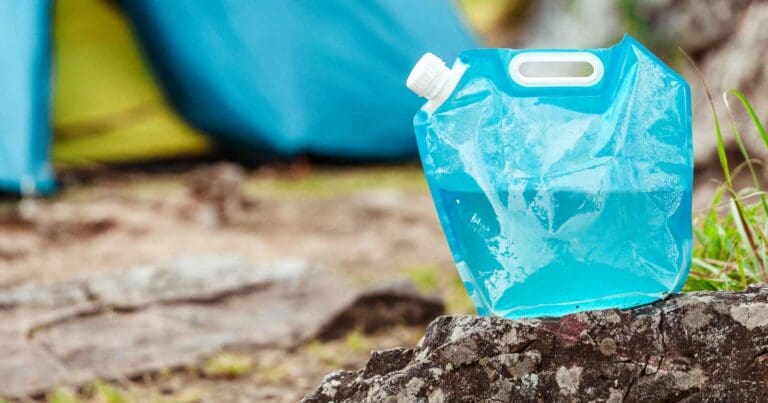
Bottles, bladders and vest systems all affect how easily you access water and how consistently you actually drink it through the day, which matters as much as how much you’re carrying in the first place. A system that’s awkward to use tends to get used less, regardless of what’s in it. There’s a fuller comparison in water bottles vs hydration bladders.
Drink steadily rather than catching up later
Once you’re actually moving, small regular sips work better than waiting and then drinking a large volume in one go. By the time you feel thirsty you’re usually already behind, especially in hot, dry or windy conditions. Keep it steady through the day rather than treating it as something to catch up on when you remember.
The early signs that you’re falling behind are easy to write off as ordinary tiredness. Unusual fatigue, a drop in your pace, a headache or feeling lightheaded, trouble concentrating, or just feeling flat and irritable can all be early dehydration showing up before it’s obvious.
Urine colour and how often you’re going can give you a rough read on where you stand. Pale yellow generally means you’re keeping up, while darker urine or going less often suggests you’re not drinking enough. It’s not exact, since temperature, activity level and individual differences all affect it, so treat it as one piece of information rather than the only thing you go by.
It’s also possible to overcorrect. Drinking large amounts of plain water without replacing salt can lead to hyponatraemia, a potentially dangerous condition that can look like dehydration in its early stages. It’s uncommon, but serious enough that more water isn’t automatically the safer response if something feels wrong.
There’s no fixed amount of water that suits every hike, because time, terrain, weather and remoteness all shift how much you actually need, and they compound rather than average out. Plan for the version of the walk where something goes wrong, not the one where everything goes to plan, and treat finishing with water left over as evidence the plan worked.