Safety, Risk and Responsible Use
Rock cairns are functional navigation tools. They exist to solve specific route finding problems in terrain where tracks cannot be reliably formed, signed, or maintained. In parts of Australia’s alpine areas, rocky plateaus, exposed ridgelines, and open country, cairns may be the only visible indication of a safe line of travel. Used correctly, they support safe route progression and back up your own judgement about which way to go. Misinterpreted, or duplicated without purpose, they can introduce ambiguity and increase risk instead.
In recent years, decorative stone stacking for photography and social media has become more common in natural areas. These informal stacks often resemble legitimate route markers but serve no navigational purpose. In benign conditions they may appear harmless. In poor visibility, remote terrain, or alpine environments, they can become a genuine safety hazard. Understanding what a cairn is, why it exists, and how to interpret it is part of basic bushwalking literacy in Australia.
What a Rock Cairn is and Why it Exists
A rock cairn is a human made marker constructed from stones found on site. Its purpose is functional, not decorative. A legitimate cairn exists to indicate the safest or most practical line of travel through terrain where the ground itself offers few clear clues. This commonly includes:
- Above the tree line in alpine regions
- Across exposed rock slabs
- Through boulder fields
- Over alpine grasslands where footpads disappear
- Across terrain altered seasonally by snow, frost heave, wind, or vegetation growth
In these settings, paint, posts, or signage may be impractical, visually intrusive, or quickly destroyed by weather. Cairns are placed so that one is visible from the next, forming a chain of visual confirmation across otherwise ambiguous terrain. If there is no navigation problem to solve in a given spot, there is no real reason for a cairn to exist there either.
Where Cairns Are Commonly Used in Australia
Cairns are most often found in environments where tracks are unreliable, unsafe to define permanently, or environmentally sensitive. In Australia, this includes:
- The Victorian Alps
- Tasmania’s Central Plateau
- Kosciuszko National Park
- Exposed coastal headlands
- Arid ranges and rocky escarpments
Snow cover, frost heave, wind exposure, and seasonal vegetation growth can erase footpads quickly in alpine areas. In rocky environments, erosion control is critical, and cairns help keep walkers on durable surfaces rather than fragile soils or unstable ground. Cairns are rarely necessary on well formed tracks, in forests with clear pads, or in signposted walking areas, and when stone stacks appear in these places, they should be treated with caution.
The problem with decorative stone stacks
Decorative stone stacking is not simply an aesthetic issue. In navigationally sensitive terrain it introduces a genuine hazard, because unofficial or decorative stone stacks resemble legitimate route markers, and walkers misinterpret them as navigation cues and commit to an incorrect line of travel as a result.
In open alpine terrain or rocky escarpments, the ground itself often provides limited directional information, so walkers naturally look for human made indicators. A decorative stack placed near a junction, creek line, or slab can override a hiker’s intended route, particularly if fatigue, time pressure, or poor weather reduces critical thinking. The error may seem minor at first, and a deviation of only a few degrees can compound across open terrain. In Australian alpine and subalpine environments, that deviation can lead to steeper ground, cliff bands, loose scree, or unstable snow patches, and to time consuming backtracking. Time lost in exposed terrain increases exposure risk, and in deteriorating weather that can escalate into hypothermia or benightment.
There is a human factor at play too. Walkers often assume that visible markers carry authority, and that assumption gets stronger under stress or in groups where individuals defer to perceived signals. Decorative stacks mimic the appearance of official route markers without fulfilling their function. Environmental impacts accumulate as well: moving rocks disturbs habitat for insects and reptiles, exposes fragile soils, and accelerates erosion, and in alpine and arid environments recovery can take decades. The rule I would apply here is simple: do not build what you do not understand.
How to Recognise a Legitimate Cairn
A legitimate navigation cairn is simple, stable, and intentional. It is constructed for visibility and durability rather than appearance. Typical characteristics include a broader, stable base, placement on high points or natural lines of travel, clear alignment with the surrounding terrain, and visibility to the next cairn in the sequence. When standing beside a legitimate cairn, you should usually be able to identify the next logical marker ahead, and the line should make sense in relation to your map, compass bearing, or planned route. Cairns placed by land managers or experienced bushwalkers are conservative in number, they exist only where needed. Excessive cairns in a short distance often indicate informal construction rather than official route marking.
Using Cairns Safely Within Your Navigation System
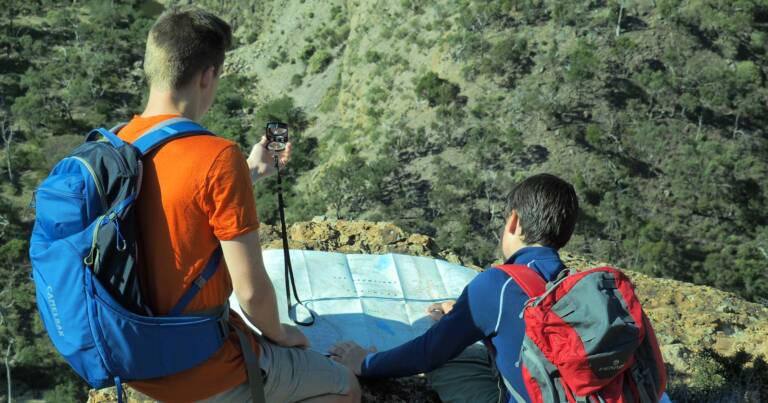
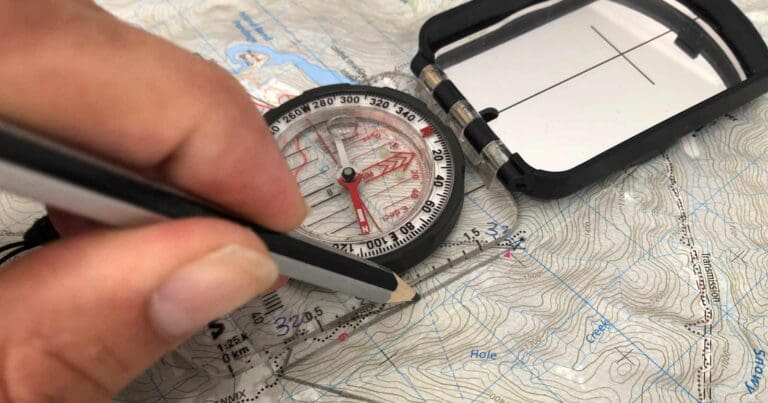
Cairns support navigation, they do not replace it. They are one piece of information within a broader navigation system that also includes map reading, understanding topographic features, compass use, GPS awareness, and continuous terrain assessment. Never follow a cairn that contradicts your map, planned bearing, or obvious terrain logic. If a cairn leads toward clearly unsafe terrain, stop and reassess.
In poor visibility, cairns can be difficult to see or easy to misinterpret. In fog, snow, or heavy rain, relying solely on visual markers increases risk, and in these conditions your primary navigation tools should be map, compass, and terrain interpretation instead. I would ask myself honestly whether I could still navigate safely if every cairn in front of me disappeared in fog. If the answer is no, the navigation system I am relying on is incomplete, and that is worth fixing before conditions force the issue.
What To Do If You Encounter Misleading Cairns
If you encounter decorative or misleading stone stacks in sensitive or navigationally important areas, the safest approach is restraint. Altering, dismantling, or rearranging stacks without authority can increase ambiguity. In some parks, rangers actively remove false cairns as part of track maintenance, and reporting misleading markers to the relevant park authority is generally more effective than intervening directly. As a general rule, do not add stones to existing cairns, do not reshape or dismantle legitimate markers, and do not build new cairns unless you are formally involved in route maintenance. Most hikers should never need to construct a cairn at all.
Why This Matters for Safety and the Environment
Navigation errors are a common factor in bushwalking incidents, particularly in poor weather or unfamiliar terrain, and false markers increase the probability of those errors. In remote Australian environments, even short deviations can result in cliff exposure, terrain traps, increased time in deteriorating weather, and delayed return times that can trigger a Search and Rescue escalation.
Environmental degradation is quieter but cumulative. Decorative stacking damages habitats, accelerates erosion, and reduces the sense of wildness that many people seek. Cairns are functional safety tools, and I treat them with the same seriousness as route markers, maps, or track signs. Responsible behaviour protects both hikers and landscapes.
Before your next alpine or off track hike, it is worth being honest with yourself about whether you actually understand why a cairn exists where you find it, whether it aligns with your map and terrain assessment, or whether you are leaning on a single visual cue instead of a proper navigation system. In the Australian bush, small assumptions can have large consequences. Clear thinking and disciplined navigation reduce that risk.




There is a very big difference between rock stacks built for fun versus cairns strategically placed to aid navigation. And to your comment ‘because says who’, this is my view and you are encouraged to offer an alternate view. That is the point of discussion. I do find it interesting and somewhat amusing that you open with ‘folks the word should is ‘always‘…’ like everyone needs to stop and listen to your view. Despite your objection to my use of words, you will find I agree with you that cairns for navigation are indeed life savers.