Hiking after dark changes the way you move, think, and make decisions. Landmarks disappear, depth perception drops away, and small navigation errors become harder to spot before they turn into big problems. I’ve seen enough overdue-hiker callouts start exactly this way to take it seriously. In Australia, the night sky gives you two reliable reference points that can help you hold a direction when visibility is low: the Southern Cross and the Moon. Used properly, they support your navigation, back up your map and compass work, and help you stay oriented if things start to unravel.
This guide covers how night navigation actually works in real hiking conditions, how to use the Southern Cross and the Moon safely and realistically, and how to manage the extra risk that comes with moving in the dark.
What changes when you navigate at night
At night, navigation becomes less about pinning down your precise position and more about holding a safe direction and avoiding errors that compound on each other. Tracks are harder to follow, junctions are easier to miss, and terrain features that stand out clearly during the day can disappear completely once the light goes. Your brain also works differently when you’re tired and cold, and that’s when poor decisions creep in.
That’s why night navigation leans on direction confirmation rather than constant correction. You’re checking that you’re still heading roughly the right way, not trying to fix your exact location every few minutes. Celestial navigation fits naturally into that approach, provided you treat it as a supporting tool rather than your primary system.
The role of celestial navigation in hiking
Celestial navigation means using objects in the sky to work out direction. For hikers, that’s a different job to marine or aviation navigation. You’re not calculating positions or angles. You’re using stable, predictable patterns in the sky to confirm north, south, east, or west when the ground isn’t giving you anything reliable to go on.
In Australia, the Southern Cross gives you a dependable reference for south, while the Moon offers broader directional cues depending on its phase and position. Both are most useful combined with a map, a compass, and a clear sense of your intended route, not used on their own.
Understanding the Southern Cross
The Southern Cross is a small but distinctive group of stars visible year-round across Australia. Its position in the sky shifts through the night and across the seasons, but its relationship to true south stays consistent, which makes it one of the most useful natural direction markers in the southern hemisphere.
The key point, and one that trips people up, is that the Southern Cross does not point south by itself. You have to use its shape and the stars around it to work out the direction correctly.
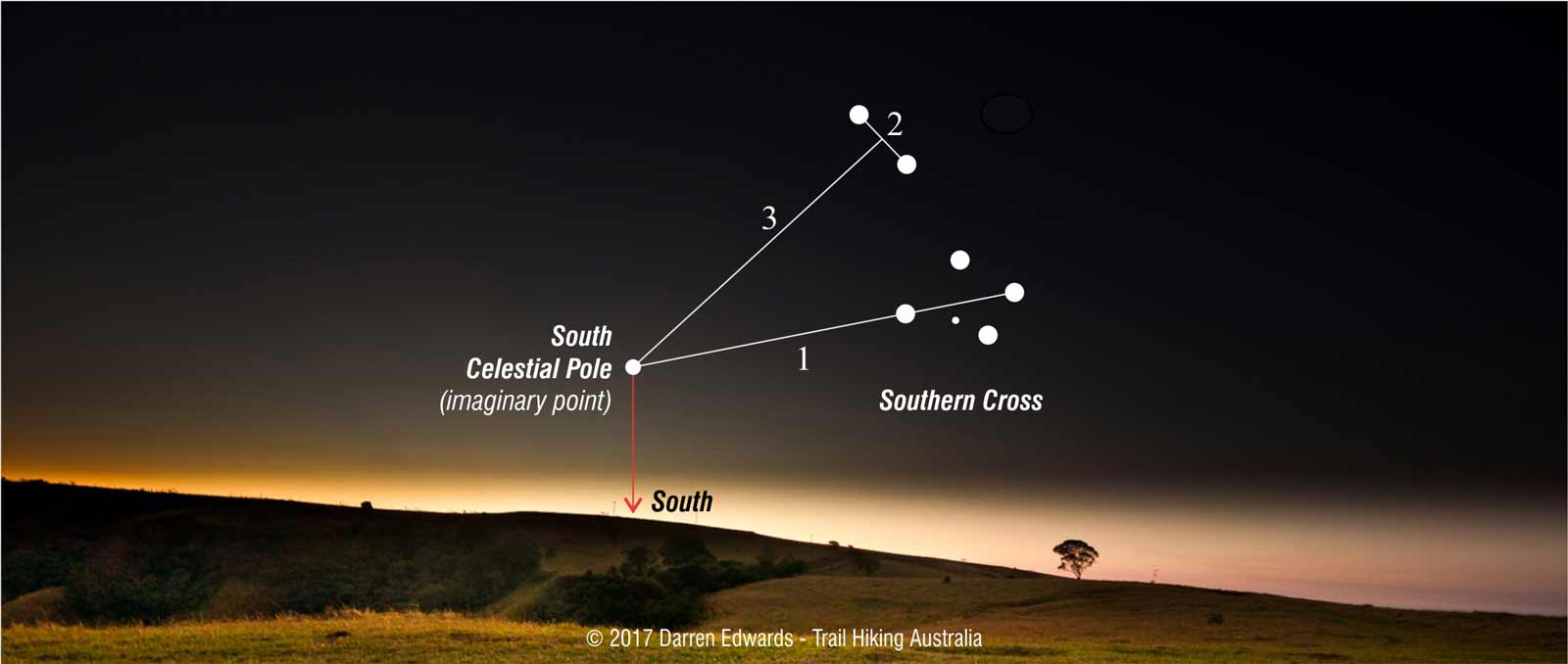
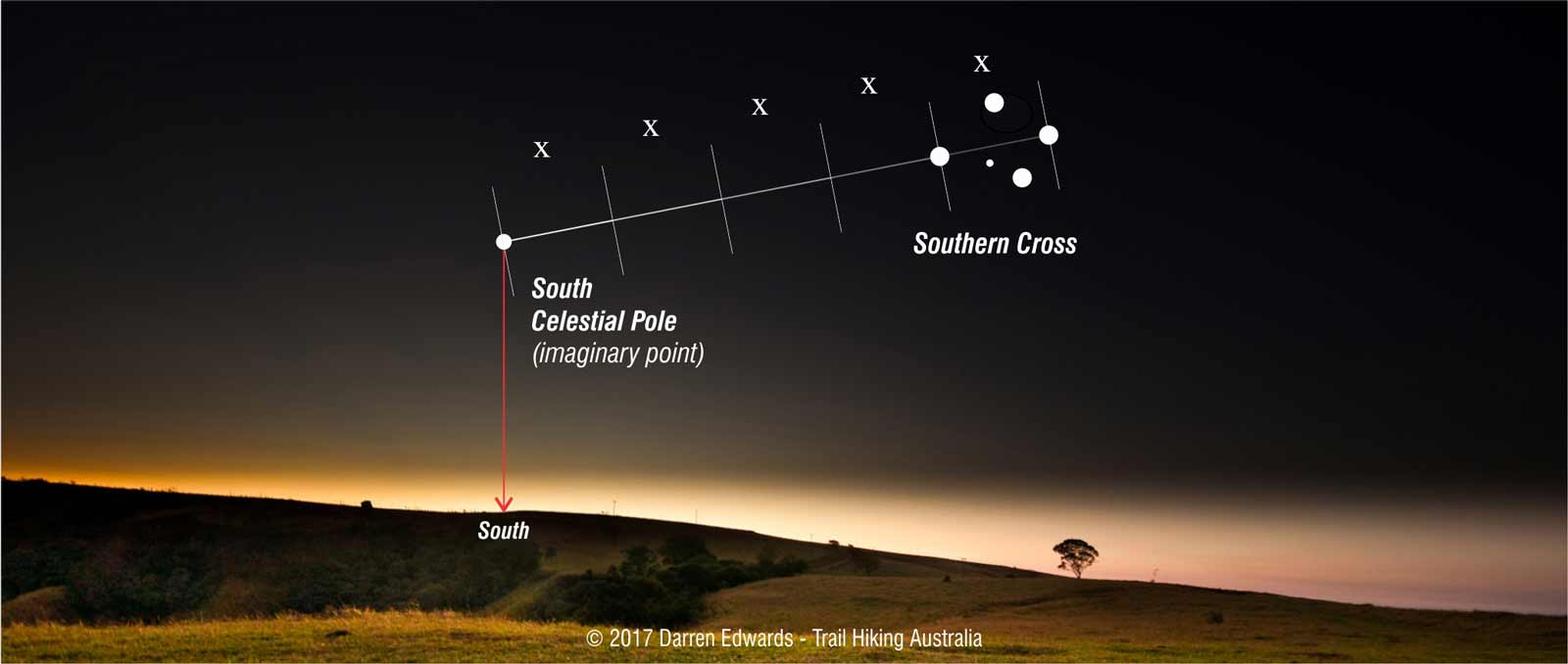
To use the Southern Cross, first identify its long axis, which runs through Acrux, the brightest star at the base of the cross, and Gacrux, the third-brightest star at the top. Extend this line about four and a half times its length beyond Acrux. This imaginary point sits close to the south celestial pole. From that point, drop a straight line down to the horizon. That direction is true south.
The long-axis method is more reliable when checked against the Pointers, the two bright stars Alpha and Beta Centauri that sit near the Cross. Draw an imaginary line halfway between the Pointers, then extend a line out from that midpoint at a right angle. This line should cross the line extended from the Cross at roughly the same point near the south celestial pole. The Pointers also help you confirm you are looking at the real Southern Cross rather than the “False Cross,” a similar but fainter and more widely spaced pattern nearby that has caught out plenty of hikers. The real Cross always has the Pointers nearby; the False Cross does not.
This matters because it’s true south, not magnetic south, that aligns with your map. At night, that gives you a reliable way to confirm your orientation when you can’t see terrain features or landmarks to check against.
Common mistakes when using the Southern Cross
Most of the errors I see with the Southern Cross come from rushing the identification, or relying on memory instead of actually looking. One common one is mistaking nearby stars for part of the cross, especially in light-polluted skies or when the cross is sitting low on the horizon. Another is forgetting that the cross rotates through the night, so it can appear tilted or even upside down depending on when you’re looking.
The more serious mistake is treating the Southern Cross as a precise instrument. It isn’t accurate enough for fine navigation through complex terrain, and I wouldn’t try to set an exact bearing off it through scrub, cliffs, or gullies. Use it to confirm your general direction, not to thread a precise line through difficult ground.
Using the Moon for direction
The Moon can help with orientation too, but it’s less reliable than the Southern Cross and needs to be used with more care. How useful it is depends on its phase and position in the sky, both of which change every night.
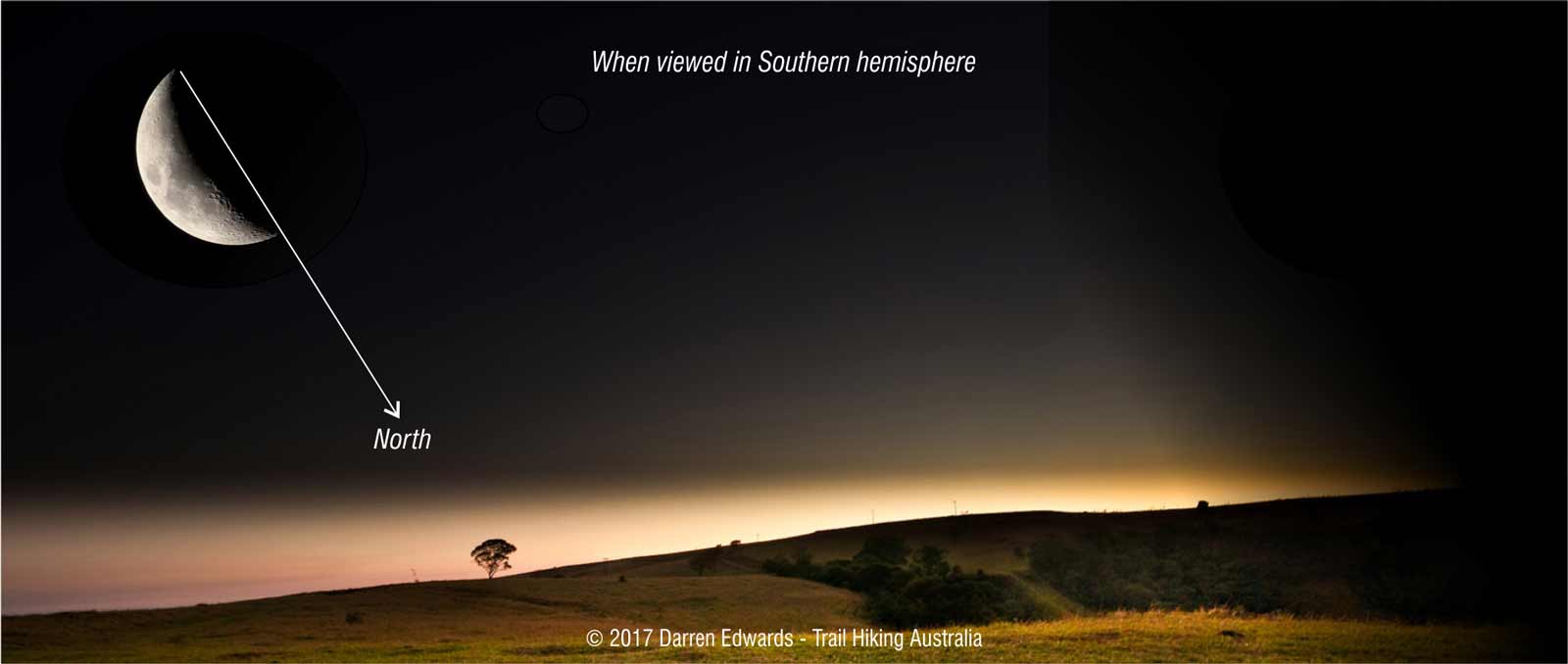
In general terms, when the Moon is rising, it will be roughly in the east. When it is setting, it will be roughly in the west. Around midnight, a full Moon will generally be closer to north, which holds true across most of Australia. This breaks down in the tropical north, such as around Darwin or Cairns, where the sun and moon can pass to the south of overhead at certain times of year, so this rule of thumb becomes unreliable at those latitudes.
I use it as a short-term check rather than a constant reference. If the Moon is rising behind you and you’re heading west, for example, it should slowly drop out of view as the night goes on. If it starts showing up off to one side instead, that’s a sign you’ve drifted off course.
Limitations and risks of moon-based navigation
Moon navigation usually fails because people overestimate how accurate it is. The Moon’s path across the sky is curved, not straight, and its apparent position can mislead you when it’s low or partly hidden by cloud. In forested country or deep valleys, it might only be visible on and off, which makes it unreliable if you’re trying to hold a direction over any distance.
The other thing people forget is the Moon’s phase. A crescent Moon behaves very differently to a full Moon, both in how much light it gives and where it sits in the sky. Relying on the Moon without knowing its phase is a good way to end up with false confidence in the wrong direction.
Combining celestial cues with map and compass
Celestial navigation works best as a support, not a replacement, for your map and compass. Before you start moving at night, you should already know your intended direction of travel from the map. The compass gives you a magnetic bearing, and the Southern Cross is there to confirm you haven’t grossly misaligned yourself, nothing more.
If your route runs generally south-southwest, say, and the Southern Cross tells you south is off to your right, that’s a strong signal something is wrong. That kind of cross-check matters more than people expect once fatigue or poor visibility starts eroding their confidence in what they’re seeing.
Visibility management at night
How well you manage your vision has a real effect on navigation accuracy at night. Headlamps are essential, but used badly they narrow your field of view and hide the cues you actually need. A narrow beam pointed straight ahead can make you miss junctions, track markers, or a change in terrain sitting just outside the light.
I’d rather use a wider beam when moving slowly, and turn the headlamp off now and then to let my eyes adjust, which brings back starlight, silhouettes, and the horizon line. Red light modes preserve night vision, but they cost you depth perception and colour contrast, and that trade-off can increase the risk of tripping or misreading the ground in front of you.
Terrain awareness after dark
Australian terrain adds its own problems after dark. Eucalypt forest throws confusing shadows, rocky escarpments disappear into blackness, and open heath or alpine country can feel disorienting once you lose visible reference points. In that kind of terrain, holding direction is usually more important than pushing for speed or precision.
Creeks, ridgelines, and track edges become useful handrails at night, but treat them carefully. A creek that’s a helpful guide by day can turn impassable or dangerous after dark, especially after rain.
What to do if you feel lost at night
Feeling uncertain at night is common, and it should register as an early warning, not a failure on your part. The first move is to stop. Continuing on while you’re unsure is the fastest way to make the problem worse.
In my experience with search and rescue callouts, this is usually the point where things either get sorted out quickly or start to go badly wrong, and the difference almost always comes down to whether someone stopped and reassessed or kept walking on a hunch. Once you’ve stopped, check your last known position and your intended direction. Use your compass to establish a bearing, then confirm it against the Southern Cross if you can see it. If the Moon is up, check whether its position matches what you’d expect. Small inconsistencies matter more at night than they do during the day.
If your confidence doesn’t come back quickly, the safest option is usually to stay where you are until daylight, provided you’ve got shelter, warmth, and water. Night navigation errors are harder to recover from than daytime ones, and pushing on without certainty tends to add risk rather than solve anything.
Planning for night navigation
Successful night navigation starts before you leave home. Knowing when the Moon will rise and set, having a sense of where the Southern Cross should be during your hike, and picking simple, directionally clear route options all take pressure off once it’s actually dark.
Night hiking should never depend on celestial navigation by itself. It’s a supporting skill, one that adds resilience when your other cues run out. Used with restraint and realistic expectations, the Southern Cross and the Moon can help you stay oriented and steady in the Australian bush after dark.




Have you ever tried navigating at night? What tools did you use and how challenging did you find it?