Digital route planning tools make it easier to visualise terrain, estimate distances, and prepare for a hike. Used properly, they help you understand where you are going, what you will encounter, and where your margins are. They do not replace map reading, compass skills, or on ground judgement. They support them.
This guide works through how to plan hiking routes using digital mapping tools, interpret elevation and terrain data, print reliable paper backups, and transfer routes to GPS devices. It also covers the common mistakes and Australian specific considerations that regularly catch hikers out.
Start planning on your computer, apps or online
Planning your own hiking route helps you understand where you are going, how the terrain will influence your day, and what challenges you may encounter. Digital planning tools make it easier to review distances, elevation changes, and route options at a broad scale, but before relying on any software, you need to consider the full context of your hike, including:
- Group size and experience
- Weather conditions
- Equipment, food, and water
- Time available
- Access points and exit options
Digital tools support this process, but they do not replace judgement. Many hikers still begin by reviewing hard copy topographic maps, and reading contours, identifying ridges and gullies, and understanding terrain remains essential. Digital mapping tools work best when they complement that foundation, not replace it.
What digital route planning tools are
Digital route planning tools are online or desktop mapping platforms. Used well, they let you view topographic maps and satellite imagery, measure distances and time estimates, analyse elevation gain, loss, and steepness, create and save routes, export them to GPS devices or apps, and print maps for offline use. They are typically used before a hike, but plenty of people also use them during a hike on a phone or GPS device.
What digital planning is good at, and what it is not
What digital planning genuinely does well is visualise terrain and elevation clearly, help you estimate distance and total climb, show track networks and intersections, highlight exposed ridgelines, valleys, and river crossings, let you compare multiple route options, and generally make planning faster and more precise.
What it does poorly matters just as much. It does not show current track conditions, and it cannot account for fallen trees, erosion, regrowth, or closures that have happened since the data was collected. It can also misrepresent faint, overgrown, or unofficial tracks, showing them with the same confidence as a well formed one, and that gap between what the map shows and what is actually on the ground is exactly what encourages overconfidence if you do not cross check it. Digital planning is a decision support tool, not a guarantee of safety, and the difference between those two things matters every time you rely on it.
Understanding the map types you will see
Topographic maps are the most important layer for hikers, because they show contour lines and terrain shape, watercourses and drainage lines, peaks, saddles, ridges, and spurs, tracks, roads, and management trails, and the other land features that actually matter for navigation. In Australia, most digital platforms draw on government topographic datasets, and these vary in age and accuracy depending on the area, so a track shown on a topo map may not exist on the ground. That is worth remembering every time you plan a route from one.
Satellite imagery shows real world surface features instead: forest density, clearings, rock slabs and open ground, and water bodies. It is useful for confirming terrain type, but it is often out of date and can hide steepness or exposure that a contour map would show clearly, so I would not rely on satellite imagery on its own.
Hybrid and shaded relief maps
Many tools combine topographic maps with shaded relief or 3D shading, which helps visualise slopes and landforms but can hide important detail if you rely on it too heavily. Use it as a supplement to standard contour maps, not a replacement for them.
Understanding contour lines and terrain digitally
Digital tools make contours easier to look at, but the rules underneath them are exactly the same as on a paper map. Close contour lines still mean steep terrain, wide spacing still means gentle slopes, V shaped contours still point uphill in valleys, spurs still point downhill, and flat areas still tend to mean swamps, plateaus, or river flats. Before relying on an elevation profile, it is worth visually inspecting the actual contours along your route rather than just trusting the graph.
Using elevation profiles properly
Elevation profiles show height over distance along your planned route, and they are useful, but often misunderstood. What they tell you is total ascent and descent, where the steep sections and sustained climbs are, where the high and low points fall, and roughly where fatigue is likely to build. What they do not tell you is track quality, surface type, whether there is exposure or difficult footing, or just how slow the steep terrain is actually going to feel underfoot. A short but steep climb can be more demanding than a longer, gradual ascent, even though the profile might make the gradual one look like the bigger effort.
Estimating time and distance safely
Most digital tools give you time estimates, and I would treat every one of them as a best case scenario. Use the distance and elevation figures as your baseline, then add margin for terrain, weather, pack weight, and group ability, and factor in navigation pauses, breaks, and delays on top of that. In Australia, heat, rough tracks, and scrub can slow progress dramatically compared to what the software predicts, and if the estimated time leaves little daylight buffer, the plan is already weak before you have taken a single step.
Creating and drawing a route
When you are drawing a route digitally:
- Follow known tracks where possible
- Mark all major junctions and decision points
- Avoid drawing straight lines across steep terrain unless off track travel is intentional
- Check contour spacing for hidden climbs
- Confirm river crossings and drainage lines
Do not assume a straight digital line equals an easy walk.
Understanding track data and its limits
Tracks shown in digital tools might be official walking tracks, management roads, fire access trails, old or decommissioned routes, or user generated lines, and the common failure point is assuming every mapped track is maintained and passable, when plenty of them are not. Always cross check against recent trip reports, park alerts, and multiple map layers before you commit to a route that depends on a track you have not actually walked.
Using 3D views and terrain visualisation
3D views help you understand how ridges and valleys relate to each other, and they are useful for identifying major climbs and drops and understanding exposure on escarpments. They are not accurate enough to base navigation decisions on by themselves, so always come back to the contours for precise interpretation.
Printing maps as a backup
Digital planning should always end with a paper map backup, especially for longer or remote hikes. When you print one, use topographic map layers, make sure north is clearly marked, include the scale and contour interval, print at a usable scale rather than zoomed too far out, and carry it in a waterproof sleeve. A printed map does not run out of battery or crash.
Transferring routes to GPS devices and apps
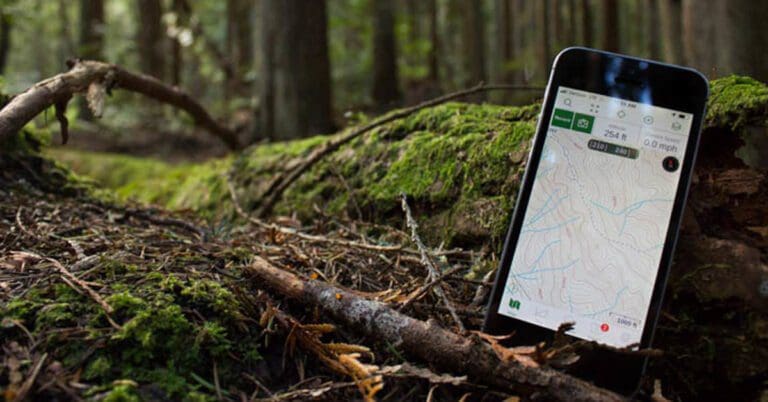
Routes can usually be exported as GPX files and loaded into handheld GPS units, phone navigation apps, or smart watches. Test the file before the hike, make sure offline maps are actually downloaded, do not rely on mobile reception, and carry a power backup if you are using a phone. A GPS track is an aid, not a substitute for awareness.
Using digital tools during a hike
During a hike, digital tools can help you confirm your position, check the distance to the next feature, and validate your direction of travel, but they should not be used to blindly follow a line on a screen. If the digital route conflicts with what you are actually seeing on the ground, stop and reassess rather than trusting the line over your own eyes.
Where digital planning goes wrong
The mistakes I see are fairly consistent: trusting time estimates without adding margin, assuming mapped tracks exist or are clear, ignoring the contour data in favour of the elevation profile, failing to carry a paper backup, over zooming and losing the big picture, relying on phone battery alone, and treating GPX lines as exact paths rather than a rough guide. Most navigation incidents come from overconfidence, not from a lack of tools.
Australian specific considerations
A few things specific to Australian conditions are worth keeping in mind: many tracks are unmaintained or only lightly marked, fire trails can be gated or overgrown, creek lines can change after floods, heat and exposure increase fatigue and water needs, topographic data can be old in remote areas, and parks can close tracks without updating their maps. Always check park alerts and conditions separately from whatever your digital planning tells you.
How digital planning fits with traditional navigation
Digital planning works best combined with paper map reading, compass use, terrain awareness, and conservative decision making. Use digital tools to plan. Use traditional skills to stay safe.
Digital planning as part of navigation
Digital route planning is a genuinely powerful tool, but it only works as part of a broader navigation system. Software estimates can be wrong, batteries can fail, and conditions on the ground can differ from what the map suggests. Combining digital planning with map reading skills, compass use, terrain awareness, and conservative decision making is what leads to safer, more informed hiking.





What’s your go-to method for planning hikes—digital tools or traditional maps? Share your experiences!
Digital every time for Tassie – LIST is the govt mapping site with topo, aerial, lidar basic layers and many other for veg, geo, and civil aspects including land tenure and ownership.
.
Once I have a clear understanding of where I want to go …. and if it is without trespass …. I can use the drawing tools to trace an intended route while using the different layers to clarify route decisions.
.
Once I am satisfied with the proposed route I can export it directly to a KM? file, but as importantly screen capture and notate and print in hard copy ( not directly from LIST )
.
KML file gets emailed to google mail and uploaded to app on device (Y).
.
I only recently got a “device” so this used to be a paperwork and compass kind of exercise with each walk being focussed to exactly where I wanted to go.
.
As always you must be aware of unmistakable geographic boundaries and exit options should you become disoriented.