Using a compass correctly is a core navigation skill for Australian hikers. It provides a reliable way to determine direction when tracks fade, weather closes in, signage is missing, or electronic devices fail. A compass does not replace good judgement or route planning, but it gives you a consistent reference point that works anywhere, at any time, without batteries or signal. When combined with a topographic map and an understanding of the terrain, a compass allows you to move deliberately, confirm your position, and avoid compounding small errors into serious problems.
This article sits within the Navigation and Positioning system, one of the core Trail Hiking Australia Safety Systems. A compass is not just a piece of equipment. It is a precision tool that links your map to the landscape, allowing you to confirm direction, manage uncertainty, and maintain control when visibility or track definition deteriorates.
This guide explains how to use a compass correctly in Australian conditions. It covers the concepts that matter in the field, not classroom theory, and focuses on techniques that reduce risk and increase confidence during real hikes.
What a Compass Does and Why It Matters
A hiking compass is a directional tool that aligns itself with the Earth’s magnetic field. The magnetic needle points toward magnetic north, not true north. By comparing that magnetic reference to a map or to the terrain around you, you can determine direction, set a bearing, and follow it accurately.
The value of a compass is not speed or precision in ideal conditions. Its value is reliability when conditions are poor or uncertain. Australian terrain often combines vague pads, open bush, uniform forests, and long ridgelines with limited visual cues. In these environments, losing direction is easy and regaining it without a compass can be difficult. A compass gives you a fixed reference that allows deliberate movement instead of guesswork.
Understanding Direction in Australia
Before using a compass effectively, it is essential to understand the difference between true north and magnetic north. True north is the direction to the geographic North Pole and is the reference used on topographic maps. Magnetic north is the direction the compass needle points, and it shifts slowly over time as the Earth’s magnetic field changes.
In Australia, magnetic north lies east of true north. The difference between the two is called magnetic declination. Declination varies depending on location and changes gradually over time. In much of eastern Australia, declination is around 10 to 13 degrees east, while in Western Australia it is smaller. This difference is large enough that ignoring it can put you well off course over even a short distance.
Using a compass correctly in Australia always involves accounting for magnetic declination when working with a map.
Magnetic Declination and Why You Must Apply It
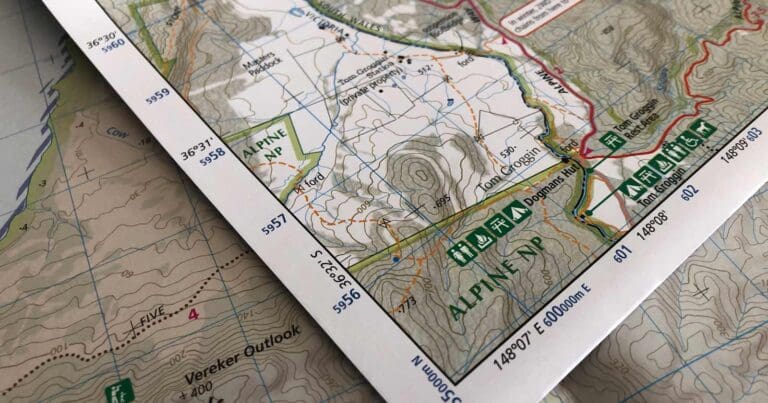
Magnetic declination is the angle between true north and magnetic north. Topographic maps show true north, while your compass points to magnetic north. To move accurately from map to ground, or from ground back to map, you must adjust for the difference.
Most hiking compasses sold in Australia allow you to set declination directly on the compass. Once set, the compass automatically compensates for the local difference, allowing you to work directly with map bearings without doing mental arithmetic in the field. This is the safest and least error-prone approach.
Failing to apply declination is one of the most common navigation mistakes. Hikers often assume that small angular errors do not matter, but over distance they compound quickly. In thick bush, gullies, or poor visibility, a small directional error can push you into the wrong catchment or onto the wrong spur, making relocation difficult.
Taking a Bearing from a Map
A bearing is a specific direction expressed in degrees, measured clockwise from north. Bearings allow you to move between two points in a controlled and repeatable way.
To take a bearing from a map, you align the compass with the map so that it points from your starting point to your destination. The compass housing is then rotated until its orienting lines match the map’s north-south grid. Once this is done, the bearing shown on the compass is the direction you must follow on the ground.
This process matters because it converts map information into a usable direction in the real world. Without it, movement off-track becomes guesswork based on visual cues that may be misleading or absent.
Following a Bearing on the Ground
Following a bearing means moving in the direction indicated by your compass while accounting for terrain, obstacles, and visibility. The key principle is that the compass gives direction, not a walking line. You must adapt that direction to the landscape in front of you.
In practice, you do not stare at the compass while walking. Instead, you set the bearing, then identify a visible feature ahead that lies along that direction. You walk to that feature, then repeat the process. This leapfrogging approach reduces drift and allows you to maintain situational awareness.
Australian terrain often includes scrub, fallen timber, rocky ground, and uneven surfaces. Attempting to walk a straight line through these features is neither practical nor safe. The compass keeps your overall direction correct while you make small, conscious deviations around obstacles.
Using a Compass with Terrain Awareness
A compass should never be used in isolation from the terrain. The most effective navigation comes from constantly cross-checking compass direction with landforms such as ridgelines, spurs, valleys, and watercourses.
In Australia, many landscapes are dominated by long spurs and drainage lines. Understanding whether you are meant to be travelling along, across, or between these features is critical. A compass helps confirm that you are moving in the intended relationship to the terrain, not just in a numerical direction.
If your compass bearing says you should be traversing across a slope but you find yourself descending steadily into a gully, that discrepancy is a warning sign. Early recognition of these mismatches prevents small navigation errors from becoming serious problems.
Common Errors When Using a Compass
Most compass-related navigation failures are not caused by faulty equipment. They result from misunderstanding or poor habits.
One common error is holding the compass incorrectly. The compass must be held flat and level, away from metal objects such as trekking poles, knives, or phones. Tilting the compass or allowing nearby metal to interfere can cause the needle to stick or give a false reading.
Another frequent mistake is mixing magnetic and grid references. Taking a bearing from a map without adjusting for declination, then following it directly on the ground, leads to consistent but incorrect travel. This error is often unnoticed until relocation becomes difficult.
Rushing is also a major factor. Compass work done under time pressure, fatigue, or stress is more prone to mistakes. Taking an extra moment to confirm orientation, bearing direction, and terrain alignment saves time and energy later.
Using a Compass When Visibility Is Poor
Poor visibility is when compass skills matter most. Fog, rain, snowfall in alpine areas, or dense forest can remove distant visual references entirely. In these conditions, following a bearing carefully is often the only safe way to move.
Short legs become important. Rather than walking long distances on a single bearing, break movement into short segments between close, identifiable features. This reduces cumulative error and makes it easier to stop and reassess if something feels wrong.
In poor visibility, it is also important to know when not to move. A compass can tell you direction, but it cannot assess hazards such as cliffs, steep drop-offs, or swollen creeks. In Australian alpine and escarpment terrain, waiting for conditions to improve is sometimes the safest decision.
Practising Compass Skills Safely
Compass navigation is a perishable skill. Understanding the theory is not enough. Regular practice in low-risk environments is essential before relying on these skills in remote or challenging terrain.
Practice should involve real terrain, not just open fields or tracks. Learning how bearings behave across slopes, through vegetation, and along complex landforms builds the judgement needed to use a compass effectively under pressure.
Mistakes made during practice are valuable. They reveal how errors develop and how to recognise them early. This experience is what turns a compass from a backup item into a dependable navigation tool.
Compass Use as Part of a Safety System
A compass is not a standalone solution. It works best as part of a broader navigation system that includes maps, terrain awareness, route planning, and conservative decision making.
In Australia, where distances can be long and help may be far away, self-reliant navigation is a core safety responsibility. A properly used compass supports that responsibility by providing clarity when uncertainty arises.
When you know how to use a compass correctly, you move with intent, because you can trust the direction you’re following instead of guessing at it. That confidence reduces stress, improves decision making, and allows you to focus on the environment and the experience.