Unexpected overnights happen more often than people expect, even on day hikes. Injuries, navigation errors, weather changes, slower progress, or loss of daylight can all force people to stop before reaching safety. When this happens, the greatest risks are usually exposure and poor decisions made under stress, not a lack of food.
A common survival myth is that shelter means building something.
In reality, shelter is about reducing exposure, not construction. Shade, wind protection, insulation from the ground, and staying dry all count as shelter. In many situations, clothing, packs, terrain features, or existing natural structures provide more effective protection than anything you could build.
This myth fails because people overbuild, waste energy, and increase exposure while trying to construct elaborate shelters. In poor weather or fading light, this can quickly turn a manageable delay into a dangerous situation.
A better way to think about shelter is to use what already exists. Focus on blocking wind, sun, rain, or cold ground with the least effort possible. The goal is to stabilise body temperature and conserve energy, not to create a perfect structure.
Survival priorities and shelter decisions
The Rule of Threes is best understood as a prioritisation tool, not a countdown. In simple terms, exposure becomes dangerous much sooner than hunger, and often sooner than people expect.
If you are cold, wet, or exposed to wind, that is usually the most immediate problem to address. In hot conditions, shelter may simply mean shade and reducing exertion. If someone is injured or unwell, stabilising their condition and protecting them from exposure takes priority over travel or construction.
The guiding principle is to address the most immediate threat first, using the lowest-risk and lowest-effort option available.
What a survival shelter really is
A survival shelter is anything that reduces exposure to environmental stress. This might be a rock overhang, dense vegetation, the lee side of a ridge, or a fallen tree. It may be created by layering clothing, using a rain shell, sitting on a pack to get off the ground, or using an emergency blanket, tarp, or bivvy.
Building a shelter is one option, not the default. In many situations, improving an existing feature or using carried gear is faster, safer, and more effective than constructing something from scratch.
Start with what you are wearing and carrying
Your first shelter is your clothing and equipment. Even on warm days, temperatures can drop quickly after sunset, especially in exposed terrain. Wind and moisture dramatically increase heat loss.
Layered clothing, insulation, and a windproof or waterproof outer layer can often prevent hypothermia without any construction at all. Lightweight tarps or bivvies are among the most effective shelter tools for their weight and are often safer than building when you are tired, injured, or short on daylight.
Before you start collecting materials, fully use what you already have.
Deciding whether to build
If you are considering building a shelter, make the decision early while you still have daylight, energy, and coordination. Ask yourself what the main exposure risk is, whether it can be reduced without building, and whether construction will genuinely improve your situation.
Building late, in poor light, while cold or dehydrated, is one of the most common ways people worsen their situation.
Principles of effective survival shelters
All effective shelters share the same principles. They block wind, shed rain, insulate from the ground, and trap a small volume of air that your body can warm. Smaller shelters are warmer and faster to build. Large shelters look impressive but are inefficient and difficult to heat.
Dry materials matter more than quantity alone. Wet debris conducts heat away from the body and defeats the purpose of insulation. Insulation beneath you is as important as insulation above you, as cold ground drains body heat rapidly. Sitting or lying directly on cold ground accelerates heat loss through conduction, even when air temperatures are mild.
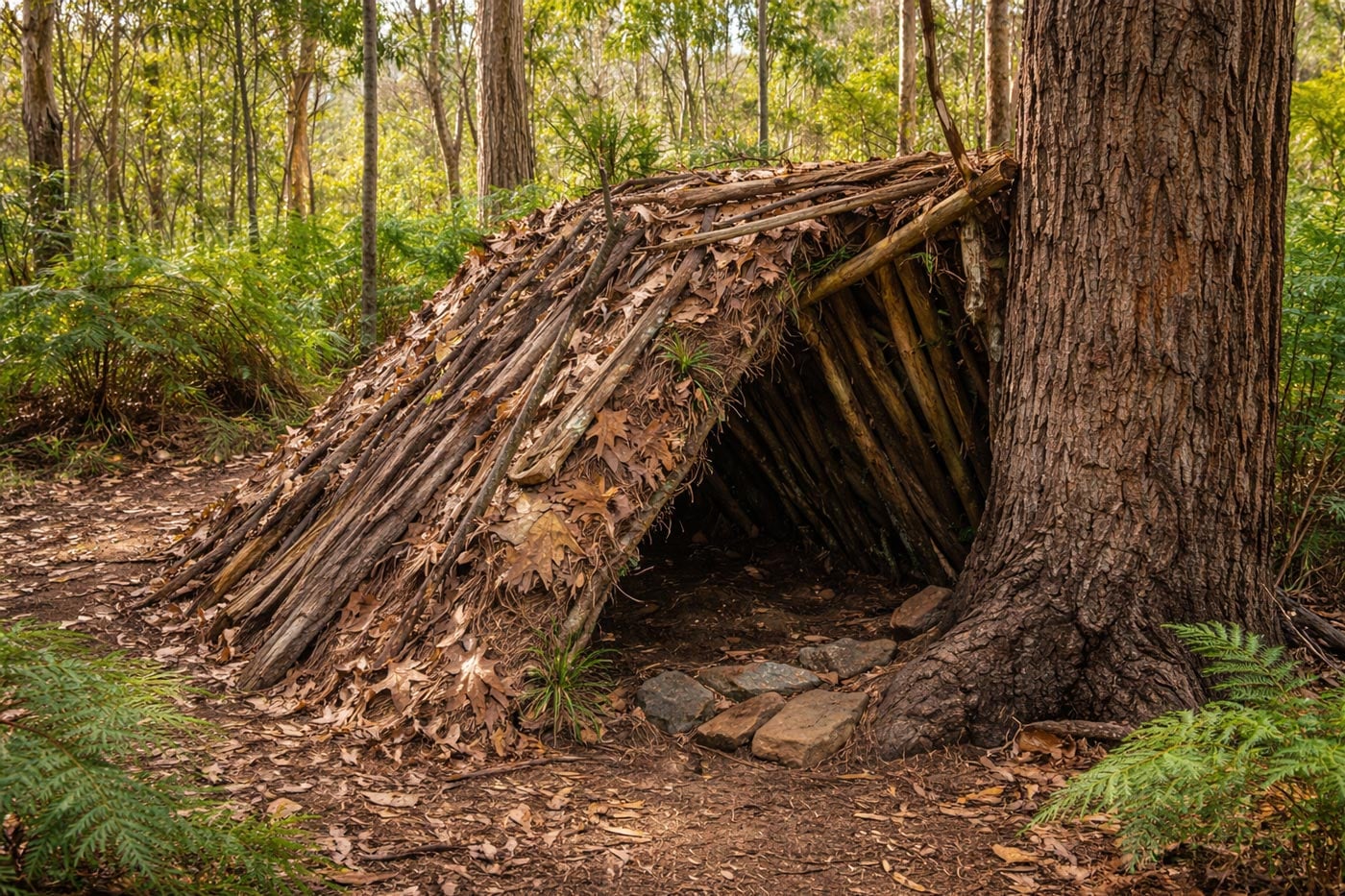
Common shelter options and when they make sense
Lean-to style shelters are quick and simple but provide limited protection and retain little heat. They can work in mild conditions but are poorly suited to cold or windy nights.
A-frame shelters, whether made with a tarp or natural materials, offer better enclosure and protection from wind and rain. When built small and insulated well, they are effective in colder conditions, but they require time and significant effort.
Using existing features such as fallen trees, rock overhangs, or dense vegetation often provides the best balance of protection and energy conservation. Improving what already exists is usually more efficient than building from scratch.
Debris cocoon shelters can provide emergency insulation when time is limited, but they are uncomfortable and rely on large volumes of dry material.
Location matters more than design
Shelter location often matters more than the structure itself. Choose the driest spot available, protected from prevailing wind. Avoid low points where cold air and water collect. Be alert to hazards such as falling branches, unstable rocks, or flood-prone gullies.
If rescue is a possibility, balance protection with visibility. Dense cover may offer warmth but reduce your chances of being seen. Improving visibility outside the shelter can be just as important as the shelter itself.
Remaining findable is part of shelter strategy, not separate from it.
Energy management and timing
Shelter building is physically demanding and should never come at the expense of hydration, rest, or injury management. Work steadily, take breaks, and stop before exhaustion sets in. If conditions allow, prioritise rest and insulation over elaborate construction.
Aim to have shelter decisions made and work underway well before darkness falls.
Visibility and rescue considerations
Shelters built from natural materials blend into the environment. If you are sheltering in place, take steps to remain visible. High-contrast clothing, packs, or other bright items placed outside the shelter can help. Ground markings or signalling devices should be prepared while you still have daylight.
Practice responsibly
Shelter building is a valuable skill, but it requires practice to understand the time, effort, and materials involved. If you practise, do so responsibly. Use only dead material, avoid damaging vegetation, and dismantle everything when finished, returning the area to its natural state.
Key takeaways
Shelter is about exposure management, not construction. Use what you are wearing and carrying first. Choose the simplest option that meets the conditions. Build early if you must build at all. Conserve energy, reduce risk, and focus on staying warm, dry, shaded, and visible rather than creating an impressive structure.
A good survival shelter keeps you alive long enough to make better decisions.



Such a helpful post. Thank you, Darren.
Thank you Jason. Glad you liked it. Hope you never have to build one in a survival situation.
Indeed. But if I ever do, I hope I can recall this post. In the meantime, there’s ‘practice’.
Great info! A diamond in the gravel bed of online survival advice.
I’m on Canada’s Pacific coast, pretty different from Australia but it all applies the same way. Our risk here is almost always hypothermia. Possibly compounded by injury due to rugged terrain and slippery wet ground. So for me, practice in building a simple shelter is the priority. The simplest is to start out by wearing the appropriate clothing in the first place. It doesn’t allow you to stay warm laying down, but I once spent a late fall / early winter night beside one of out fjords, standing up and jumping around in the rain to prevent hypothermia. A long night, but it works. (I took an interest in the subject after finding out the hard way that what I was carrying didn’t work the way I imagined. Practice it the way you’d practice anything. Real survival is miserable but the practice and experimentation are kinda fun).
If a fire is possible, I like a lean-to. WIth a tarp and no wind it’s fairly easy. Without a tarp. a waterproof lean-to takes a few hours assuming that the materials are at hand, and most people don’t stop in time to build one. With no fire I like to sit of semi-recline in a shelter built against a tree or whatever, with the upper part enclosed to retain the warmth around my head and shoulders. Even a 5×7 Mylar sheet can work for that. Esp combined with debris (although covering your bright orange Mylar with debris doesn’t help anyone who’s looking for you)
Just my thoughts. Possibly too many of them.
I
Thanks Bill, really appreciate you taking the time to share that. You’re absolutely right that hypothermia is the dominant risk in cold, wet coastal environments, and your point about clothing being the first and most important shelter is exactly the mindset I was aiming to reinforce.
What you describe about standing and moving through the night is a good illustration of how shelter is really about exposure management and energy balance, not structures. Miserable, but effective, and very different from how most people imagine “survival” playing out.
I also agree with you on practice. The gap between what people imagine will work and what actually works when you’re cold, wet, tired, and stressed is huge, and that’s something you only really learn by testing it in controlled conditions. Lean-tos, tarps, Mylar, debris, they all have a place, but only if people understand the time, effort, and trade-offs involved.
And you’re spot on about visibility. Warmth and concealment are often in tension with being found, which is why I like your point about not burying high-visibility gear when rescue is a possibility.
Different environments, same underlying principles. Thanks again for adding a really practical, lived-experience perspective.
I live on the south east coast of Australia and I have never seen a forest like the ones in the photos. How to I build a shelter in a south eastern Australian environment, with all the gum trees? Also, is there a way I can keep safe from snakes while collecting my materials?
Hi Lucy. Good questions, and very relevant for south-eastern Australia.
The first thing I’d say is that in most south-east Australian conditions, you’re usually better off not planning to build a shelter from scratch unless you genuinely have no other option. Eucalypt forests don’t lend themselves well to quick, effective shelters. The leaf litter is often sparse or damp, branches are hard and brittle, and building something weatherproof takes more time and energy than most people expect.
If you do need shelter, start by using what already exists. The lee side of a ridge, a fallen tree, dense scrub, or a shallow gully that’s not flood-prone will often give better wind and rain protection than anything you can build quickly. Get off the ground using your pack, spare clothing, or vegetation, and focus on blocking wind rather than trying to make a roof.
If you’re carrying gear, a rain jacket, emergency blanket, tarp, or bivvy is far more reliable than natural materials in eucalypt country. Even a small sheet used as a windbreak behind you or wrapped around your upper body can make a big difference with far less effort.
On snakes, the risk while collecting materials is usually low, but awareness matters. Most snake bites happen when people put hands or feet where they can’t see. Avoid reaching blindly into hollows, under logs, or into dense grass. Use a stick to move debris rather than your hands, watch where you step, and slow down when visibility is poor. Snakes are generally defensive, not aggressive, and most encounters happen when they’re surprised.
The bigger safety takeaway is to avoid unnecessary movement and risk late in the day. If shelter is needed, make decisions early, keep it simple, and minimise wandering around collecting materials.
This was really helpful for my school project, Darren! Thanks!
You’re very welcome, Cat. I’m glad it was useful, and best of luck with your project.