Group separation is one of the most common contributors to incidents on group hikes, and it’s rarely down to one single mistake. It’s usually a combination of things: uneven fitness levels, unclear expectations about pace, poor visibility, or someone losing focus at a junction. Downhill sections, long climbs, and technical terrain are where it tends to happen, because that’s where the fitness gaps in a group actually show up, and a group will naturally stretch out on that kind of ground unless someone’s actively managing it. Recognising where separation is most likely is the first step in stopping it before it starts.
Setting the pace and giving people roles
A group can only move as fast as its slowest member, which means setting the pace off the strongest hikers at the front almost guarantees separation. I’d rather set a steady, sustainable pace based on the slowest person in the group and hold it than have the front surge ahead and then stand around waiting for everyone else to catch up. It’s safer, and over a full day it’s actually more efficient too.
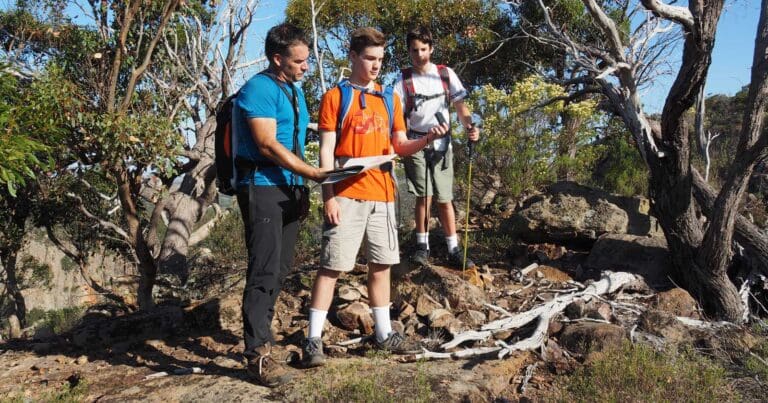
That’s a lot easier to do if people have clear roles, because someone needs to actually be watching the back of the group for it to work. Even an informal group benefits from at least two roles. A lead hiker is responsible for navigation, setting the direction, and stopping at every trail junction. A “Whip”, or tail hiker, is a skilled hiker who stays at the back to make sure no one’s left behind, and who tells the leader if the pace is becoming unsustainable or if gaps are starting to form. The leader should be checking in on the position and condition of those at the back of the group regularly and adjusting speed accordingly, rather than pushing on and assuming everyone’s still there.
Regrouping and staying in contact
Even with a lead and a tail hiker doing their jobs properly, a group still needs to stop and regroup regularly, because waiting until it’s obviously spread out makes pulling it back together much harder. Do a head count and regroup at track junctions, after significant climbs or descents, before entering technical or exposed sections, or whenever visibility is reduced. That keeps everyone aligned and stops confusion about direction or decisions from creeping in.
Regular regrouping covers the main track, but a lot of the gaps that actually cause trouble open up during routine stops, which is why a group needs a couple of firm rules around them. The first is what I’d call the Toilet Rule: if someone needs to stop for any reason, they tell another hiker, ideally the Whip, and leave their pack on the trail at the point where they left the track. That way the group doesn’t accidentally continue on without them, and the leader knows exactly where to look. The second is the Sightline Rule: everyone keeps the person in front of them in view, and if that sight line is lost, they call out immediately so the group can stop. In bad weather or dense bush, it doesn’t take much, only a few metres of separation, for someone to actually go missing.
Fatigue makes it harder to hold together
All of this gets harder as people tire, because fatigue affects balance, judgement, and pace, and spacing naturally increases unless effort is managed throughout the day. Short, regular breaks and conservative pacing help maintain cohesion, rather than trying to fix a stretched-out group later on when everyone’s already tired. It also helps to plan the day properly from the start, so it’s worth looking at time and distance planning for hikes to reduce that pressure later in the day.
It still comes down to the individual
None of this replaces individual responsibility, though. Keeping a group together is shared: each person still needs to remain aware of the route, stay engaged with navigation, and monitor their own condition, rather than switching off because someone else is leading. The guide on how to keep yourself safe on a group walk explains why self-reliance remains essential even within a group setting.
If the group does separate
If a group does begin to fragment despite all this, stop and regroup immediately rather than pushing on and hoping it sorts itself out. If a member becomes unaccounted for, follow established lost-person procedures without delay, rather than waiting to see if they turn up on their own. The guide on what to do when a group member becomes lost hiking outlines what that response actually looks like.
Final thoughts
For me, the thing to remember is that a group doesn’t stay together by accident. It takes active management for the whole day: set the pace off the back rather than the front, assign the roles, regroup often, and treat the toilet and sightline rules as non-negotiable. It’s usually a small, routine moment, someone stopping for a minute, a missed sight line, that costs you the group, not the obviously dangerous terrain everyone’s already being careful on.





What strategies have you found effective in keeping a hiking group together, especially when fitness levels vary? Would love to hear your tips!
Trail Hiking Australia A convoy always travels at the speed of the slowest ship!
Barry Ward totally agree. That’s a great plan to have
Hiking with good friends where the company is as, or more important than the destination.
I’m usually the slowest in our group, at the moment as I recover from an injury I am definitely the slowest. I don’t like being the pace setter. I prefer to be at the back of the group as it allows me to hike at my own pace. I don’t like being at the front as I feel pressure from those behind me, even though there isn’t any. Before we start hiking I assure my friends/group that I am OK being at the back. They wait at decision points or if terrain means we will loose sight of each other.
Such a great topic 🙂 Having a back marker who is confident also to navigate is a good idea and UHF radios for communication where gaps present. Always a challenge to ensure everyone gets to the end safely at a pace that works for all. We have observed too that some slower walkers do not like leading as they feel pressure to walk faster/beyond their pace capability to please the faster walkers too.
Being clear at the beginning that we stick together, always have a tail and make sure the people walking have the right level of fitness for the walk
The only guided walks I’ve done were for a crevasse rescue course (for beginners) in British Columbia, and the first thing that struck me was how slowly our leader seemed to walk. He was young, super fit, and the group was 20-40 ish so I assumed we’d be on a cracking pace. It wasn’t long, as we gained altitude, before I realised how sensible his pace was, how it kept us all together and not exhausted when we got to the technical bits. Not to mention the controlled slides down a glacier…
The only thing I hate about being at the back of the pack is lack of rest time. By the time I’ve caught up, the others are raring to go. Especially if we’ve just gone up a steep hill.
My hiking buddies are ok to wait but I’ve found guided hike are different.
Gee Young totally hear you there. Nothing worse than catching up just to see the group head off again
Gee Young Yeah, this is tough. If someone has fallen behind they almost certainly need a minute or more of rest once they catch up.
Navigator and experienced at the front, everyone else in the middle and experienced at the back.
That’s how TSA do it.
I’ve found that group members need to be realistically screened prior to the walk, regular stops to allow slower walkers to catch up and the use of two-way radios is invaluable between the leader and tail. I’ve had a couple of walks where there were some walkers who overestimated their ability and it caused quite a predicament for the group.
Linda McKenzie a very good suggestion.