The grading system is a starting point, not a verdict
The Australian Walking Track Grading System, or AWTGS, provides a nationally consistent method for classifying walking tracks from Grade 1 to Grade 5. It is based on descriptors drawn from Australian Standard 2156.1-2001 and endorsed by the Council of Bushwalking Australia.
It is useful. It is structured. It creates consistency. But it does not tell the whole story.
A single grade number does not make all Grade 4 tracks equal. Completing one Grade 4 does not automatically prepare you for another. The system describes track characteristics. It does not measure your judgement, self-reliance, or how the environment may change on the day.
This article explains where the system works well, where it is commonly misunderstood, and how to interpret grades responsibly in real Australian conditions.
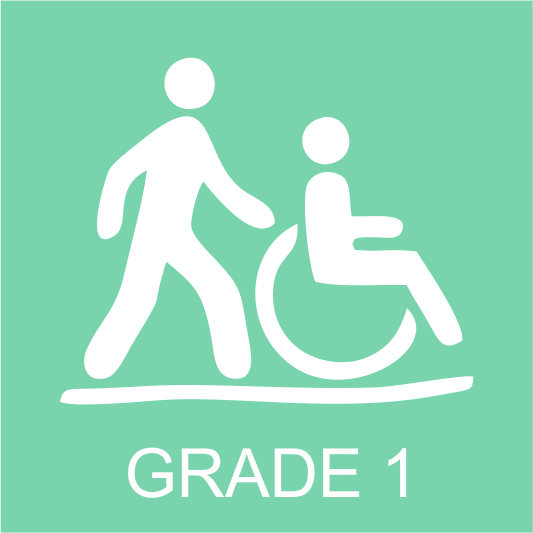
Grade 1 (All-abilities)
No bushwalking experience required. Flat even surface with no steps or steep sections. Suitable for wheelchair users who have someone to assist them. Walks no greater than 5km
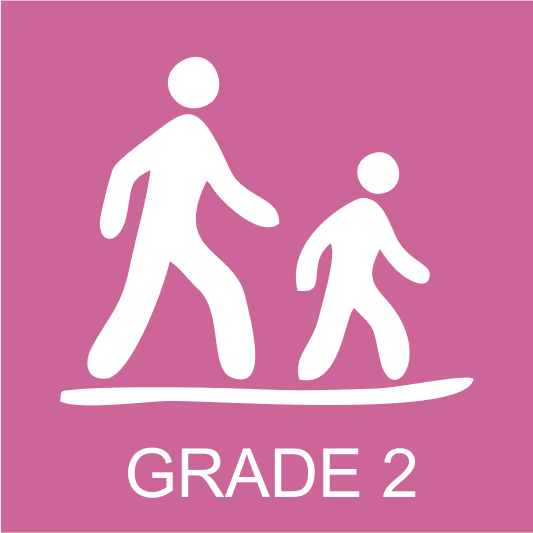
Grade 2 (Easy)
No bushwalking experience required. The track is a hardened or compacted surface and may have a gentle hill section or sections and occasional steps. Walks no greater than 10km.
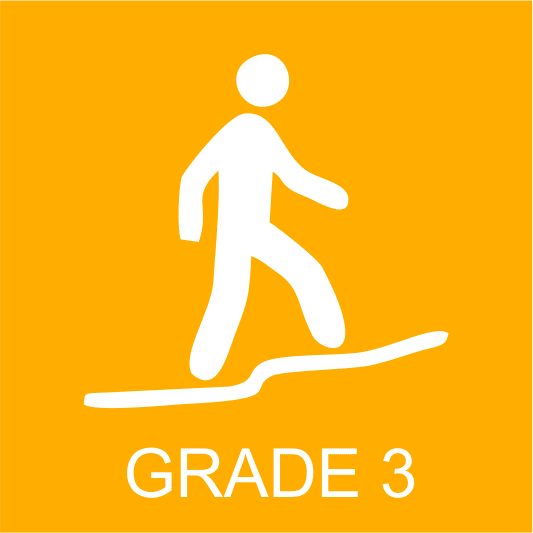
Grade 3 (Moderate)
Suitable for most ages and fitness levels. Some bushwalking experience recommended. Tracks may have short steep hill sections a rough surface and many steps. Walks up to 20km.
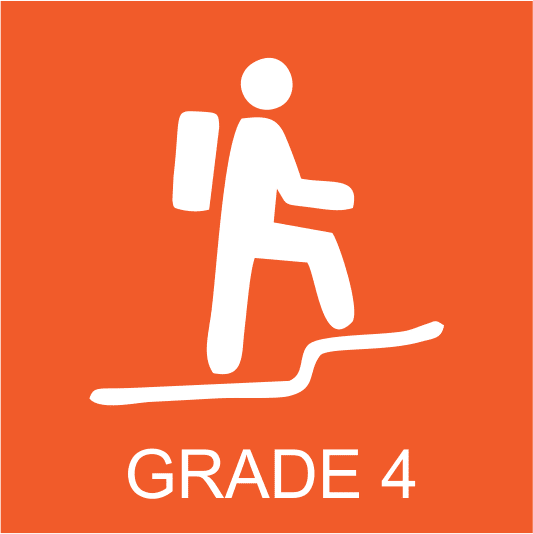
Grade 4 (Hard)
Bushwalking experience recommended. Tracks may be long, rough and very steep. Directional signage may be limited.
Grade 5 (Difficult)
Very experienced bushwalkers with specialised skills, including navigation and emergency first aid. Tracks are likely to be very rough, very steep and unmarked. Walks may be more than 20km.
The false equivalence problem
One of the most common mistakes walkers make is assuming that two tracks with the same grade represent comparable experiences. They often do not.
For example, a long coastal walk on firm sand in Victoria may be classified as Grade 4 primarily because of its length. Navigation is obvious. Terrain is predictable. Exposure is limited. In contrast, a Grade 4 walk in the southwest of Tasmania may involve steep muddy slopes, unformed pads, minimal signage, complex route finding, remote terrain, and highly changeable weather. Both are Grade 4. They are not the same undertaking.
The AWTGS grade reflects the most challenging aspect of a track according to defined criteria. It does not guarantee similarity in terrain, remoteness, technical difficulty, or consequence. Assuming equivalence based on the number alone is where overconfidence begins.
How the criteria escalate across grades
Understanding how the system escalates helps clarify where responsibility shifts.
| Criteria | Grade 3 | Grade 4 | Grade 5 |
| Track surface | Formed with obstacles | Rough, may be indistinct | Unformed |
| Signage | Some signage | Limited signage | Generally none |
| Navigation | Recommended skills | Required skills | Advanced navigation essential |
| Self-reliance | Moderate | High | Very high |
| Environmental exposure | Manageable | Significant | Potentially severe |
The jump from Grade 3 to Grade 4 is the most important shift in the system.
The self-reliance threshold
The transition from Grade 3 to Grade 4 is not simply an increase in steepness. It represents a change in responsibility. Grade 3 still assumes a managed walking experience. Signage is generally present. The track is formed. While some bushwalking experience is recommended, the environment is typically structured to guide walkers. Grade 4 assumes something different.
At Grade 4, you are expected to manage:
- Navigation decisions
- Hazard identification
- Route finding in indistinct terrain
- Environmental exposure
- Self-management during incidents
- Emergency response until help arrives
For beginners, Grade 4 is the true point of no return. It is no longer a guided experience. It is self-managed. This is not simply a harder walk. It is a different category of responsibility.
The Grade 4 Trap
Because Grade 4 includes both long endurance walks and steep technical terrain, many walkers develop a false sense of capability.
If your previous Grade 4 experiences have been:
- Formed tracks
- Clear signage
- Predictable terrain
- Low exposure
- Minimal navigation complexity
You are not necessarily prepared for:
- Unformed wilderness terrain
- Active navigation across open country
- Prolonged exposure in alpine or coastal cliffs
- Remote Tasmanian or alpine environments
A Grade 4 in a managed coastal park is not equivalent to a Grade 4 in a designated Wilderness Area. The number is the same. The consequences are not.
Distance can blur technical difficulty
In Grades 1 to 3, distance plays a formal role in classification:
- Grade 1 up to 5km
- Grade 2 up to 10km
- Grade 3 up to 20km
This can create confusion.
A flat 19km rail trail may be Grade 3 due to endurance demands rather than terrain complexity. Meanwhile, a shorter walk with steep uneven sections may also be Grade 3. To an inexperienced walker, both appear equivalent. In practice, they demand different preparation. Distance influences stamina. It does not always reflect technical challenge.
Static grades, dynamic environments
The AWTGS grade does not change when conditions change. A Grade 3 track that includes a river crossing remains Grade 3 in the guidebook. After heavy upstream rainfall, that same crossing may become impassable or dangerous.
Similarly:
- A moderate alpine walk can become a serious snowbound navigation problem.
- A well-formed clay track can become a slip hazard after rain.
- A long exposed walk can become medically dangerous in heat.
- A remote track may become inaccessible after storm damage.
The grading system is static. The Australian bush is dynamic. Grades describe baseline characteristics. They do not reflect environmental flux.
From track characteristics to system demand
The grading system describes the track. It does not describe the total demand placed on you.
A Grade 2 track in extreme heat may place high strain on hydration and environmental protection. A Grade 3 completed late in the day may increase pressure on decision-making and mobility. A well-formed Grade 4 undertaken by an inexperienced group may expose weaknesses in supervision, load management, and injury prevention. The terrain classification remains the same. The systems under strain change.
Grading does not account for fatigue accumulation, remoteness, communication limitations, weather volatility, or group dynamics. These factors determine how hard the day becomes in practice. Instead of asking only “What is the grade?”, experienced walkers ask a different question: Which safety systems are most likely to be stressed in these conditions, with this group, at this time?
This shift moves grading from a decision-maker to a planning input. The number provides context. Your systems determine outcome.
Grade 5 is open-ended
Grade 5 is not a ceiling. It is an open-ended category.
It includes:
- Very difficult formed tracks
- Remote wilderness traverses
- Extended exposure routes
- Terrain that may approach mountaineering seriousness
Two Grade 5 walks can differ dramatically in objective risk. Sections of the Grampians Peaks Trail are classified as Grade 5. The Western Arthur Traverse in Tasmania is also classified as Grade 5. Both sit within the same grading band. Their seriousness, remoteness, and consequence profile differ significantly. The grading scale does not subdivide within Grade 5. Interpretation requires context.
Pre-Hike Reality Check
Before committing to a Grade 4 or 5 walk, pause and assess:
- Is this grade influenced primarily by distance or terrain?
- How remote is the track?
- How long would rescue realistically take?
- Does this route require active navigation?
- What happens if the weather shifts?
- Have I managed similar terrain before?
- Have I done this terrain with the pack weight I will carry?
- If I had to self-rescue, could I?
If you cannot confidently answer these questions, more research is required. The grade should prompt investigation, not reassurance.
How grading is applied on this website
On this website, grading is based on:
- The official AWTGS classification
- The AWTGS Users Guide
- Australian Standard 2156.1-2001 descriptors
- Field observation and technical assessment
In some cases, interpretation may differ slightly from a land manager’s published grade due to contextual factors or updated track conditions. Grades are guidelines. Conditions, season, terrain type, and personal capability ultimately determine real difficulty on the day. Detailed descriptions are provided to give walkers more than a number. The goal is informed decision-making, not reliance on a single rating.
That is really what the grading system is for. It gives national consistency and helps prevent obvious mismatches between terrain and ability, but it was never built to measure judgement, navigation competence, environmental awareness, or consequence management, and treating it as if it does is where the risk creeps in. Completing one Grade 4 does not qualify you for every Grade 4, and a long coastal Grade 4 does not prepare you for a remote alpine one just because the number matches. The grade is a starting point. What you do with the context around it is what actually determines how the day goes.




I think a distinction needs to be made for technical difficulty versus simple length. I have kids and when looking for hikes to go on with them, I have to be very careful in my assessment, looking at the description more than the number.
Matthew White the grading is based on quite a range of factors which includes length, difficulty, terrain, topography, availability of trail markers etc. Agree they should only be used as a guide and more in depth analysis is needed to find the right trail.
Club grade systems are much better.