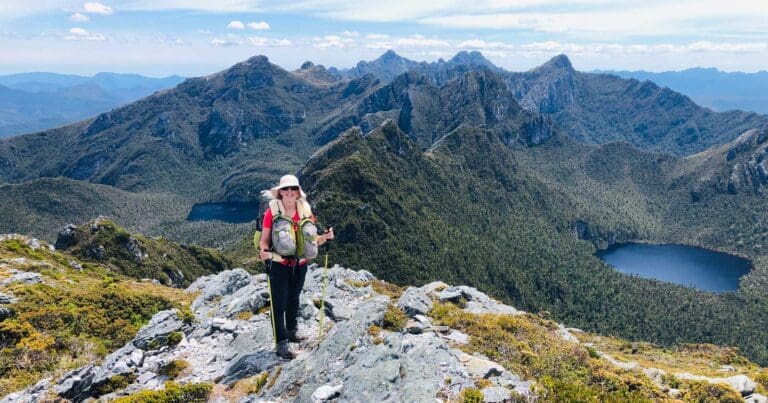
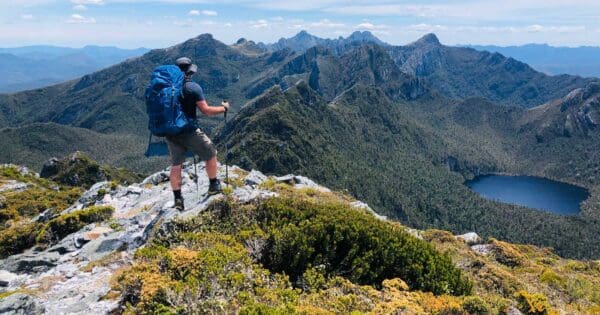
The Western Arthur Range Traverse is a full traverse of the Western Arthur Range. To traverse the rugged Western Arthur Range is considered a major bushwalking challenge and has been undertaken regularly by experienced bushwalkers since the 1960s. Located in Southwest National Park, and part of the Tasmanian Wilderness World Heritage Area (TWWHA), the full Western Arthur Range Traverse covers extensive, rugged topography and funnels walkers through narrow corridors throughout much of the range.
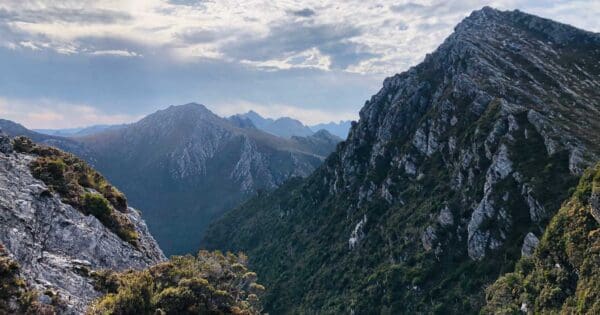
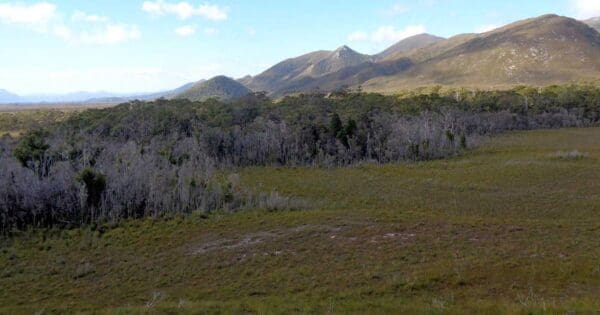
The landscape that contributes to the area's World Heritage values is made up of steep slopes, alpine moorlands and glacial lakes. The ranges are a geological delight, composed almost exclusively of deformed Precambrian quartzite and quartz schist. Walkers will mainly journey through alpine heath and alpine scrub vegetation. Elsewhere, buttongrass heath is widespread and scrub, wet forest and patches of rainforest occur on the lower slopes.
A shorter version of this walk, the Western Arthurs Traverse A-K, can be experienced from Alpha Moraine to Kappa Moraine in 6 to 7 days. Those only wishing to walk into Lake Cygnus or Lake Oberon and back will need to set aside 3 to 4 days. Walkers will need to register for each of these options.
The challenges of the walk are not to be underestimated, and should be completed only by walkers with significant experience in remote, alpine conditions. The Western Arthur Range Traverse is a Grade 5 walk suited to very experienced walkers. The rough and challenging terrain can make short distances into an all-day event and walkers new to the traverse should allow plenty of time to cover the route. The walk can be significantly impacted by weather conditions, and walkers should be prepared to turn back if they find the weather or the conditions too challenging. All walkers should come prepared with a Personal Locator Beacon (PLB).
Trip Notes (9 day full traverse)
Day 1 – Huon Campground to Junction Creek
8.5 km, 3-4 hours
The track to Junction Creek is clearly marked, featuring gentle hills and multiple creek crossings, which can become challenging or impassable during heavy rains due to the lack of infrastructure. The track can be extremely muddy, so to protect the vegetation, walk through the mud. The campsite at Junction Creek is prone to flooding in heavy rain, but drier spots are available south of the creek.
Ensure all gear is checked before starting. The trail begins at the walkers' registration booth, leading to the Port Davey Track (sometimes called McKays Track). After passing through the tree line, the environment shifts to a shady forest with myrtle beech, sassafras, and eucalypts. The forest floor is covered with moss and leaf litter, and the path winds through undulating terrain.
For the first kilometre, the track alternates between forest and buttongrass plains before reaching vast moorlands stretching towards Mt Hesperus. These moorlands are characterised by stunted banksia, waratah, and swamp heath. The muddy trail, with small streams and deep pools, eventually leads to Junction Creek, the first potential campsite 8.5 kilometres from the trailhead.
Day 2 – Junction Creek to Lake Cygnus
9 km, 6-7 hours
The second day’s journey from Junction Creek to Lake Cygnus begins at the track junction, following the Port Davey Track towards the Western Arthur Range. The trail starts on flat terrain but soon ascends steeply up Alpha Moraine, leading to the crest of the range and an exposed ridge. After crossing a moor and passing below Mount Hesperus, some boulder hopping and rock scrambling are required. The trail then descends steeply to Lake Cygnus, where a right turn at the junction leads to the campsite.
The track navigates through a gully to the first junction, where Port Davey intersects with McKays Track. Continuing towards Alpha Moraine, the rugged Arthur Range becomes more prominent as the muddy trail winds southwest. The second junction marks the start of the Moraine A Track, which ascends Alpha Moraine towards Mount Hesperus. At the base of Alpha Moraine, a small stream with a sandy beach provides a final opportunity to refill water supplies or camp if needed, though no facilities are available.
Crossing the stream, the challenging ascent of Alpha Moraine begins, offering stunning views of Mount Anne and Lake Pedder. At the peak of the moraine, the Western Arthurs Traverse officially starts, revealing the dramatic landscape of the Arthur Range.
The trail continues beneath the western face of Mt Hesperus, then descends into the saddle above Lake Fortuna. After a final climb towards Capella Crag, the first view of Lake Cygnus appears, nestled in a deep glacial cirque. The descent to Lake Cygnus is steep but aided by manmade stairs and switchbacks, ending at a coarse white beach by the lake.
Lake Cygnus offers a refreshing, though cold, swim in favourable weather. The campsite, sheltered on three sides by a rugged ridgeline, features two wooden tent platforms and additional space on black mats or the beach. Water can be sourced from the lake or nearby streams with filtration. An open toilet is located south of the tent platforms, among the trees.
Day 3 - Lake Cygnus to Lake Oberon
5 km, 5-6 hours
On Day 3, the route from Lake Cygnus to Lake Oberon begins with a climb back to the track junction before heading southeast along the exposed crest of the Western Arthur Range. The rocky path passes Mount Hayes and involves steep climbs, rock scrambling, and navigating gullies. A junction below Mount Orion offers a right turn for the steep descent to the Lake Oberon campsite.
Morning sunlight may reveal the slopes as you prepare for the day. Water can be replenished at a creek below Square Lake, about halfway along the route, reducing the need to carry large amounts. The trail departs from Lake Cygnus with views over Bathurst Harbour and the southern ranges. It follows a rocky path beneath Mount Hayes, descending steeply and winding through a shaded chute, eventually leading to a saddle with views back towards Mount Hayes and onward to Procyon Peak.
The trail traverses the western face of Procyon Peak and descends towards Square Lake, where a stream provides the day’s only fresh water. After replenishing supplies, the rough trail ascends sharply, rewarding you with stunning views of quartzite spires and alpine lakes.
Cresting the saddle between Mount Orion and Mount Sirius offers the first view of Lake Oberon. The final descent is steep and challenging, requiring rock scrambling and careful footing. The trail then enters a forest of pandani, myrtle, and scoparia, with boardwalks guiding the way to Lake Oberon.
The Lake Oberon campsite is nestled in a deep glacial cirque, with towering quartzite spires and streams flowing toward the lake. The water is warmer than other lakes, making it ideal for a refreshing swim. The campsite features four tent platforms, shaded by moss-covered trees, and a sandy cove for additional tents. An open toilet is located in the forest, and water can be sourced from the river, though filtration is recommended.
Day 4 - Lake Oberon to High Moor
5 km, 5-7 hours
The route from Lake Oberon to High Moor is increasingly challenging, with rougher terrain, steep climbs, and exposed ridges. This section requires extensive climbing, scrambling, and pack-hauling, with navigation relying on intermittent rock cairns. Water is scarce, so carrying enough to reach Haven Lake is essential. Attempt this segment only in favorable weather and if you have experience.
After Lake Oberon, the trail ascends towards Mount Pegasus, passing a tarn before a treacherous section near the summit, requiring pack-hauling. The route then descends into a steep gully beneath a buttress, where large boulders hide deep gaps, posing significant hazards.
Climbing towards Mount Pegasus signals a day full of technical challenges. Reliable water sources between Lake Oberon and High Moor are nonexistent, so start with a full day's supply. Mobile reception is limited to high points like Mount Sirius.
The ascent from Lake Oberon heads southeast towards Mount Pegasus, where rock cairns guide you up a boulder wall. Packs may need to be passed up to manage the climb. The trail skirts a cliff base, avoiding any exposed vertical climbs. After a short reprieve, the path narrows into a cave formed by boulders, requiring careful navigation.
The descent from Mount Pegasus involves white quartzite rocks and dense shrubs, with views of Lake Uranus and Mount Capricorn. Cairns guide the way through misleading paths. After scrambling up Mount Capricorn, the descent involves scaling a steep, shrub-covered cliff using branches for support.
Reaching the saddle below brings a sense of accomplishment. The final stretch to High Moor is more manageable, ending at a boardwalk leading to the campsite.
High Moor campsite, beneath Mount Columba, offers sweeping views over the Arthur Range. The campsite features an open toilet, a small stream for water, and two tent platforms connected by boardwalks. Up to nine tents can fit on the platforms, though it can get cozy. A summit of Mount Columba at sunset provides a spectacular end to the day, with golden light over the Arthur Range.
Day 5 - High Moor to Haven Lake
5 km, 6-7 hours
After leaving High Moor, the trail leads to the Beggary Bumps, the most challenging section of the Western Arthurs Range. The Tilted Chasm is particularly daunting, requiring careful navigation and possibly pack-hauling. There are no reliable water sources between High Moor and Haven Lake, so carrying sufficient water is essential.
The day starts with a climb onto the jagged Beggary Bumps, quickly transitioning into a steep descent through a shaded chute lined with woolly tea trees and pandani. The trail then traverses above Lake Ganymede, with horizontal trees aiding the steep slope. After passing through gnarled trees, you reach the Tilted Chasm, a notorious descent between damp granite slabs, where careful navigation is important.
Past the Tilted Chasm, the trail continues towards The Dragon, with a fun scramble near the summit followed by another steep descent through gnarled trees and boulders. After this, the trail reaches a saddle beneath The Dragon, offering a view of the jagged Beggary Bumps, emphasizing the difficulty of the previous section. The trail then continues along the ridgeline towards Mount Taurus, navigating more exposed boulders and rutted slopes.
Before reaching Mount Taurus, the trail passes a final unnamed peak with views of two lakes on either side of the Beggary Bumps, offering a good break spot. The final descent before Mount Taurus includes an awkward boulder drop, best navigated using tree limbs for support.
The climb onto Mount Taurus is the last peak before reaching Haven Lake, which comes into view after descending its eastern shoulder. A final tricky descent between boulders leads to the shrub-filled slope towards the lake.
Haven Lake campsite is a welcome sight, offering four platforms for two tents each and an open drop toilet. Water is available from the lake, but filtration is advised.
Day 6 - Haven Lake to Promontory Lake
5 km, 5 hours
From Haven Lake, the trail begins with a gentle climb to the saddle to the west, followed by a traverse across the eastern face of a rocky knoll. After descending the knoll's northern side, an easy, open walk leads to the next knoll, which can be climbed without difficulty. The descent from the northern side of this second knoll is steeper in places, leading down to the exposed Lake Sirona.
From Lake Sirona, the route across the moorland to Mount Scorpio (1,108 metres) is straightforward. An optional ascent involves a 10-metre scramble along a narrow ridge to reach the summit. The path then continues north, offering extensive views to both the east and west, towards what appears to be the edge of an escarpment, with Kappa Moraine descending to the plains below.
The trail descends this escarpment for about half an hour to the top of the moraine, where it forks. One route heads northeast down the moraine, while another leads south towards the scarcely visible Lake Vesta. Unless exiting the track here, take the southern route, which follows a stream valley down to Lake Vesta and then descends steeply to Lake Juno. From Lake Juno, it is a short 100-metre climb to Promontory Lake. Following the northern and eastern shores will lead to campsites in the southeastern corner of the lake.
Day 7 - Promontory Lake to Lake Rosanne
11 km, 9 hours
Head southeast from the lake, following a faint path through thinning vegetation, ascending past the rocky knoll of The Sculpture. Continue upwards over the boulder-strewn mountain of The Phoenix, which stands at 1,091 metres. Beyond The Phoenix, the Crags of Andromeda await, separated by a valley.
To reach the Crags, descend to a broad saddle and traverse the undulating Centaurus Ridge, which extends for about 3 kilometres. At the ridge's end, the slopes leading to West Portal begin. West Portal, at 1,191 metres, is the highest peak in the Western Arthurs. Ascend its western ridge to the 1,100-metre contour, where it is advisable to leave your pack. From here, scramble to the summit via the south side of its twin peaks, where sweeping views encompass the ground covered over the past five days and the Eastern Arthurs. If this ascent is skipped, deduct an hour from the time estimate.
After returning to your pack, follow the faint path north along the stony slopes of the Crags of Andromeda, staying close to the crest or just west of it for about an hour. At the northern end of the Crags, descend eastward into a valley, then navigate a challenging path through thick scrub, contouring to avoid the densest sections. As the scrub gives way to grass, Lake Rosanne, at 633 metres, comes into view below, offering a suitable campsite.
Day 8 – Lake Rosanne to Seven Mile Creek
14 km, 6 hours
Skirt around the ridge south of Lake Rosanne, push through scrub at the outlet, and begin the long 400-metre descent down the moraine. This descent leads out of the mountains and onto the flat Strike Creek Plains. Cross these wet button grass plains in a northeast direction for a few kilometres, heading towards the low Razorback Ridge. Ascend through the ridge for a couple of kilometres to reach the junction with the Huon and McKay Tracks, located just west of Cracroft Crossing.
Follow McKay's Track northwest as it circles around the northern side of the Razorback Ridge, then veers west to climb back up to the low crest. This section provides excellent views of the Western Arthurs. By following this route, the track avoids dense vegetation and remains on drier areas of the hillside. It then descends the southern side of the Razorbacks onto the Arthur Plains, a vast, flat area situated to the north of the Western Arthurs.
Proceed northwest across the muddy button grass plains for 5 kilometres, passing to the north of a wooded knoll. After traversing these wet plains, you will reach Seven Mile Creek, where the descent down Kappa Moraine meets McKay's Track. This area offers good sheltered campsites.
Day 9 – Seven Mile Creek to Scotts Peak Dam
16.5 km, 8 hours
From Seven Mile Creek, the path continues west across the Arthur Plains, generally following the slightly higher ground. The trail predominantly traverses gravel-covered button grass, although it occasionally dips into shallow valleys formed by small creeks, where the vegetation is dense and the terrain often muddy. Throughout this section, the rugged quartzite peaks of the Western Arthurs, traversed earlier in the journey, remain visible to the south.
After approximately four hours on McKay's Track, the junction with the Port Davey Track is reached, marking a return to familiar territory. Turning right, the route retraces the path taken eight days earlier, leading to a quick descent to Junction Creek. After crossing the creek, the journey continues north along the Port Davey Track for just under four hours to reach the carpark at the Huon River Campsite.
The initial part of this section on the Port Davey Track is frequently muddy, but it transitions to well-drained, boarded areas after a couple of hours, followed by a brief passage through primeval forest. Given the length of the final day, camping at Junction Creek and completing the remaining 8.5 kilometres to the trailhead the following day is a viable option.






6 Reviews on “Western Arthur Range Traverse Hike (79km)”
Laura Purcell
Andrew Mackenzie
Mani Andreetta this one’s next for you
Lynda Maddison I’d love to do this but think it’s too risky for me – so weather dependant, requiring pack hauling, climbing preciptious rock faces etc.
Mani Andreetta I think you can do it
This is the best hike I’ve done in Australia….
Absolutely love this adventure. As you can see, the weather was amazing and the scenery spectacular (the mountains beyond my wife were pretty good too). We were extremely fortunate.