Hike at a Glance
Max elevation: 49m
Min elevation: 0m
Total Ascent: 318m
Essential information
This walk is currently closed at the northern end due to the absence of safe public access to Malabar Head. Do not attempt to continue beyond the designated track, as cliff edges and restricted areas present serious safety risks.
Hike overview
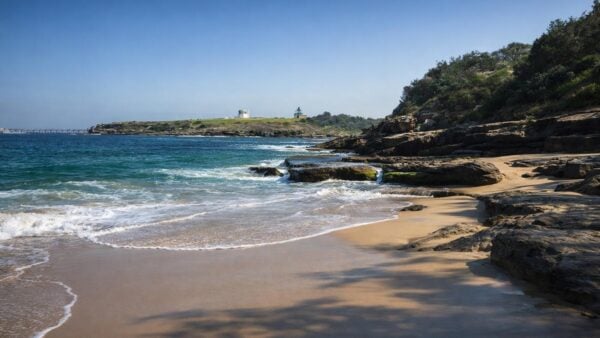
Exploring the cliffline on the northern side of Botany Bay, this walk combines sweeping coastal views with pockets of layered history. From the outset near Cann Park at La Perouse, the track drops down towards Congwong Beach, where calm bay waters sit in contrast to the open ocean further north. It is worth slowing down here. Bare Island stands just offshore, linked by a footbridge and rich with military history, while Browns Rock draws local fishers to its exposed sandstone shelf. Up on the headland, manicured greens from the neighbouring golf courses sit unexpectedly close to wind shaped heath and low coastal scrub.
From Congwong Beach the route threads its way past Little Congwong Beach, a sheltered cove known for its clear water and long standing reputation as a clothing optional beach. It can be busy on summer weekends and shade is limited in the afternoon, so plan accordingly. Beyond the beaches the track climbs steadily towards Henry Head, alternating between sandy paths, timber steps and sections of bare rock. Views open across Botany Bay, with ships entering and leaving the port and, in winter, the chance of spotting humpback or southern right whales moving along the coast.
Henry Head itself is a highlight. The former artillery battery, built in the 1890s, still holds its underground chambers and observation posts. Later reused during World War Two, it speaks quietly of the strategic importance of this headland. Nearby stands the white Endeavour Tower, a navigation marker rather than a true lighthouse, but distinctive all the same. Take care around the structures, as there are rusted fittings and uneven surfaces.
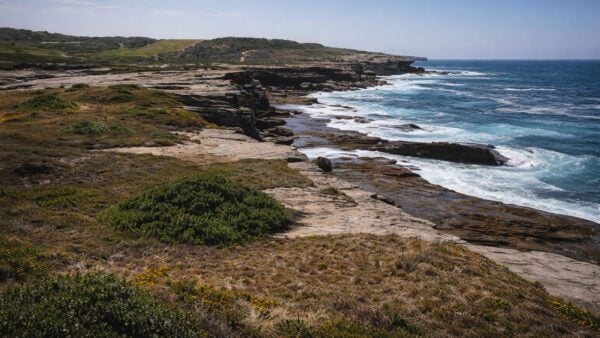
From Henry Head the walk becomes more rugged as it tracks across rock slabs and narrow heath lined paths towards Cruwee Cove and Shelly Beach. The coastline here feels more exposed. Waves wrap around the sandstone platforms and the air carries that mix of salt and coastal bush that defines this part of Sydney. The route then skirts the edge of the golf course before reaching Cape Banks, where the full force of the ocean is on display. From the unfenced cliffs you can look south across the bay or east to the open sea. At low tide, the wreck of the SS Minmi lies visible among the rocks. During the whale migration season, keep an eye on the horizon for spouts and breaches offshore.
Climbing away from Cape Banks, the trail passes more wartime remnants, including concrete bunkers and gun emplacements near the Westpac helicopter facility. These relics sit among windswept grass and low shrubs, blending military history with raw coastal scenery. The track then joins Cape Banks Road, where the Coast Hospital Cemetery lies just off the route. Established in the 1880s for patients of the nearby quarantine hospital, it contains marked and unmarked graves, including those of people who died from smallpox, influenza, plague and other infectious diseases. An information sign also acknowledges the returned ancestral remains of La Perouse Aboriginal people buried here. It is a solemn place and deserves quiet respect.
Heading north, the walk crosses sections of St Michael’s, The Coast and Randwick golf courses. Public access is permitted, though walkers move at their own risk and should remain alert for play. The route dips to Little Bay Beach before climbing again along the coastline, eventually linking suburban footpaths and reserves. At Malabar Headland there are numerous side tracks leading to additional World War Two structures and areas of significant ecological value, with hundreds of native plant and bird species recorded.
The final stretch continues past the Anzac Rifle Range and through Arthur Byrne Reserve, descending towards South Maroubra. After around 14 kilometres and roughly five hours on foot, the walk concludes near South Maroubra Surf Life Saving Club car park. It is a varied and rewarding coastal hike that blends natural beauty, maritime outlooks and layers of Sydney’s military and medical history. Carry water, allow time for the side trips to Bare Island, Browns Rock and Cape Banks, and take care on exposed cliffs and rock platforms, particularly in windy or wet conditions.
Track grade
Grade 4 (Hard) - Challenging Walks for Experienced Walkers: Grade 4 on the AWTGS signifies challenging walking tracks. Bushwalking experience is recommended for these tracks, which may be long, rough, and very steep. Directional signage may be limited, requiring a good sense of navigation. These walks are suited for experienced walkers who are comfortable with steeper inclines, rougher terrain, and potentially longer distances.
Walk map and GPX file
Max elevation: 49 m
Min elevation: -5 m
Total climbing: 318 m
Total descent: -324 m
GPX files, maps and content are copyright Trail Hiking Australia. Not to be copied, redistributed or uploaded to other platforms including AllTrails.
Explore safely
Planning this hike? Most incidents develop before you even start. Safe outcomes depend on how navigation, hydration, environment, load and judgement work together. Small oversights can compound quickly in Australian conditions. See how it happens in the Hiking Safety Systems Foundations. Then use the Hiking Safety Systems, planning calculators, and make sure a trusted contact has your trip plan before heading out.
Leave a trip plan
Before you go, complete a trip intentions form and share it with a trusted contact. Agree on a Late-Back Time and ask them to call 000 (Police) if you have not checked in. A clear trip plan is one of the simplest and most effective safety steps you can take.
Planning checklists
Download the hiking preparation and safety checklists before leaving home to help you think through your plans. They help ensure important considerations are not overlooked and support safer decision-making on the trail.
Getting there
Getting to the trailhead: Kamay Botany Bay National Park.
The La Perouse to Maroubra via Henry Head walk begins at the southern end of Cann Park in La Perouse. If you are driving, head towards La Perouse at the northern entrance to Botany Bay National Park and park near Cann Park. Parking fees apply in this area, so check signage and allow time to secure a spot, particularly on weekends and during summer.
The walk finishes at the South Maroubra Surf Life Saving Club car park at the southern end of Maroubra Beach. Free parking is available here, making it a practical pickup point if you are arranging a car shuffle. As this is a one way walk of around 14 kilometres, plan your transport in advance, especially if relying on a single vehicle.
Need a rental car to get you to the hike? Find one here.
Accommodation nearby
Find accommodation close to the trailhead including hotels, cabins, and campgrounds. Use the interactive map to explore available options in nearby towns.
Nearby towns: Banksia, Bexley, Brighton-Le-Sands, Caringbah, Carlton, Cronulla, Hurstville, Kogarah, Kurnell, Kyeemagh, La Perouse, Mascot, Miranda, Ramsgate, Rockdale, Sans Souci, Sydney, Sylvania, Woolooware
About the region
Kamay Botany Bay National Park is located at La Perouse and Kurnell in Sydney. Discover its rich Aboriginal culture, explore Captain Cook's Landing Place, spot native plants on a bushwalk or whales at Cape Solander.
Filled with significant sites, coastal landscapes and heritage-listed attractions, Kamay Botany Bay National Park is an easy day out in Sydney's south. Separated by the marine-rich waters of historic Botany Bay, the park's northern and southern headlands feature a unique combination of natural and cultural heritage.
Explore the southern area around Kurnell where in 1770, local Aboriginal people encountered the crew of the Endeavour. The northern area at La Perouse is just as fascinating, where French explorer Comte de Laperouse was last sighted in 1788.
This park is also blessed with several sheltered coves and beaches, if you like swimming in salt water without fighting the surf. Its diverse waters offer plenty of beautiful snorkelling and scuba diving spots suitable for all levels of experience. You'll find rocky reefs at the entrance of Botany Bay, and underwater sea grass meadows inside the bay itself.
Similar walks nearby
Looking for more walks in or near Kamay Botany Bay National Park? Try these trails with a similar difficulty grade.
Gallery
Got any photos from this hike? Your photos can help others plan. Share shots from along the trail so fellow hikers know what to expect.
Click to add your photos >>
Suggest an edit
Notice something different about this trail? Whether it’s a new feature, a route change, or a closure, share your update so we can keep our info accurate and helpful for fellow hikers.
Click to suggest edits >>
Acknowledgement of Country
Trail Hiking Australia acknowledges the Traditional Owners of the lands on which we hike and pay respects to their Elders, past and present, and we acknowledge the First Nations people of other communities who may be here today.