Hike at a Glance
Max elevation: 16m
Min elevation: 0m
Total Ascent: 22m
Hike overview
The La Perouse Historical Walk is a 2 kilometre, grade 2 circuit in Kamay Botany Bay National Park in New South Wales. Allow around an hour to complete it at a relaxed pace. It is an easy, mostly sealed walk with a short bridge crossing, making it suitable for families and anyone looking for a gentle coastal outing with plenty of history along the way.
The walk begins at the southern end of Cann Park on Anzac Parade at La Perouse, near the Congwong Beach sign. From here, follow the footpath towards the water and the distinctive stone tower ahead. After a short stretch, cross Anzac Parade and pass through the timber posts marked by a Botany Bay National Park sign. A brief walk across open grass brings you to the Barrack Tower, a solid stone structure that hints at the area’s layered military past.
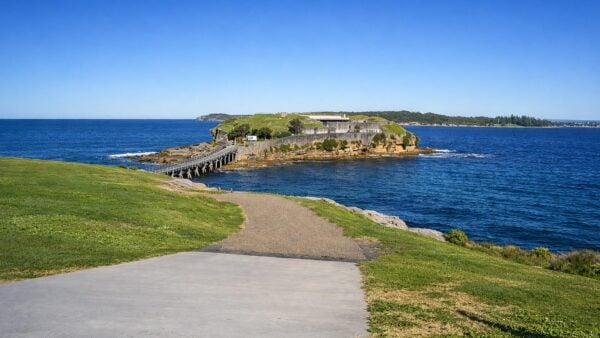
From the tower, the track heads gently downhill over grass towards the shoreline. Steps lead down to Anzac Parade again, where you will find seating at the top of the Bare Island Trail beside another park sign. This is a natural pause point before continuing downhill along the moderately steep driveway that leads towards Bare Island. The concrete gives way to asphalt as you approach the 100 metre timber bridge. The bridge is wide and sturdy, and the views back towards the headland and across Botany Bay are worth slowing down for.
At the far end of the bridge, a large metal gate marks the entrance to Bare Island Fort. The island is generally locked, but guided tours operate on Sunday afternoons. Built in 1885 to protect the colony’s water supply and defend against potential foreign invasion, the fort later served as a retirement home for veterans of the Crimea, Sudan and China campaigns. It closed in 1963 and eventually came under the care of the New South Wales National Parks and Wildlife Service as a museum and historic site. Tours involve many steps and are not wheelchair accessible. The surrounding waters are popular with scuba divers, and a steep set of timber steps near the gate leads down to a rock platform that is only safe to access at low tide and in calm seas.
After exploring the bridge and island entrance, retrace your steps to the main junction and turn left. A gravel track runs for about 80 metres with the road on your right and the water on your left, leading to a roadside car park. Cross the road and continue across the grass towards the large brick building that houses the La Perouse Museum.
The museum occupies the former cable station and contains an impressive collection of artefacts linked to the French expedition led by Jean François de Galaup, known as La Perouse. Inside, you will find relics from shipwrecks, historic maps and scientific instruments dating back to the sixteenth century. One of the highlights is a complete atlas of the Voyage of La Perouse, featuring seventy two coloured drawings and maps from the expedition between 1785 and 1788. The museum is open Thursday to Sunday from 10 am to 4 pm and is closed on Christmas Day. Access is via a steep staircase.
Nearby stands the tomb of Père Laurent Receveur, a priest and botanist who died in February 1788 from injuries sustained earlier in the voyage. His grave is recognised as the first known European burial site on Australian soil. A short distance away, near Cape Banks, a monument commemorates La Perouse himself. His ships, the Astrolabe and the Boussole, disappeared not long after leaving Australia, making Botany Bay the last confirmed point of contact with the expedition.
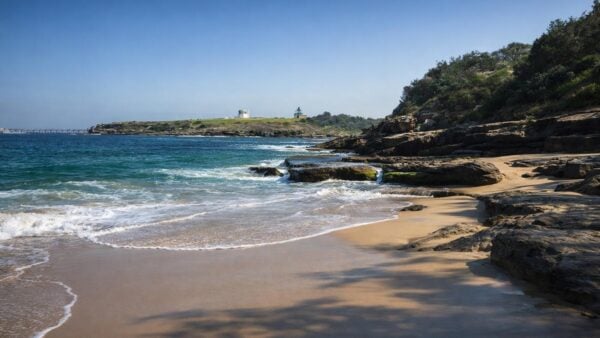
Frenchmans Bay Beach sits on the northern side of Botany Bay and offers a sheltered stretch of sand. There is a playground for children, electric barbecues and several nearby cafes and restaurants, making it an easy place to extend your visit. From the Boatshed Cafe, follow the footpath gently uphill for about 240 metres, passing Danny’s Seafood Restaurant and crossing sealed roads. This brings you back to the southern end of Cann Park and the Congwong Beach sign, completing the loop.
This short walk combines open coastal scenery with significant colonial and maritime history. It is an easy outing, but one that rewards anyone who takes the time to read the signs, visit the museum and look closely at the details that shaped this part of Sydney’s coastline.
Track grade
Grade 2 (Easy) -Â A Gentle Introduction to Inclines: Grade 2 on the AWTGS represents easy walking tracks that offer a slightly more challenging experience compared to Grade 1. Similar to Grade 1, no prior bushwalking experience is required. The track surface is typically hardened or compacted and may have gentle hill sections or occasional steps. The total distance of a Grade 2 walk is typically no greater than 10 kilometers. These walks are still suitable for families with a bit more experience or those seeking a gentle introduction to some inclines.
Walk map and GPX file
Max elevation: 16 m
Min elevation: 0 m
Total climbing: 22 m
Total descent: -22 m
GPX files, maps and content are copyright Trail Hiking Australia. Not to be copied, redistributed or uploaded to other platforms including AllTrails.
Explore safely
Planning this hike? Most incidents develop before you even start. Safe outcomes depend on how navigation, hydration, environment, load and judgement work together. Small oversights can compound quickly in Australian conditions. See how it happens in the Hiking Safety Systems Foundations. Then use the Hiking Safety Systems, planning calculators, and make sure a trusted contact has your trip plan before heading out.
Leave a trip plan
Before you go, complete a trip intentions form and share it with a trusted contact. Agree on a Late-Back Time and ask them to call 000 (Police) if you have not checked in. A clear trip plan is one of the simplest and most effective safety steps you can take.
Planning checklists
Download the hiking preparation and safety checklists before leaving home to help you think through your plans. They help ensure important considerations are not overlooked and support safer decision-making on the trail.
Getting there
Getting to the trailhead: Kamay Botany Bay National Park.
The La Perouse Historical Walk begins and ends at the southern end of Cann Park in La Perouse. If you are driving, head towards Anzac Parade and follow the signs into Cann Park. There is free parking available near the southern end of the park, making it a straightforward starting point. From the car park, it is just a short walk to the Congwong Beach sign where the track begins.
Need a rental car to get you to the hike? Find one here.
Accommodation nearby
Find accommodation close to the trailhead including hotels, cabins, and campgrounds. Use the interactive map to explore available options in nearby towns.
Nearby towns: Banksia, Bexley, Brighton-Le-Sands, Caringbah, Carlton, Cronulla, Hurstville, Kogarah, Kurnell, Kyeemagh, La Perouse, Mascot, Miranda, Ramsgate, Rockdale, Sans Souci, Sydney, Sylvania, Woolooware
About the region
Kamay Botany Bay National Park is located at La Perouse and Kurnell in southern Sydney. The park is known for its rich Aboriginal cultural heritage, historic European landing sites and diverse coastal landscapes. Visitors can walk through native bushland, explore the site of Captain Cook’s 1770 landing, or watch for migrating whales from Cape Solander during the cooler months.
Separated by the waters of Botany Bay, the park’s northern and southern headlands each offer a distinct mix of natural and cultural significance. At Kurnell, local Aboriginal people encountered the crew of the Endeavour in 1770, marking a pivotal moment in Australian history. Across the bay at La Perouse, the French explorer Comte de Lapérouse was last sighted in 1788 before his expedition disappeared at sea.
Beyond its historical importance, the park also provides sheltered coves and calm beaches that are well suited to swimming. The waters range from rocky reef systems near the entrance of Botany Bay to seagrass meadows within the bay itself, supporting a variety of marine life. Snorkelling and scuba diving are popular here, with options suitable for beginners through to more experienced divers.
Gallery
Got any photos from this hike? Your photos can help others plan. Share shots from along the trail so fellow hikers know what to expect.
Click to add your photos >>
Similar walks nearby
Looking for more walks in or near Kamay Botany Bay National Park? Try these trails with a similar difficulty grade.
Suggest an edit
Notice something different about this trail? Whether it’s a new feature, a route change, or a closure, share your update so we can keep our info accurate and helpful for fellow hikers.
Click to suggest edits >>
Acknowledgement of Country
Trail Hiking Australia acknowledges the Traditional Owners of the lands on which we hike and pay respects to their Elders, past and present, and we acknowledge the First Nations people of other communities who may be here today.