A Remote Coastal Circuit Along Victoria’s Southern Ocean
Julie and I hiked the Great South West Walk in January 2021. This guide brings together what we learned on the trail, along with the practical details required to plan the walk properly, including timing, logistics, costs, camping, water, navigation, fitness requirements, and safety considerations. It is intended as a planning reference rather than a day-by-day story, grounded in the realities of the track, from long sand sections to water reliability and the influence of the Southern Ocean.
1. Overview of the Trek
The Great South West Walk is a long-distance circular walking track located in the far southwestern corner of Victoria, Australia. Spanning approximately 250 to 262 kilometres depending on route variations, the trail forms a complete circuit beginning and ending in the historic port town of Portland.
The route traverses four distinct environments: tall eucalypt forests, the limestone gorge of the Glenelg River, extended sections of wild ocean beach, and the exposed volcanic capes of the Southern Ocean coastline. While the highest point is Mount Richmond at just 223 metres, the physical challenge comes from sustained daily distances and the cumulative fatigue of long beach sections on soft sand.
The walk was established in 1981 through a community initiative involving Portland High School staff and students and is now maintained by a dedicated volunteer organisation in partnership with land management authorities. Fourteen purpose-built hiker-only campsites support the route, allowing for multi-day travel through otherwise isolated landscapes.
Although the terrain is not mountainous, completing the full circuit typically takes 12 to 16 days and requires consistent endurance, weather awareness, and careful planning. The Great South West Walk rewards persistence with exceptional environmental variety rather than elevation or technical difficulty.
2. Key Facts at a Glance
| Feature | Data Point |
| Total Distance | 250 km to 262 km |
| Typical Duration | 12 to 14 days |
| Trail Type | Circular loop |
| Highest Elevation | 223 metres (Mount Richmond) |
| Total Elevation Gain | Approximately 4,191 metres |
| Difficulty Level | Grade 4 (moderate to hard) |
| Environment Sections | Forest, river, beach, capes, and bays |
| Campsites | 14 designated hike-in sites |
| Permits | Campsite bookings required via Parks Victoria and GSWW |
| Starting Point | Portland Maritime Discovery and Visitor Information Centre |
The grading of “Hard” is predominantly due to the cumulative physical load of the 250-kilometre distance and the specific challenges of the Discovery Bay beach sections, where walking on soft sand is required for several days.
3. Where the Trek Is and How to Get There
The Great South West Walk is located in the Barwon South West region of Victoria, bordering South Australia. Portland, the primary trailhead, is roughly 350 kilometres west of Melbourne and 540 kilometres east of Adelaide.
Public Transport Access
Reaching the trail via public transport is feasible from Melbourne using V/Line services. The standard route involves taking a train from Southern Cross Station to Warrnambool, which takes approximately 3 hours and 30 minutes. From Warrnambool, hikers transfer to a V/Line coach destined for Portland, adding another 1 hour and 30 minutes to the journey. Alternatively, a coach service runs via Ballarat and Hamilton, though this route typically takes longer, between 7 and 23 hours depending on connection times.
| Route Option | Mode | Duration (Approx) |
| Melbourne to Portland (via Warrnambool) | Train + coach | 5.5 to 6 hours |
| Melbourne to Portland (via Ballarat/Hamilton) | Coach | 7 to 23 hours |
| Adelaide to Portland | Regional coach | Varies |
Vehicle Access and Parking
For those driving, Portland is accessed via the Princes Highway. Long-term parking is a consideration for thru-hikers. It is not advisable to leave vehicles unattended at remote trackheads for the duration of the hike. Instead, hikers should register their vehicle at the Portland Visitor Information Centre, where safer parking options are often available.
Local Logistics
The town of Nelson, situated approximately halfway through the loop, serves as an alternative access point or a secondary trailhead. Local transport operators provide shuttle services for hikers needing car shuffles for shorter sections of the walk, particularly between Cape Bridgewater and Portland.
✈️ Find flights →
🚗 Compare car hire →
4. Best Time to Hike and Seasonal Conditions
The maritime climate of southwestern Victoria strongly influences conditions on the Great South West Walk. While the trail is open year-round, seasonal weather patterns have a significant impact on comfort, water availability, and overall safety.
Spring (September to November)
Spring is generally the best time for most hikers. Conditions are typically mild, with cool nights and comfortable daytime temperatures. This period offers the greatest chance to see the region’s diverse flora, including orchids and the floral emblem of Victoria, the pink heath. Water tanks at designated campsites are usually well replenished following winter rainfall, reducing the need for long water carries.
Autumn (March to May)
Autumn brings stable weather, lower humidity, and fewer insects, making it another favourable season for the walk. Daytime conditions are often comfortable, and sea temperatures can remain suitable for swimming in sheltered bays or the lower reaches of the Glenelg River. As the season progresses, however, campsite water tanks may begin to drop after the dry summer months, requiring closer attention to water planning.
Summer (December to February)
Summer conditions can be harsh and are not recommended for most walkers. Extended periods of heat, limited shade along coastal sections, and long distances between camps increase the risk of dehydration and heat-related illness. Total Fire Ban days are common, during which the use of any flame, including fuel stoves, is prohibited within the parks. Walking in forested sections during periods of high fire danger carries significant risk and should be avoided.
Winter (June to August)
Winter is the most challenging season on the Great South West Walk. Frequent cold fronts bring heavy rainfall, strong southwesterly winds, and prolonged wet conditions. Forest sections, particularly within Cobboboonee National Park, can become waterlogged, with the water table rising high enough to flood tracks and force diversions onto forest roads. Beach walking may also be difficult or unsafe, as high tides and storm surges can make sections of Discovery Bay impassable.
5. Track Conditions and Terrain
The Great South West Walk is defined by its transition through four unique environments. Each environment presents specific terrain challenges that hikers must prepare for physically.
The Forest Walk (Portland to Moleside)
The first 80 kilometres of the trail traverse the Cobboboonee and Lower Glenelg National Parks. The track here is largely flat and consists of compacted earth and forest litter. While generally even, hikers will encounter sections of four-wheel-drive tracks and gravel roads. In wetter months, these sections can become muddy, and fallen trees may require climbing over or navigating around.
The Glenelg River Gorge (Moleside to Nelson)
As the trail approaches the Glenelg River, the terrain becomes more rugged. Hikers walk along the rim of limestone gorges that rise up to 50 metres above the water. The path is often narrow and rocky, with uneven limestone surfaces that require careful foot placement. There are occasional steep descents and ascents where the trail moves from the clifftops down to the riverbank.
The Discovery Bay Beach Walk (Nelson to Swan Lake)
This 55-kilometre section is the most physically demanding. The terrain consists of open sandy beaches and high mobile sand dunes. Walking on soft, dry sand above the high-tide mark is exceptionally tiring. When the tide is low, harder compacted sand is available near the water’s edge, which facilitates faster movement.
The Capes and Bays (Swan Lake to Portland)
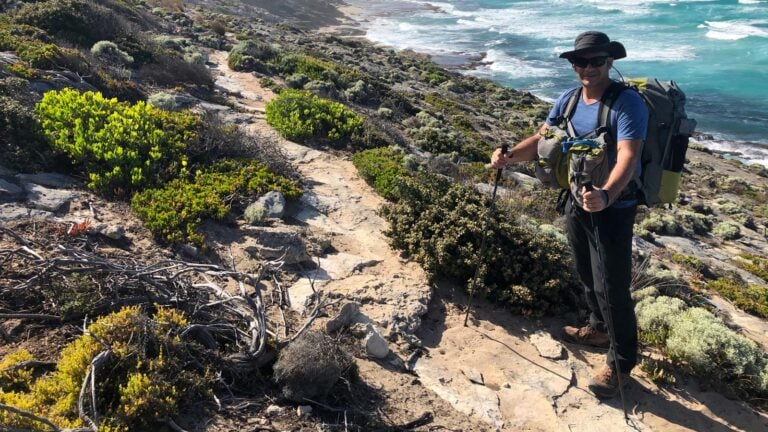
The final leg traverses the dramatic coastal features of Cape Bridgewater and Cape Nelson. The track follows clifftop paths over volcanic rock and calcified sediment. Highlights include the “Petrified Forest” and the “Enchanted Forest,” the latter involving a landslip area where twisting Moonah trees and vines create a dense canopy. The surface varies from grassy headlands to sharp, rocky sections near the blowholes.
6. Daily Distances and Typical Itinerary
A 14-day itinerary is the standard recommendation for a full circuit, allowing for a steady pace and a rest day in Nelson.
Week One: Forest and River
| Day | Route | Distance (km) | Terrain Type |
| 1 | Portland to Cubbys Camp | 20.2 km | Urban fringe and forest |
| 2 | Cubbys Camp to Cut-Out Camp | 15.0 km | Eucalypt forest |
| 3 | Cut-Out Camp to Fitzroy Camp | 22.9 km | Forest and river headwaters |
| 4 | Fitzroy Camp to Moleside Camp | 21.6 km | Forest and river banks |
| 5 | Moleside Camp to Battersbys Camp | 19.4 km | Limestone river gorge |
| 6 | Battersbys Camp to Pattersons Camp | 13.4 km | River cliffs |
| 7 | Pattersons Camp to Nelson | 20.9 km | River estuary and town |
Day 7 finishes in the township of Nelson, which provides an opportunity for a rest day to resupply and enjoy the local amenities such as the Nelson Hotel or roadhouse.
Week Two: Beach and Capes
| Day | Route | Distance (km) | Terrain Type |
| 8 | Nelson to Monibeong Camp | 22.6 km | Beach and dunes |
| 9 | Monibeong Camp to Swan Lake Camp | 17.0 km | Beach and freshwater lake |
| 10 | Swan Lake Camp to Tarragal Camp | 22.1 km | Mount Richmond and forest |
| 11 | Tarragal Camp to The Springs Camp | 12.6 km | Coastal heath and lakes |
| 12 | Springs Camp to Trewalla Camp | 17.1 km | High sea cliffs and capes |
| 13 | Trewalla Camp to Mallee Camp | 15.3 km | Clifftop and lighthouse |
| 14 | Mallee Camp to Portland | 22.2 km | Coastal cliffs and town |
On Day 10, hikers can choose to go over Mount Richmond, the highest point of the walk, or take a direct beach route to Springs Camp, which saves a day but bypasses the forest and cave views.
7. Navigation and Wayfinding
Navigation on the Great South West Walk is considered straightforward due to extensive and consistent marking.
Markings and Signage
The primary markers are red metal arrows attached to posts along the length of the track. In many sections, signs also feature the “GSWW” or “GGSW” acronym. At major intersections, particularly in the forest and river sections, larger signs provide distances to the next campsite or significant landmark.
Digital vs. Physical Navigation
While the track is well-signed, hikers are advised to carry physical maps, such as the 1:50,000 scale maps produced by Meridian Maps. These are vital for safety if markers are obscured by overgrowth or damaged by storms. Digital navigation through apps like VicEmergency is essential for monitoring fire risks, but GPS devices should be used as a secondary tool due to intermittent mobile reception in the Glenelg River gorge and deep forest areas.
Common Navigation Challenges
- Beach Exits: Finding the specific marker in the dunes to exit the beach for a campsite can be difficult, especially in poor visibility or after heavy storms have reshaped the foredunes.
- Overgrowth: Occasionally, sections between the beach and Lake Monibeong can become overgrown, making the track less obvious.
- Diversions: In cases of high water tables or bridge damage (such as the 2026 closure of Ralph’s Bridge south of Cut Out Camp), hikers must follow temporary diversion signs onto forest roads.
8. Accommodation Options
The walk is primarily a camping experience, though town-based options are available at key points.
Designated Hiker Campsites
There are 14 overnight hiker-only campsites spaced roughly a day’s walk apart. These sites are designed specifically for bushwalkers and are not accessible to vehicles or canoeists.
Each campsite provides:
- A three-walled timber shelter for cooking and gear storage.
- A communal table and seating.
- A pit toilet.
- A freshwater rainwater tank.
- A designated fire ring or wood barbecue (except for Mallee Camp, which is fuel-stove only).
Town-Based Accommodation
For those seeking more comfort, accommodation can be found in:
- Portland: Motels, hotels, and B&Bs (e.g., Admella Motel).
- Nelson: A wide range of options from caravan parks to B&Bs and the Nelson Hotel.
- Cape Bridgewater: Cabins and seaside accommodation near the Bridgewater Bay Cafe.
Advance bookings are essential for all town-based accommodation, particularly during peak holiday periods.
9. Food, Water, and Resupply
Successful completion of the loop requires meticulous planning of resupply and water treatment.
Water Availability and Treatment
Water is available from rainwater tanks at all 14 campsites. However, this water is untreated and must be considered unsafe to drink without processing. Contaminants from animal waste on roofs or microbial growth can lead to illnesses like gastroenteritis.
Treatment Methods:
- Boiling: The most effective method, requiring a rolling boil.
- Filtering: Using micro-filters (e.g., Sawyer Mini) to remove bacteria and protozoa.
- Chemical Treatment: Iodine or chlorine dioxide tablets are a lightweight backup.
Resupply Logistics
Portland is the most comprehensive resupply point with full supermarkets. Nelson, situated near the 130 km mark, provides the primary mid-hike resupply opportunity.
| Location | Resupply Options |
| Portland | Large supermarkets, outdoor stores, and specialty shops. |
| Nelson | Roadhouse for basic groceries, meals at the Nelson Hotel and kiosk. |
| Cape Bridgewater | Meals and snacks at the Bridgewater Bay Café; no full grocery range. |
Many thru-hikers choose to post a food parcel to themselves at the Nelson Post Office (VIC 3292) to avoid carrying 14 days of food from the start.
10. Permits, Fees, and Regulations
The Great South West Walk requires advanced administrative planning regarding campsite bookings.
Booking System
Campsite fees are mandatory for all 14 designated sites. The booking process is divided between two different entities:
- Parks Victoria: Manages 12 of the 14 sites. Bookings are made via the “ParksStay” website.
- Friends of the Great South West Walk: Manages Cubbys Camp and Tarragal Camp. These must be reserved by contacting the Friends’ liaison directly via phone or email.
Costs and Fees
As of mid-2025, the Victorian Government has a half-price camping initiative in place for many bookable campgrounds.
- Standard hiker-only campsite fees typically range from $14.00 to $17.30 per night per site depending on the specific location and time of week.
- Cancellation policies apply: 100% refund for cancellations 30+ days out, 50% for 8–29 days, and no refund if cancelled within 8 days of arrival.
Park Regulations
- Group Limits: A maximum of 20 walkers per campsite is enforced to preserve the wilderness character of the trail.
- Fuel Stoves: While fireplaces are provided at most sites, fuel stoves are preferred and often mandatory during high fire danger periods.
- Waste Management: Hikers must adhere to “Carry In, Carry Out” principles. No rubbish bins are available at campsites.
11. Safety Considerations and Risks
The Great South West Walk presents several environmental hazards that must be managed with preparation and alertness.
Coastal Hazards and Tides
The Discovery Bay section requires careful timing. High tides and heavy swells can make beach walking extremely difficult, forcing hikers into soft sand or potentially cutting off passage at rocky headlands.
- Tide Charts: Always check the Bureau of Meteorology tide charts for Portland before starting a beach section.
- Swimming: Swimming in Discovery Bay is not recommended due to powerful rip currents, unpredictable surf, and undertows.
Bushfire and Extreme Weather
The walk is located in the South West fire district.
- Total Fire Bans: During these periods, all fires are prohibited, and hikers are advised to leave the forest.
- Emergency App: Downloading the VicEmergency app is essential for real-time alerts.
- Exposure: The lack of shade on the beaches and capes increases the risk of heatstroke in summer and hypothermia in winter due to biting winds.
Wildlife Risks
- Snakes: Tiger snakes and Copperheads are common, particularly in the coastal heath and sunny forest clearings. Wear gaiters and carry a pressure-immobilization bandage.
- Ticks and Leeches: These can be encountered in the dense forest and damp river sections; regular checks and insect repellent are recommended.
12. Fitness and Experience Required
This trail is designed for hikers with a moderate to high level of fitness.
Physical Fitness
Thru-hiking the 250 km loop requires endurance rather than technical climbing ability. The primary challenge is the ability to maintain a pace of 15–25 km per day for two weeks while carrying a full backpack.
- Conditioning: Prospective hikers should train by walking on varied surfaces, including sand, to strengthen the ankles and calves.
Experience Level
The Great South West Walk is an excellent introduction to long-distance trekking for those who have previously completed multi-day hikes like the Great Ocean Walk.
- Self-Reliance: Because many sections are isolated, hikers must be confident in their ability to manage their own water, food, and basic first aid.
- First-Time Thru-Hikers: While the navigation is straightforward, the length of the circuit, extended beach walking, and exposure to weather mean the trail is best suited to hikers who already have experience with multi-day walks.
13. Gear and Packing Considerations
Packing for the GSWW requires a balance between lightweight efficiency and robust protection against the coastal elements.
Footwear and Sand Management
The choice of footwear is a major topic for GSWW hikers due to the 55 km of beach walking.
- Trail Runners: Many modern hikers prefer tight-weave trail runners over heavy boots for better flexibility on sand.
- Sand Gaiters: Lightweight Lycra or nylon gaiters (e.g., Dirty Girl gaiters) are essential to prevent sand from entering the shoe and causing abrasive blisters.
- Sock Strategy: Using toe-socks (e.g., Injinji) can help prevent sand friction between toes.
Climate-Driven Gear
- Sun Protection: Reflection from the white sand and water is intense. High-SPF sunscreen, a broad-brimmed hat with a chin strap (for wind), and quality sunglasses are mandatory.
- Windproofing: A high-quality waterproof and windproof jacket is necessary year-round to combat the persistent Southern Ocean breezes.
- Cooking: As firewood is scarce and fires are often banned, a reliable gas or liquid-fuel stove is required.
14. Guided vs. Independent Hiking
The Great South West Walk accommodates various hiking styles based on personal preference and experience.
Independent Thru-Hiking
The vast majority of hikers complete the trail independently, carrying all their own gear and camping at the 14 sites.
- Pros: Total flexibility of pace; lower cost; greater sense of self-reliance.
- Cons: Requires significant planning regarding permits, transport, and resupply.
Guided and Supported Hiking
Commercial operators provide several levels of support, from fully guided group treks to “pack-free” supported walks.
- Supported Walks: Operators transport your main luggage between accommodations, allowing you to walk with only a light day-pack.
- Guided Walks: These often include prepared meals, town-based accommodation in Nelson and Portland, and professional guides who handle all logistics.
- Who it suits: Ideal for hikers who want to experience the landscape without the physical strain of a heavy pack or the complexity of wilderness navigation.
🥾 Explore nearby experiences →
15. Environmental and Cultural Respect
The walk traverses the traditional lands of the Gunditjmara people, for whom this “Country” holds deep spiritual and historical significance.
Gunditjmara Cultural Heritage
The Gunditjmara have maintained a connection to this landscape for over 30,000 years.
- Cultural Names: The trail covers four distinct types of “Mirring” (Country): Woorowarook Mirring (Forest), Pareetj Mirring (Freshwater), Bocara (River Country), and Nyamat Mirring (Sea Country).
- Middens: Hikers will encounter Aboriginal middens, deposits of shells and bones that indicate ancient gathering places, particularly in the Discovery Bay dunes. These are sacred sites protected by law; hikers must stay on the defined track and never touch or disturb them.
- Aquaculture: The nearby Budj Bim Cultural Landscape (a UNESCO World Heritage site) showcases the Gunditjmara’s ancient engineering of eel traps and stone houses, reflecting a settled and sophisticated society.
Leave No Trace Principles
- Waste: Use the provided pit toilets at campsites. If you must go between camps, bury waste at least 15 cm deep and 100 m away from any water or tracks.
- Wildlife: Observe animals from a distance. Never feed kangaroos, emus, or birds, as this can make them aggressive toward future hikers.
- Plants: Do not pick wildflowers or disturb native vegetation; many species, like the Australasian gannet at Point Danger, are environmentally sensitive.
16. Is This Trek Right for You?
The Great South West Walk offers a unique experience compared to other Australian long-distance trails.
Who will enjoy it:
- Hikers looking for a logistically simple circuit that doesn’t require complex transport.
- Wildlife enthusiasts wanting to see koalas, emus, whales, and rare seabirds in their natural habitats.
- Those who appreciate coastal solitude and the sound of a wild ocean.
Who may find it challenging:
- Hikers who dislike walking on soft sand or flat terrain for extended periods.
- Individuals seeking the dramatic elevation changes and alpine views found in the Victorian High Country.
- Walkers who prefer the social atmosphere and hut-based systems of more popular tracks like the Overland Track.
Choosing to hike the Great South West Walk is a commitment to a slow, physically demanding circuit shaped by distance, sand, and weather rather than elevation. If you are comfortable with long days, self-sufficiency, and adapting plans to tides and coastal conditions, this guide will help you plan the walk realistically and manage the challenges involved.
Photo Gallery
/Guide%20to%20the%20Great%20South%20West%20Walk%20(5).jpg "Complete Guide to the Great South West Walk (Victoria)")
/Guide%20to%20the%20Great%20South%20West%20Walk%20(9).jpg "Complete Guide to the Great South West Walk (Victoria)")
/Guide%20to%20the%20Great%20South%20West%20Walk%20(10).jpg "Complete Guide to the Great South West Walk (Victoria)")
/Guide%20to%20the%20Great%20South%20West%20Walk%20(2).jpg "Complete Guide to the Great South West Walk (Victoria)")
/Guide%20to%20the%20Great%20South%20West%20Walk%20(14).jpg "Complete Guide to the Great South West Walk (Victoria)")
/Guide%20to%20the%20Great%20South%20West%20Walk%20(8).jpg "Complete Guide to the Great South West Walk (Victoria)")
/Guide%20to%20the%20Great%20South%20West%20Walk%20(13).jpg "Complete Guide to the Great South West Walk (Victoria)")
/Guide%20to%20the%20Great%20South%20West%20Walk%20(7).jpg "Complete Guide to the Great South West Walk (Victoria)")
/Guide%20to%20the%20Great%20South%20West%20Walk%20(3).jpg "Complete Guide to the Great South West Walk (Victoria)")
/Guide%20to%20the%20Great%20South%20West%20Walk%20(11).jpg "Complete Guide to the Great South West Walk (Victoria)")
/Guide%20to%20the%20Great%20South%20West%20Walk%20(1).jpg "Complete Guide to the Great South West Walk (Victoria)")
/Guide%20to%20the%20Great%20South%20West%20Walk%20(6).jpg "Complete Guide to the Great South West Walk (Victoria)")
/Guide%20to%20the%20Great%20South%20West%20Walk%20(4).jpg "Complete Guide to the Great South West Walk (Victoria)")
/Guide%20to%20the%20Great%20South%20West%20Walk%20(12).jpg "Complete Guide to the Great South West Walk (Victoria)")
Do you have any photos from this hike?
Your photos can help others plan. Share shots from along the trail so fellow hikers know what to expect.
Plan carefully, hike safely: These guides are for inspiration and general planning only. Trails can change, conditions vary, and you are responsible for your own decisions, preparation, and safety. Use judgement, maps, and the Hiking Safety Systems to help you prepare effectively.