Over the past decade, the language used to describe Australia’s national parks and protected landscapes has quietly shifted. Places once discussed primarily in terms of conservation, public access and natural value are increasingly framed as opportunities for premium tourism: private lodges, exclusive guided walks, high-end accommodation, curated adventure experiences.
Each proposal tends to arrive wrapped in reassuring language. It will be low impact, sustainable, world-class, nature positive. It will connect more people with the environment, support regional communities, encourage visitors to care about conservation. Some of that may be genuine. Tourism can help people build confidence outdoors, learn about a landscape, support businesses in nearby towns. Good guides can improve safety, deepen understanding, help visitors travel with greater care. But none of it answers the question that should come first: should permanent commercial development be placed inside a protected landscape at all?
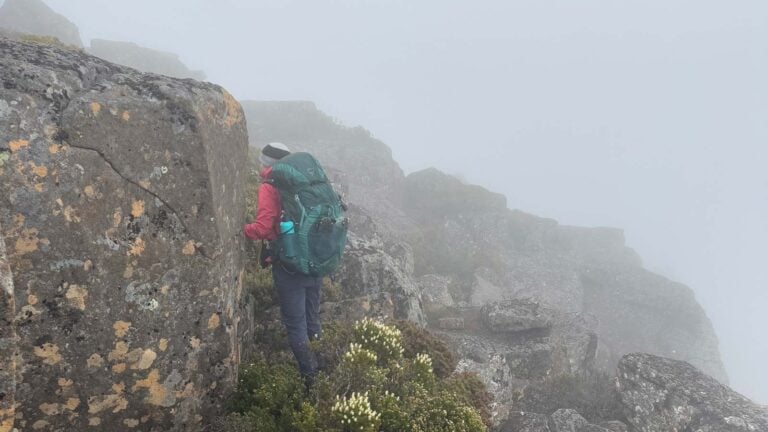
What makes wild places valuable is rarely comfort. It is preparation, effort, uncertainty, and the need to meet a landscape on its own terms. Weather changes plans. Tracks become difficult to follow. Campsites are basic and, at times, uncomfortable. The reward is not something provided as part of a package, it comes from being present somewhere that has not been arranged entirely around the visitor. That relationship matters, because wild landscapes remind people they are not the centre of everything. They ask for judgement, for accepting limits, for recognising that access brings responsibility, in a way a carefully managed visitor experience often cannot replicate. When every difficulty is softened, every viewpoint engineered and every stage of a journey serviced, the landscape may remain beautiful, but the relationship has changed. The visitor has stopped adapting to the place and started adapting the place to the visitor.
The concern here is not tourism itself. It is the point at which a protected landscape becomes the essential ingredient in a commercial product. A lodge inside a national park is not simply a building. It requires construction access, water, waste management, energy, supplies, maintenance, emergency arrangements, staff movements. A premium guided walk may depend on exclusive facilities, tightly managed itineraries, and enough paying customers to justify the investment behind it. Even where the immediate footprint looks limited, the development introduces permanence and sets a new expectation about what belongs in the landscape. Once the first building exists, the next proposal is assessed against an already altered setting. A supply track can become a service route. Helicopter access can become routine. Additional facilities get justified as necessary to support what has already been approved. None of these changes looks decisive on its own. Together, they can shift a place from wild and publicly shared to managed, marketed and consumed.
The effects of this shift are cultural as well as physical, and the cultural change is harder to measure than the area of vegetation cleared or the efficiency of a building. Infrastructure that once seemed exceptional can quickly become familiar. Serviced accommodation, hot showers, transported luggage, premium dining begin to be presented as ordinary ways of experiencing wilderness. Other parks are then judged against that new standard, and the absence of those services gets treated as a shortcoming rather than an intentional part of the place. This is how baselines shift. Each generation inherits a different understanding of what a national park normally contains. People may still see dramatic cliffs, ancient forests, alpine ridgelines, but they may never know the simpler, less managed experience that existed before commercial infrastructure was accepted as part of the landscape. What is lost is not only scenery or habitat. It is the chance to encounter nature without being treated primarily as a customer.
National parks are among the few landscapes held for everyone, including people who may never visit them. Their value is public, shared, and not dependent on a person’s ability to pay for an experience. When the most immersive opportunities inside a park become tied to costly packages, access starts to divide along financial lines. A commercial walk may be described as inclusive because it removes the need to carry equipment or plan independently, but an experience costing hundreds or thousands of dollars is not equitable public access. It is a luxury product available to those who can afford it. There is nothing inherently wrong with premium tourism. The issue is why it requires a national park setting, when accommodation, meals, guiding and transport can all be provided in gateway towns, on private land, or within existing tourism precincts. Commercial tourism and protected areas can coexist without occupying the same land.
One of the most common arguments for development is that it lets more people experience nature. That sounds reasonable, but it rests on the assumption that every remarkable landscape should be adapted to serve the widest possible range of visitor expectations. Australia already offers thousands of ways to connect with nature: accessible paths, short walks, family campgrounds, coastal trails, regional reserves, multi-day routes, and remote journeys requiring genuine experience and self-reliance. That diversity is worth protecting rather than replacing with a standard model of comfort and service. Some landscapes suit higher visitation and more substantial facilities. Others are fragile, remote, or valuable precisely because relatively little has been built within them. There is no need for every person to have every experience in every place. Providing appropriate access across a broad network is a different project from reshaping each landscape until it accommodates everyone the same way. Sometimes respecting a place means accepting that it will remain difficult, simple, or beyond reach.
Commercial proposals are usually supported by forecasts of visitor numbers, employment, regional spending and wider economic benefit, and these projections often become central to the argument that development serves the public interest. But no business case can know how people will behave over several decades. Demand shifts with weather, bushfires, economic conditions, changing travel habits, pricing, competition from other destinations. A development may succeed. It may also fail, change hands, or need further public support, and by the time the assumptions are tested, the infrastructure has already been built. If the business fails, the buildings, roads and other services do not necessarily disappear with it. They can sit unused or deteriorate while questions of ownership, leases and rehabilitation stay unresolved. The commercial life of a project may be brief, but the landscape can carry its physical legacy for generations. Viability is supporting information, not the foundation of the argument. A profitable lodge and an unprofitable one have something important in common: both permanently change the protected landscape they are placed in.
There is a habit of treating development as evidence of progress. Governments announce projects, tourism bodies promote new experiences, land managers are encouraged to show that parks deliver growing economic and social value. The decision not to build is far less visible. There is no opening ceremony for a valley left unchanged, no tourism campaign built around infrastructure that was deliberately refused. But restraint can be one of the most important decisions a government or land manager makes. It recognises that a protected landscape already has value and does not need to be made commercially productive to justify its existence. Publicly managed tracks, basic campsites, tent platforms, toilets, boardwalks and modest shelters can all have a legitimate role where they respond to real conservation, safety or visitor-management needs. The difference is in their purpose: they support the park rather than turning the park into a product. The revised Falls to Hotham Alpine Crossing is a useful example of this in practice. The earlier plan for commercial accommodation inside the Alpine National Park was replaced with a more restrained approach built around publicly managed camping infrastructure, supporting walkers and better protecting fragile alpine environments without embedding a private accommodation business in the park. That is not a failure of ambition. It is public stewardship leading by example.
The way a national park is managed teaches visitors what that place is for. A simple campsite says visitors are welcome but must adapt to the landscape. A boardwalk across fragile vegetation shows access being managed around conservation. A closure is a reminder that the needs of the place sometimes come before a visitor’s plans. Commercial accommodation communicates something else: that protected landscapes are suitable settings for comfort, exclusivity and private enterprise. Once that message becomes normal, the next development becomes easier to accept. This generation is not the final audience for these decisions. The parks known today will be inherited by people who had no voice in what was approved, built or normalised on their behalf, and there is no way to know whether they will want more development or wish for more restraint. The only way to preserve that choice for them is to avoid making unnecessary permanent decisions now.
I have spent much of my life walking through the Australian bush, and it has left me with a fairly settled view on this: humans are quick to believe that if something can be built, promoted or monetised, the opportunity should be taken, and slower to give the same weight to the decision to leave something alone. Protected landscapes are not there to be remade according to the preferences of one lifetime. They are inherited for a brief period, experienced, and passed on. Visitors are not owners. They are custodians. Knowing that means recognising when the desire for access, comfort or commercial return is asking more of a landscape than it should be expected to give, and understanding that nature does not become more valuable once it has been packaged for consumption. A place left largely unchanged is not an opportunity wasted. Sometimes it is the most generous inheritance available.
Once wilderness becomes something designed for consumption, it is no longer truly wild.
Trail Hiking Australia exists to help people find walks, prepare well and experience the outdoors safely, and that carries a responsibility to think about how information, promotion and rising visitation affect the landscapes being shared. The responsible access and stewardship position and the broader position on trail access and development set out that thinking in more detail, alongside the wider conservation philosophy at Keep It Wild Australia.
This essay is part of the Human Factors in Hiking series, exploring behaviour, awareness and decision-making on the trail. Explore the series →