Hike at a Glance
Max elevation: 1004m
Min elevation: 339m
Total Ascent: 1049m
Essential information
Please note that Mount William and the Major Mitchell Plateau are highly exposed areas where weather can change rapidly. In winter and during wet periods, hikers may encounter heavy rain, sleet and strong winds. Snow is possible between May and October. July is typically the coldest month, with average temperatures around 5°C and about 170 mm of rainfall. Walkers should be well prepared for these conditions and carefully reconsider crossing the plateau during poor weather.
Hike overview
Redman Bluff from Redman Road is a 16 kilometre, grade 4 return hike in Grampians National Park in western Victoria. The trailhead is located near Halls Gap, Victoria, about 260 kilometres west of Melbourne, and the hike typically takes between seven and eight hours to complete. This is a rewarding but demanding bushwalk that suits experienced walkers who are comfortable with long days on rugged terrain. The route is well known among hikers exploring the higher parts of the Grampians, offering a challenging journey through remote sections of the park.
The hike begins at the Redman Road Trailhead and climbs steadily through dense woodland before reaching more exposed terrain. As the track gains elevation the surroundings begin to open up, revealing sections of rocky ground and scattered moss beds that add texture to the landscape. One interesting feature along the route is a section of historic raised water fluming supported by dry stone pillars, a reminder of earlier efforts to manage water in the region. The climb continues toward Seven Dials, where the terrain becomes rockier and the views begin to expand.
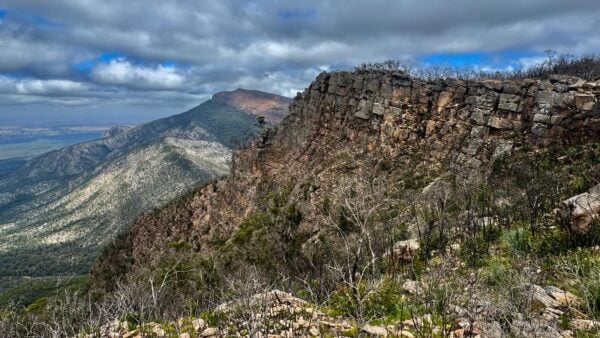
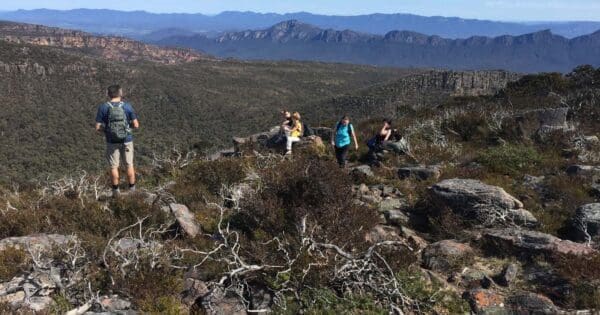
From Seven Dials the hike becomes more rugged as the route traverses a series of rocky outcrops before joining the ridgeline that leads to Redman Bluff. This section requires careful footing, particularly in wet conditions, but the effort is rewarded with increasingly impressive views across the surrounding ranges. The vegetation changes as well, with seasonal wildflowers adding bursts of colour during spring and early summer. These higher ridgelines are also known for their sweeping mountain scenery, making this one of the more memorable hikes in the park.
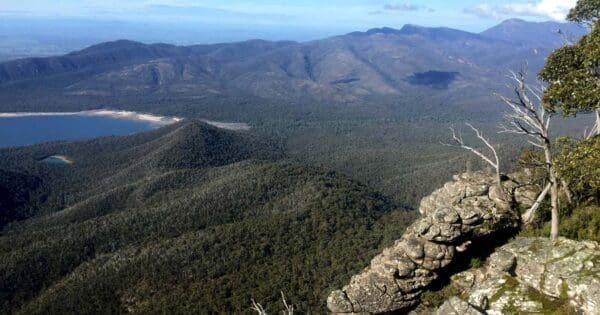
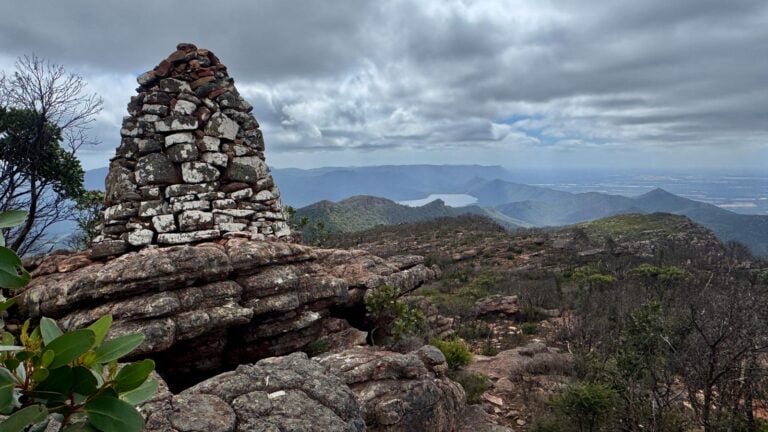
Redman Bluff rises to about 1017 metres and is marked by a historic rock cairn at the summit. From this vantage point the views stretch widely across the park. The Serra Range stands prominently to the west, while Mount Abrupt can be seen to the south and Mount Difficult to the north. Lake Bellfield and the township of Halls Gap are clearly visible below, and Mount William, the highest peak in the Grampians, often draws the eye on clear days. The summit area is an excellent place to rest and take in the surrounding terrain before beginning the return journey.
After spending time at the summit, retrace your route along the ridgeline, back past Seven Dials and through the woodland to return to Redman Road Trailhead. The return journey offers a second opportunity to appreciate the varied terrain and scenery along the track, and many hikers find that the shifting light across the ranges reveals new perspectives along the way.
This hike highlights why the Grampians is such a popular destination for walkers looking for rewarding bushwalks and longer hikes. With a mix of forest tracks, rocky ridgelines and expansive mountain views, Redman Bluff is a memorable addition to the many all trails available throughout the park.
Track grade
Grade 4 (Hard) - Challenging Walks for Experienced Walkers: Grade 4 on the AWTGS signifies challenging walking tracks. Bushwalking experience is recommended for these tracks, which may be long, rough, and very steep. Directional signage may be limited, requiring a good sense of navigation. These walks are suited for experienced walkers who are comfortable with steeper inclines, rougher terrain, and potentially longer distances.
Walk map and GPX file
Max elevation: 1004 m
Min elevation: 339 m
Total climbing: 1049 m
Total descent: -1049 m
GPX files, maps and content are copyright Trail Hiking Australia. Not to be copied, redistributed or uploaded to other platforms including AllTrails.
Explore safely
Planning this hike? Most incidents develop before you even start. Safe outcomes depend on how navigation, hydration, environment, load and judgement work together. Small oversights can compound quickly in Australian conditions. See how it happens in the Hiking Safety Systems Foundations. Then use the Hiking Safety Systems, planning calculators, and make sure a trusted contact has your trip plan before heading out.
Leave a trip plan
Before you go, complete a trip intentions form and share it with a trusted contact. Agree on a Late-Back Time and ask them to call 000 (Police) if you have not checked in. A clear trip plan is one of the simplest and most effective safety steps you can take.
Planning checklists
Download the hiking preparation and safety checklists before leaving home to help you think through your plans. They help ensure important considerations are not overlooked and support safer decision-making on the trail.
Getting there
Getting to the trailhead: Grampians National Park.
From the centre of Halls Gap, begin by heading south on Grampians Road (C216) toward Dunkeld. Follow this sealed road for about 6 kilometres as it winds along the eastern side of the Serra Range and passes Lake Bellfield. Shortly after passing the lake, turn right onto Redman Road. Redman Road is an unsealed park management road, so drive slowly and take care, especially after rain when conditions can become rough.
Continue along Redman Road for approximately 3 kilometres. The road passes through open forest and gradually climbs into the foothills of the range. Watch for the signed Redman Road Trailhead parking area on the side of the road. This small clearing serves as the starting point for the Redman Bluff hike via Seven Dials. From Halls Gap the total driving distance to the trailhead is roughly 12 kilometres and usually takes around 15 minutes, depending on road conditions.
Need a rental car to get you to the hike? Find one here.
Accommodation nearby
Find accommodation close to the trailhead including hotels, cabins, and campgrounds. Use the interactive map to explore available options in nearby towns.
Nearby towns: Ararat, Cavendish, Dadswells Bridge, Dunkeld, Halls Gap, Horsham, Landsborough, Pomonal, Stawell, Warracknabeal
About the region
Grampians National Park, traditionally known as Gariwerd, forms part of an important Aboriginal cultural landscape in western Victoria. The park sits near the town of Halls Gap in Victoria, about 260 kilometres west of Melbourne, and is one of the most recognisable national parks in Australia. For many visitors, the best way to experience the park is on foot, following the network of well-known walks, bushwalks and longer hikes that wind through its rugged ranges and valleys. Scenic drives offer a good introduction, but stepping onto the trail allows you to properly appreciate the scale and character of the landscape.
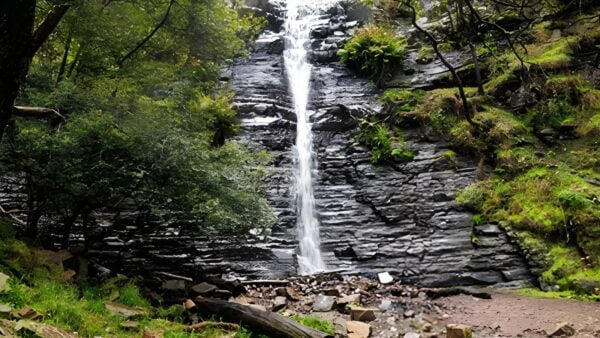
Walking through the Grampians reveals an ever-changing environment. Tracks lead to waterfalls that flow strongly after rain, across rocky ridgelines, and through forest that bursts into colour during the spring wildflower season. Along the way it is common to see kangaroos grazing in open clearings, wallabies moving quietly through the bush, or emus striding across grassy flats. Birdlife is also abundant, and many people find that slowing their pace on walks helps them notice far more than they would from a vehicle.
The area holds deep cultural significance for the Traditional Owners and contains the largest concentration of Aboriginal rock art sites in southern Australia. These ancient shelters and paintings provide an important connection to the long human history of the region. Visitors interested in learning more can start their visit at Brambuk – The National Park and Cultural Centre near Halls Gap. The centre provides cultural information and context that adds meaning to many of the nearby bushwalks and hikes.
Today the Grampians attracts walkers from across Australia and overseas, drawn by its wide range of all trails suitable for different levels of experience. Short walks around Halls Gap and the Wonderland Range provide accessible ways to explore the area, while more demanding hikes lead to some of the park’s most recognised viewpoints. The climb to The Pinnacle is particularly popular, offering expansive views across the ranges, although the steep sections mean it is best suited to reasonably fit walkers.
For those seeking a longer challenge, the park also supports multi-day hikes that reward careful planning and preparation. The Grampians Peaks Trail has become one of Australia’s most talked about long-distance hikes, linking dramatic sections of the range across several days of walking. Experienced bushwalkers may also consider overnight routes such as Major Mitchell Plateau or the hike through The Fortress and Mount Thackeray area, where quieter trails allow walkers to spend more time exploring remote parts of the park.
Whether you are planning a relaxed walk, a challenging bushwalk, or a multi-day hike, the Grampians offers an impressive range of trails that highlight the character of this remarkable part of Victoria. With careful planning and the right level of preparation, visitors can experience some of the most rewarding walks and hikes in the state.
Similar walks nearby
Looking for more walks in or near Grampians National Park? Try these trails with a similar difficulty grade.
Gallery
Got any photos from this hike? Your photos can help others plan. Share shots from along the trail so fellow hikers know what to expect.
Click to add your photos >>
Suggest an edit
Notice something different about this trail? Whether it’s a new feature, a route change, or a closure, share your update so we can keep our info accurate and helpful for fellow hikers.
Click to suggest edits >>
Acknowledgement of Country
Trail Hiking Australia acknowledges the Traditional Owners of the lands on which we hike and pay respects to their Elders, past and present, and we acknowledge the First Nations people of other communities who may be here today.