Hike at a Glance
Max elevation: 950m
Min elevation: 240m
Total Ascent: 862m
Essential information
Accessing Mount Ernest via the northeastern ridge from Yellow Pinch requires crossing private property. It's crucial to obtain permission from the landowner to ensure you have the necessary authorisation before proceeding with this hike.
Hike overview
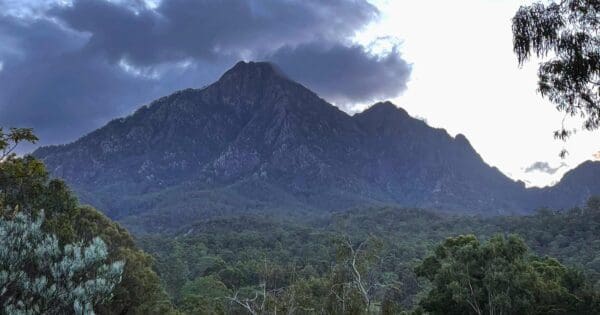
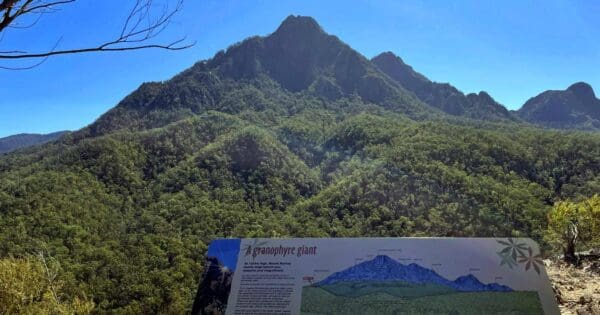
Mount Ernest, located on the northern side of Mount Lindesay Highway, provides spectacular views of Mount Barney to the north. Though much lower than the main peaks of Mount Barney, the routes to the summit of Mount Ernest are equally challenging and less frequently trodden. The hike offers stunning views of Mount Barney and Mount Lindesay from the ridgeline and requires navigating through unmarked and steep sections with loose rocks and scree.
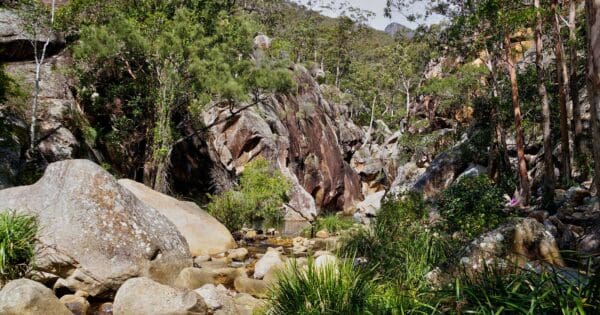
The initial section follows a creek with some rock hopping. The first ascent is very steep and loose, requiring caution due to falling rocks. The boulder scrambling section, though challenging, is enjoyable. Hikers will encounter multiple false peaks before reaching the summit, with scenic views of Mount Barney and Mount Lindesay from the first peak onward.
The ascent and descent pose safety hazards due to loose scree and falling rocks. Proper footwear and a good level of fitness are essential. This hike is not suitable for inexperienced hikers due to its challenging nature and steep sections.
The route starts on the fire road to the southern Mount Barney routes before branching off and crossing the Logan River three times. The northeastern ridge begins as a grassy slope, quickly leading to steep bands of rock. Several feasible routes exist, but all require caution. The ridge ascends several false summits, with generally straightforward scrambling, except for an unavoidable exposed downclimb with plenty of holds available. Navigational aids are advisable, as a faint track only exists in places. Staying close to the ridge is crucial.
A small rock cairn marks the summit, where a rocky platform provides a great spot to enjoy views of Mount Barney. Views of Mount Lindesay are limited to the earlier sections of the ridge, as vegetation obscures it at the summit. This hike is only for very experienced hikers who know how to read a map. Inexperienced hikers should not attempt this route. It is important to avoid trespassing on private land and to check with National Parks authorities if unsure.
The hike to Mount Ernest is demanding, with no trail to the summit. Navigational skills and fitness are essential. Approximately 70 percent of the hike involves bush bashing, with the remainder requiring rock scrambling or hiking up very steep ridges on loose rock and scree. The strenuous hike spans 12 kilometres with an elevation of 964 metres, taking between 8 to 10 hours for a return trip.
Track grade
Grade 5 (Difficult) - Walks for the Most Experienced: Grade 5 represents the most challenging walking tracks on the AWTGS. These are only recommended for very experienced and fit walkers with specialised skills, including navigation and emergency first aid. Tracks are likely to be very rough, very steep, and unmarked. Walks may be more than 20 kilometers. These challenging walks demand a high level of fitness and experience to navigate difficult terrain, significant elevation changes, and potentially unformed paths.
Walk map and GPX file
Max elevation: 950 m
Min elevation: 240 m
Total climbing: 862 m
Total descent: -863 m
GPX files, maps and content are copyright Trail Hiking Australia. Not to be copied, redistributed or uploaded to other platforms including AllTrails.
Explore safely
Planning this hike? Most incidents develop before you even start. Safe outcomes depend on how navigation, hydration, environment, load and judgement work together. Small oversights can compound quickly in Australian conditions. See how it happens in the Hiking Safety Systems Foundations. Then use the Hiking Safety Systems, planning calculators, and make sure a trusted contact has your trip plan before heading out.
Leave a trip plan
Before you go, complete a trip intentions form and share it with a trusted contact. Agree on a Late-Back Time and ask them to call 000 (Police) if you have not checked in. A clear trip plan is one of the simplest and most effective safety steps you can take.
Planning checklists
Download the hiking preparation and safety checklists before leaving home to help you think through your plans. They help ensure important considerations are not overlooked and support safer decision-making on the trail.
Getting there
Getting to the trailhead: Mount Barney National Park.
To reach the Mount Barney trailhead at Yellow Pinch Car Park, navigate to Upper Logan Road using your preferred mapping app. This scenic route is accessible by conventional vehicles. From either direction on the Mount Lindesay Highway, turn onto Barney View Road near Palen Creek. After following Barney View Road for a short while, take a left turn onto Upper Logan Road. Continue for approximately 25 minutes, passing Barney View and Mount Barney Lodge along the way. You’ll arrive at the Yellow Pinch Car Park on your left-hand side. Park your car and look for signage to direct you towards your chosen walking track.
Need a rental car to get you to the hike? Find one here.
Accommodation nearby
Find accommodation close to the trailhead including hotels, cabins, and campgrounds. Use the interactive map to explore available options in nearby towns.
Nearby towns: Barney View, Beaudesert, Boona, Boonah, Canungra, Harrisville, Kalbar, Mount Barney, Rathdowney, Wonglepong
About the region
Mount Barney National Park, a World Heritage Site encompassed by the Gondwana Rainforests of Australia, boasts a dramatic landscape. Roughly 120km southwest of Brisbane along the Mount Lindesay Highway, the park is dominated by the rugged peaks of Mounts Barney, Maroon, May, Lindesay, Ernest, Ballow and Clunie. These peaks are remnants of the ancient Focal Peak Shield Volcano, which erupted a staggering 24 million years ago. Notably, Mount Barney holds the title of second-highest peak in Southeast Queensland.
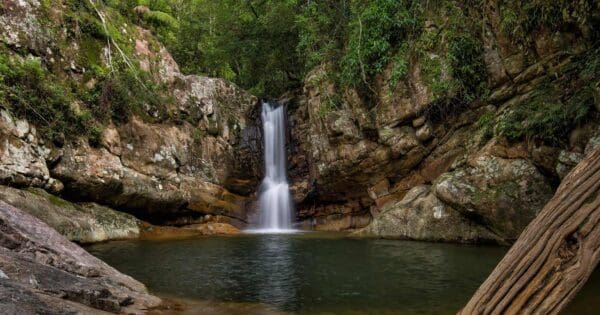
Within the park's boundaries lie cascading creeks and pristine rainforests that provide sanctuary for a wealth of rare plants and vulnerable animals. Visitors seeking a relaxed experience can explore the Yellow Pinch picnic area, where kingfishers flit above the water's surface. For seasoned hikers, the opportunity awaits to ascend the park's sheer peaks and be rewarded with awe-inspiring views of craggy ridges and distant ranges. Less adventurous visitors can enjoy several moderate walking tracks that weave around the base of the mountains.
The park's diverse vegetation ranges from open forests at the foothills to subtropical rainforests above 600 metres and montane heath shrublands closer to the summits. Interestingly, the summit of Mount Ballow features cool temperate rainforest, while Mount Maroon boasts mallee eucalypt shrublands.
A botanical haven, the park offers refuge to numerous rare and unusual plant species. Among these are the endangered Mount Maroon wattle (Acacia saxicola), the near-threatened bell-fruited mallee (Eucalyptus codonocarpa), the vulnerable bush pea (Pultenaea whiteana), and the Hillgrove gum (Eucalyptus michaeliana).
Encompassing a significant portion of the Gondwana Rainforests of Australia World Heritage Area, Mount Barney National Park provides a network of four established and graded walking tracks. These tracks offer the chance to appreciate the park's beauty, including its cascading creeks and pockets of subtropical rainforest, without requiring an ascent of the mountains. All four tracks are classified as grade 4, so choose the one that best suits your group's fitness level. Remember to avoid hiking during the hottest part of the day.
Similar walks nearby
Looking for more walks in or near Mount Barney National Park? Try these trails with a similar difficulty grade.
Gallery
Got any photos from this hike? Your photos can help others plan. Share shots from along the trail so fellow hikers know what to expect.
Click to add your photos >>
Suggest an edit
Notice something different about this trail? Whether it’s a new feature, a route change, or a closure, share your update so we can keep our info accurate and helpful for fellow hikers.
Click to suggest edits >>
Acknowledgement of Country
Trail Hiking Australia acknowledges the Traditional Owners of the lands on which we hike and pay respects to their Elders, past and present, and we acknowledge the First Nations people of other communities who may be here today.