Hike at a Glance
Max elevation: 36m
Min elevation: 3m
Total Ascent: 61m
Hike overview
Cape Banks Walk combines sweeping coastal scenery with layers of history that quietly reveal themselves as you move along the headland. It is not a long walk at just 3 kilometres, but it feels rich and varied, with plenty to pause for along the way. Allow around 1.5 hours, more if you enjoy exploring side tracks and lingering at the cliff tops. Graded 4, the track includes uneven and steep sections, so sturdy footwear and a steady approach are important.
From the Cemetery Trail trackhead and dirt car park on Cape Banks Road at La Perouse, about 1 kilometre past the NSW Golf Course main gate, the walk begins by skirting a locked gate and following a management trail. The grassy path quickly crosses a short cobbled stone section before continuing along a mostly level stretch to a large three way intersection near the Coast Hospital Cemetery.
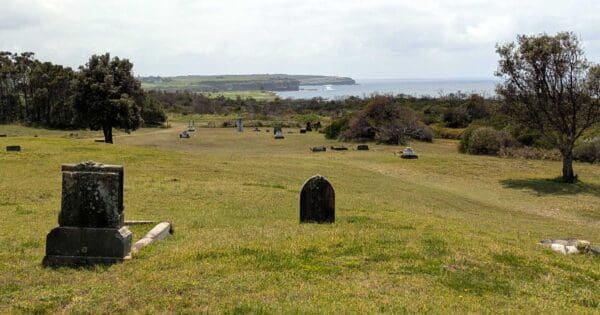
A short detour to the cemetery is well worth your time. Established in the early 1880s to serve the Coast Hospital, later known as Prince Henry Hospital, this quiet ground holds up to 2000 graves. The hospital was originally built as a smallpox quarantine facility, far enough from Sydney to isolate infectious diseases. Over time it treated influenza, bubonic plague, typhoid and leprosy. Many graves are unmarked and some headstones are worn and difficult to read, a reminder of how easily stories can fade. On the eastern edge, an information sign explains that ancestral remains of La Perouse Aboriginal people, once held in museums, have been returned and laid to rest here. It is a place that invites reflection and respect.
Back on the main route, the trail follows the road gently uphill, offering views back towards the cemetery, before descending to a locked gate marked with a Botany Bay National Park sign. If starting instead from the southern end of Cape Banks Road, the path passes the Westpac helicopter shed and a concrete building before reaching an intersection marked by an NPWS arrow post. Close by stands a World War II bunker, solid and weathered, a reminder that this dramatic headland once played a defensive role during uncertain times.
Beyond the bunker, the management trail heads away from the buildings and climbs briefly before descending towards the sea. The ocean soon comes into view on your left as the grassy track drops down a series of steep and rough sections. These parts require care, especially in wet conditions, as the surface can be uneven and eroded. The trail flattens near a striking cleft in the sea cliffs, then continues downhill towards the golf course and the water, eventually meeting a concrete footpath marked by Cape Banks Aquatic Reserve signs. Keep an eye out for stray golf balls in this section.
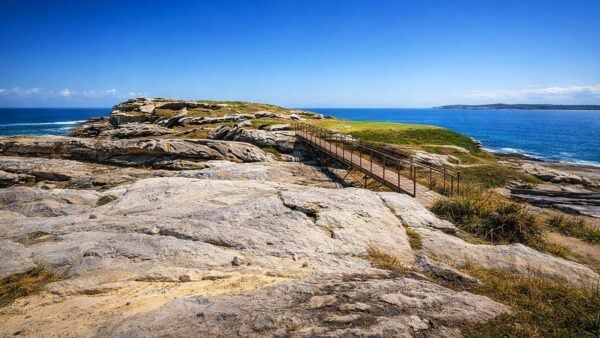
A short metal footbridge leads across to the rocky headland itself. From here, Cape Banks opens up in all directions. Unfenced sandstone cliffs meet the restless ocean, and waves surge and explode against the rock platforms below. Looking back into Botany Bay, the water appears calmer, dotted with boats moving in and out of the sheltered harbour. At low tide, the remains of the SS Minmi can be seen on the western side of the cape, resting among the rocks. Scattered concrete foundations hint at former military structures, blending into the landscape as if slowly being reclaimed.
During whale migration season, this is one of the better vantage points in the park. Humpback and Southern Right whales sometimes pass close to shore, spouting and occasionally breaching as they travel north or south. Even without whales, the headland has a wild, exposed feel that makes it easy to stand still and simply watch the shifting light and sea.
Cape Banks Walk may be short, but it carries a strong sense of place. Between its historic cemetery, wartime relics, shipwreck remains and dramatic coastline, it offers a thoughtful and engaging coastal experience that rewards those willing to slow down and look closely.
Track grade
Grade 4 (Hard) - Challenging Walks for Experienced Walkers: Grade 4 on the AWTGS signifies challenging walking tracks. Bushwalking experience is recommended for these tracks, which may be long, rough, and very steep. Directional signage may be limited, requiring a good sense of navigation. These walks are suited for experienced walkers who are comfortable with steeper inclines, rougher terrain, and potentially longer distances.
Walk map and GPX file
Max elevation: 36 m
Min elevation: 3 m
Total climbing: 61 m
Total descent: -61 m
GPX files, maps and content are copyright Trail Hiking Australia. Not to be copied, redistributed or uploaded to other platforms including AllTrails.
Explore safely
Planning this hike? Most incidents develop before you even start. Safe outcomes depend on how navigation, hydration, environment, load and judgement work together. Small oversights can compound quickly in Australian conditions. See how it happens in the Hiking Safety Systems Foundations. Then use the Hiking Safety Systems, planning calculators, and make sure a trusted contact has your trip plan before heading out.
Leave a trip plan
Before you go, complete a trip intentions form and share it with a trusted contact. Agree on a Late-Back Time and ask them to call 000 (Police) if you have not checked in. A clear trip plan is one of the simplest and most effective safety steps you can take.
Planning checklists
Download the hiking preparation and safety checklists before leaving home to help you think through your plans. They help ensure important considerations are not overlooked and support safer decision-making on the trail.
Getting there
Getting to the trailhead: Kamay Botany Bay National Park.
The Cape Banks Walk starts and finishes at the intersection of Pistol Club Road and the Coastal Cemetery Management Trail in La Perouse, within Kamay Botany Bay National Park.
By car, follow Anzac Parade south through Maroubra towards La Perouse. Continue along Anzac Parade until you reach the La Perouse area, then turn onto Pistol Club Road. Drive to the end of Pistol Club Road where it meets the Coastal Cemetery Management Trail. There is limited roadside parking available near the intersection, so arrive early on weekends and during whale season.
If travelling by public transport, buses run regularly along Anzac Parade to La Perouse. From the nearest stop, it is a short walk along local roads to reach Pistol Club Road and the trailhead intersection.
Need a rental car to get you to the hike? Find one here.
Accommodation nearby
Find accommodation close to the trailhead including hotels, cabins, and campgrounds. Use the interactive map to explore available options in nearby towns.
Nearby towns: Banksia, Bexley, Brighton-Le-Sands, Caringbah, Carlton, Cronulla, Hurstville, Kogarah, Kurnell, Kyeemagh, La Perouse, Mascot, Miranda, Ramsgate, Rockdale, Sans Souci, Sydney, Sylvania, Woolooware
About the region
Kamay Botany Bay National Park is located at La Perouse and Kurnell in Sydney. Discover its rich Aboriginal culture, explore Captain Cook's Landing Place, spot native plants on a bushwalk or whales at Cape Solander.
Filled with significant sites, coastal landscapes and heritage-listed attractions, Kamay Botany Bay National Park is an easy day out in Sydney's south. Separated by the marine-rich waters of historic Botany Bay, the park's northern and southern headlands feature a unique combination of natural and cultural heritage.
Explore the southern area around Kurnell where in 1770, local Aboriginal people encountered the crew of the Endeavour. The northern area at La Perouse is just as fascinating, where French explorer Comte de Laperouse was last sighted in 1788.
This park is also blessed with several sheltered coves and beaches, if you like swimming in salt water without fighting the surf. Its diverse waters offer plenty of beautiful snorkelling and scuba diving spots suitable for all levels of experience. You'll find rocky reefs at the entrance of Botany Bay, and underwater sea grass meadows inside the bay itself.
Similar walks nearby
Looking for more walks in or near Kamay Botany Bay National Park? Try these trails with a similar difficulty grade.
Gallery
Got any photos from this hike? Your photos can help others plan. Share shots from along the trail so fellow hikers know what to expect.
Click to add your photos >>
Suggest an edit
Notice something different about this trail? Whether it’s a new feature, a route change, or a closure, share your update so we can keep our info accurate and helpful for fellow hikers.
Click to suggest edits >>
Acknowledgement of Country
Trail Hiking Australia acknowledges the Traditional Owners of the lands on which we hike and pay respects to their Elders, past and present, and we acknowledge the First Nations people of other communities who may be here today.