Hike at a Glance
Max elevation: 42m
Min elevation: 9m
Total Ascent: 166m
Hike overview
This walk begins at the Botany Bay Visitor Centre at Kurnell and heads south into Kamay Botany Bay National Park. The centre itself is worth a few minutes of your time. It provides a clear overview of the area’s cultural and environmental history, along with basic food and drink, a souvenir shop, accessible toilets and a large parking area. A TrailRider is available for free hire for visitors with limited mobility, which makes this part of the park more inclusive than many coastal reserves.
From the main exit of the Discovery Centre car park, the route leaves along an old service trail rather than the Banks Solander Track. It crosses a small bridge before reaching Cape Solander Drive, where another service trail continues on the opposite side of the road. A short stretch along the management trail leads to a sandy track on the left, and from there the walk begins to feel more like a bush track than a service road.
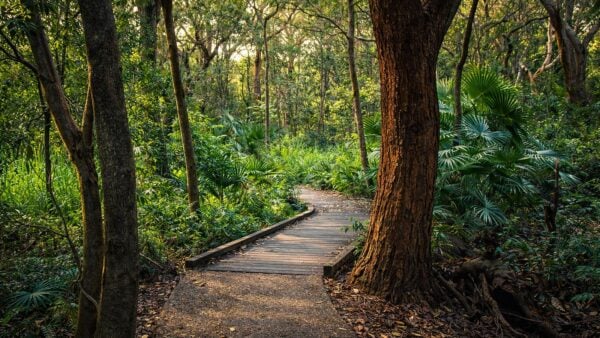
The early section moves through dry gum forest before opening into low heath. There are a few gentle rises and dips as you pass Kurnell Lookout, though views here are mostly filtered by trees. Soon after, the track links with wider management trails near the radar tower and water tank. This part can be very sandy underfoot, so allow a little extra time and energy, particularly on warm days.
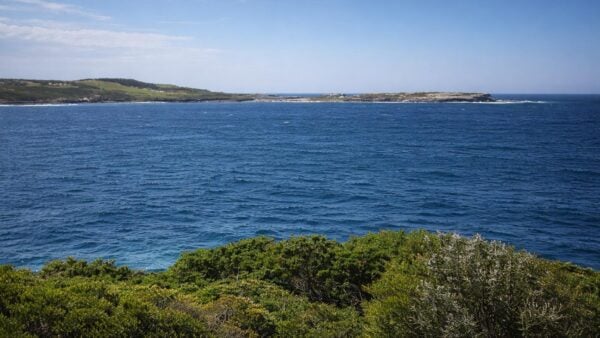
As the walk continues south, it narrows again into a sandy bush track and eventually reaches exposed rock shelf. The ocean sits off to your left, sometimes hidden behind scrub, sometimes revealing glimpses of deep blue water and white wash against the cliffs. The rock platform is marked by wind and water erosion, with small hollows worn into the surface over time. It is a striking landscape and a reminder of how exposed this coastline can be during strong southerlies.
At Tabbigai Gap, the route swings inland briefly, climbing through sand dunes and low, dense scrub. This is where the character of the walk really shifts. The dunes rise and fall in soft ridges, and between them sit a series of hanging swamps. These freshwater wetlands form where rainfall seeps through surrounding ground and collects in shallow depressions. From a distance they can be hard to detect, as thick reeds and vegetation often conceal the water. Up close, you may notice frogs calling after rain and a surprising diversity of plant life thriving in what appears to be an otherwise dry landscape.
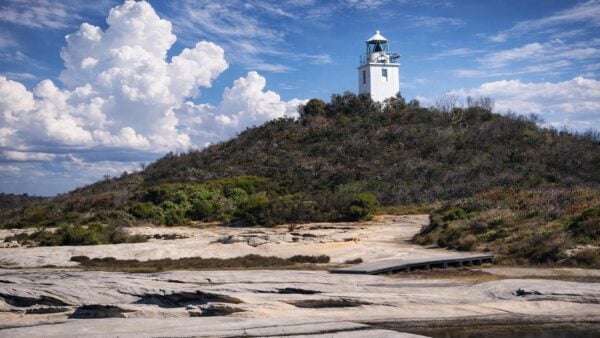
A side trip to Cape Baily Lighthouse is well worth the detour. The track becomes slightly overgrown near the end, though the lighthouse itself is visible as you approach. Built in 1950, it was positioned so northbound ships could safely follow the coast and avoid stronger currents further offshore. While coastal views from the lighthouse are partly screened by scrub, the inland outlook provides a different perspective across the dunes and heath.
Back on the main track, the route continues south along the coastline, gradually descending through tall heath to an open rock platform. The ocean remains on your left as the management trail winds across grassy slopes and skirts the edge of the scrub. Eventually, the defined trail fades and the walk follows the coastline more loosely, crossing the mouths of sand dunes before curving up towards the Sir Joseph Banks Drive car park.
At 6.5 kilometres one way, this grade 4 hike typically takes around three hours, depending on how often you stop to take in the landscape. It is not technically difficult, but the sandy sections, exposure to wind and limited shade can make it more demanding than the distance suggests. Carry adequate water, wear sun protection and be mindful of changing coastal weather. For those who enjoy a mix of heathland, dune systems, rock platforms and open ocean views, this stretch of the Cape Baily track offers a varied and distinctly Australian coastal experience.
The Cape Baily track can be walked in either direction, so you can choose the start point that best suits your transport plans.
Track grade
Grade 4 (Hard) - Challenging Walks for Experienced Walkers: Grade 4 on the AWTGS signifies challenging walking tracks. Bushwalking experience is recommended for these tracks, which may be long, rough, and very steep. Directional signage may be limited, requiring a good sense of navigation. These walks are suited for experienced walkers who are comfortable with steeper inclines, rougher terrain, and potentially longer distances.
Walk map and GPX file
Max elevation: 42 m
Min elevation: 9 m
Total climbing: 166 m
Total descent: -177 m
GPX files, maps and content are copyright Trail Hiking Australia. Not to be copied, redistributed or uploaded to other platforms including AllTrails.
Explore safely
Planning this hike? Most incidents develop before you even start. Safe outcomes depend on how navigation, hydration, environment, load and judgement work together. Small oversights can compound quickly in Australian conditions. See how it happens in the Hiking Safety Systems Foundations. Then use the Hiking Safety Systems, planning calculators, and make sure a trusted contact has your trip plan before heading out.
Leave a trip plan
Before you go, complete a trip intentions form and share it with a trusted contact. Agree on a Late-Back Time and ask them to call 000 (Police) if you have not checked in. A clear trip plan is one of the simplest and most effective safety steps you can take.
Planning checklists
Download the hiking preparation and safety checklists before leaving home to help you think through your plans. They help ensure important considerations are not overlooked and support safer decision-making on the trail.
Getting there
Getting to the trailhead: Kamay Botany Bay National Park.
The Cape Baily track can be walked in either direction, so you can choose the start point that best suits your transport plans.
Most walkers begin at the Botany Bay Visitor Centre car park within Kamay Botany Bay National Park at Kurnell. This is the more developed trailhead, with parking, toilets and information available on site. Parking fees apply in this section of the park, so allow for that when planning your visit.
If you prefer to start at the southern end, the walk finishes at the Sir Joseph Banks Drive car park at Boat Harbour Reserve. This car park offers free parking and is located at approximately
As there is no direct public transport linking the two ends of the track, most hikers use a car shuffle if walking one way, or complete the route as an out and back. Before heading out, it is worth checking current access conditions and parking details for both car parks so your day runs smoothly.
Need a rental car to get you to the hike? Find one here.
Accommodation nearby
Find accommodation close to the trailhead including hotels, cabins, and campgrounds. Use the interactive map to explore available options in nearby towns.
Nearby towns: Banksia, Bexley, Brighton-Le-Sands, Caringbah, Carlton, Cronulla, Hurstville, Kogarah, Kurnell, Kyeemagh, La Perouse, Mascot, Miranda, Ramsgate, Rockdale, Sans Souci, Sydney, Sylvania, Woolooware
About the region
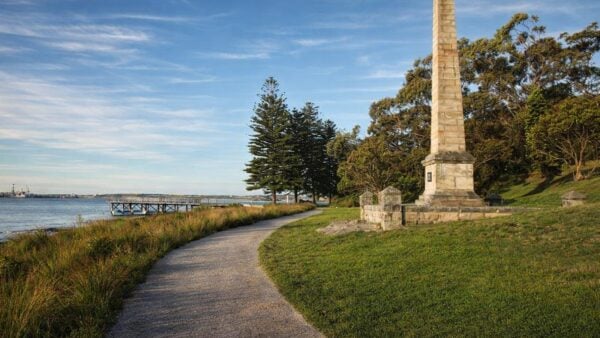
Kamay Botany Bay National Park is located at La Perouse and Kurnell in southern Sydney. The park is known for its rich Aboriginal cultural heritage, historic European landing sites and diverse coastal landscapes. Visitors can walk through native bushland, explore the site of Captain Cook’s 1770 landing, or watch for migrating whales from Cape Solander during the cooler months.
Separated by the waters of Botany Bay, the park’s northern and southern headlands each offer a distinct mix of natural and cultural significance. At Kurnell, local Aboriginal people encountered the crew of the Endeavour in 1770, marking a pivotal moment in Australian history. Across the bay at La Perouse, the French explorer Comte de Lapérouse was last sighted in 1788 before his expedition disappeared at sea.
Beyond its historical importance, the park also provides sheltered coves and calm beaches that are well suited to swimming. The waters range from rocky reef systems near the entrance of Botany Bay to seagrass meadows within the bay itself, supporting a variety of marine life. Snorkelling and scuba diving are popular here, with options suitable for beginners through to more experienced divers.
Similar walks nearby
Looking for more walks in or near Kamay Botany Bay National Park? Try these trails with a similar difficulty grade.
Gallery
Got any photos from this hike? Your photos can help others plan. Share shots from along the trail so fellow hikers know what to expect.
Click to add your photos >>
Suggest an edit
Notice something different about this trail? Whether it’s a new feature, a route change, or a closure, share your update so we can keep our info accurate and helpful for fellow hikers.
Click to suggest edits >>
Acknowledgement of Country
Trail Hiking Australia acknowledges the Traditional Owners of the lands on which we hike and pay respects to their Elders, past and present, and we acknowledge the First Nations people of other communities who may be here today.





8 Reviews on “Cape Bailey Track - Visitor Centre to Boat Harbour Reserve (6.5km)”
Tess Campbelll