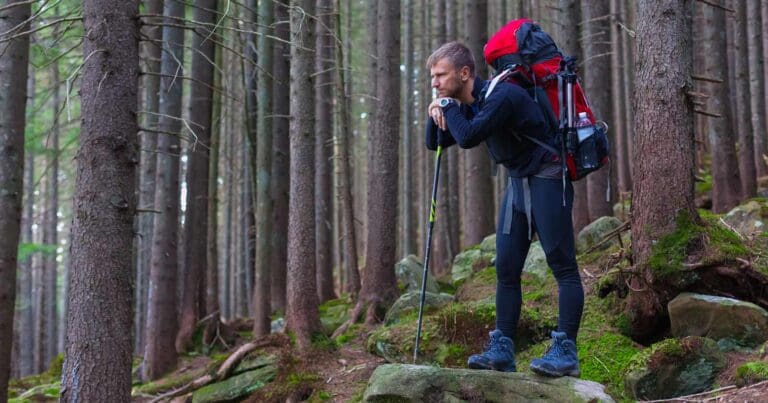
Why hiking influences how you think and feel
Hiking affects the mind in ways that go beyond physical exercise. Many people notice changes in clarity, creativity, and perspective after time on the trail, and these aren’t sudden or dramatic transformations. They reflect how movement, environment, and attention interact when we step away from daily pressures, and research and lived experience suggest hiking can support mental processes that are often strained in modern life, including focus, creative thinking, and emotional regulation.
Quieting repetitive thinking
Constant stimulation, deadlines, and information overload can lead to repetitive or unhelpful thought patterns. Hiking reduces this pressure because it combines steady movement with environments that place fewer demands on attention, so walking outdoors encourages a gentler focus that lets the mind settle. For many people, that’s what reduces rumination and mental noise, and makes space for clearer thinking.
Space for creative thinking
Creative thinking often benefits from mental space rather than effort, and hiking provides this space by removing common distractions and allowing the mind to wander. Research has shown that time spent in natural environments, particularly when disconnected from technology, is associated with improved performance on creative problem-solving tasks. Hiking offers a practical way to access this state without needing to actively try to be creative.
Better attention and focus
Physical movement supports cognitive function by increasing blood flow and oxygen delivery to the brain, and hiking combines this with sustained attention to terrain, balance, and navigation, gently engaging focus without overwhelming it. That balance is what can improve concentration and reduce mental fatigue, particularly for people who spend long periods sitting or working on screens.
Gaining perspective
Distance from familiar environments often brings emotional and cognitive perspective, because hiking removes us from routines that reinforce stress and allows problems to be viewed from a wider angle. That doesn’t mean challenges disappear. They often just feel more manageable when thought about in open space and away from constant demands.
Mental recovery
The brain requires periods of recovery to function well, and natural environments support this recovery by reducing sensory overload and encouraging a slower pace of thought. Hiking provides an opportunity for this reset, and over time, regular exposure to nature and movement can support mental resilience and a steadier baseline of wellbeing.
Keeping expectations realistic
Hiking does not change the mind overnight, and it is not a replacement for professional support when it is needed. Its value lies in consistency rather than intensity. Short, regular hikes often provide more benefit than infrequent, demanding outings, and when approached without pressure, hiking becomes a reliable way to support mental clarity, creativity, and perspective as part of a balanced life.
Explore related guides
- How hiking supports brain health, mood, and mental clarity
- How nature can alter our sense of time
- How nature and time outdoors can support mental wellbeing
- Why hiking feels good: Mood, energy, and mental clarity explained
- The benefits of hiking for physical health, mental wellbeing, and connection
References
Atchley, R. A., Strayer, D. L., & Atchley, P. (2012). Creativity in the wild: Improving creative reasoning through immersion in natural settings. PLOS ONE, 7(12), e51474.
https://doi.org/10.1371/journal.pone.0051474
Berman, M. G., Jonides, J., & Kaplan, S. (2008). The cognitive benefits of interacting with nature. Psychological Science, 19(12), 1207–1212.
https://doi.org/10.1111/j.1467-9280.2008.02225.x
Kaplan, S. (1995). The restorative benefits of nature: Toward an integrative framework. Journal of Environmental Psychology, 15(3), 169–182.
https://doi.org/10.1016/0272-4944(95)90001-2