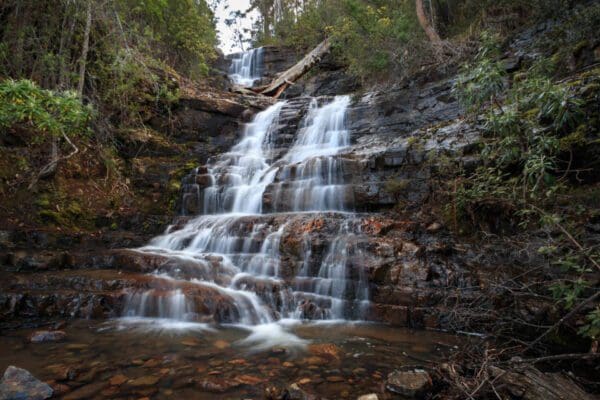
Dolerite Columns and Foothill Forests Above Hobart
Overview
Wellington Park rises straight from Hobart’s western edge, giving the city its mountain backdrop and a huge area of protected bushland close to town. The park covers 18,011 hectares and stretches west from the 1,271 metre summit of Kunanyi / Mount Wellington for almost 30 kilometres. It is not a national park, but a separately managed reserve with a strong mix of natural, scenic and water catchment values.
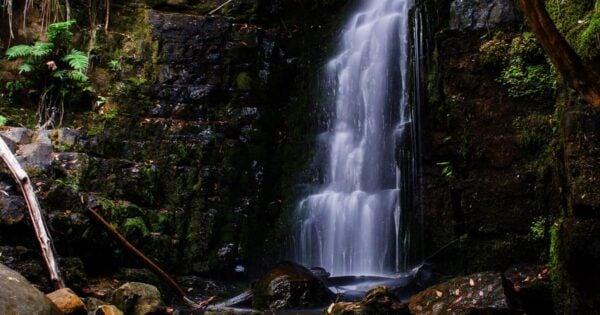
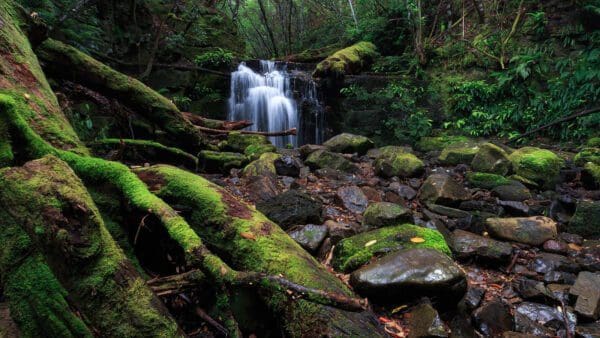
What makes this area feel so distinctive is the quick change from lower dry forest and foothill gullies to exposed alpine country higher up. That range in altitude, landforms and vegetation gives the park a much broader character than many urban-edge reserves, with everything from ferny slopes and waterfalls to bare rock, boulder fields and high, wind-shaped country.
Highlights
The defining feature here is the Wellington Range itself, with Kunanyi / Mount Wellington forming the skyline above Hobart. Across the park, the scenery shifts between prominent peaks and ridgelines, dolerite cliffs, sandstone shelves, waterfalls and broad slopes of forest. Well-known natural features include the Organ Pipes, the Lost World boulder cave system, Yellow Cliffs, Collins Cap and Collins Bonnet.
From the summit area, the outlook takes in Hobart, the Derwent estuary, the east and south coast, and westward country reaching towards the Tasmanian highlands and the World Heritage Area. Lower down, the mountain has a different feel, with sheltered gullies, creek lines and changing views back across the city and river.
Best Time to Visit
Wellington Park can be rewarding in any season because its character changes so much through the year. Warmer months usually make it easier to appreciate the contrast between dry lower slopes, forested middle elevations and the open country higher up, while the cooler months often bring clearer air, snow on the upper mountain and a sharper sense of the park’s alpine edge.
Because the foothills and summit country can feel like very different places on the same day, timing really depends on what kind of landscape you want to experience. Spring is especially appealing for fresh growth and flowing creeks and falls, while autumn and winter tend to emphasise the mountain’s rock forms, open slopes and wide views.
Plants and Animals
The park supports more than 500 native plant species, representing about 30 per cent of Tasmania’s native vascular flora. More than 80 of those species are found only in Tasmania, and the mountain is recognised as one of the state’s richest sites for endemic plants. There are also important moss, liverwort and lichen communities, along with several plant communities that are restricted in distribution or poorly reserved elsewhere in Tasmania.
Animal life is just as varied. The park has at least 67 bird species, including many Tasmanian endemics, and it provides habitat for species such as the wedge-tailed eagle, swift parrot and grey goshawk. Mammals recorded here include eastern quoll, platypus, echidna, long-nosed potoroo, pademelon and bandicoots. The mix of altitude, vegetation and rocky landforms is a big reason for that diversity, with high boulder screes, damp gullies and lower forests each supporting different species.
Culture and Heritage
Kunanyi / Mount Wellington and the Wellington Range are the traditional lands of the Muwinina people. The mountain also has a long place in Hobart’s visual and cultural history, standing as the city’s most recognisable natural landmark and shaping how generations of locals and visitors have understood the landscape around the Derwent.