Leaving the World Behind: Three Days of Stillness in Corinna
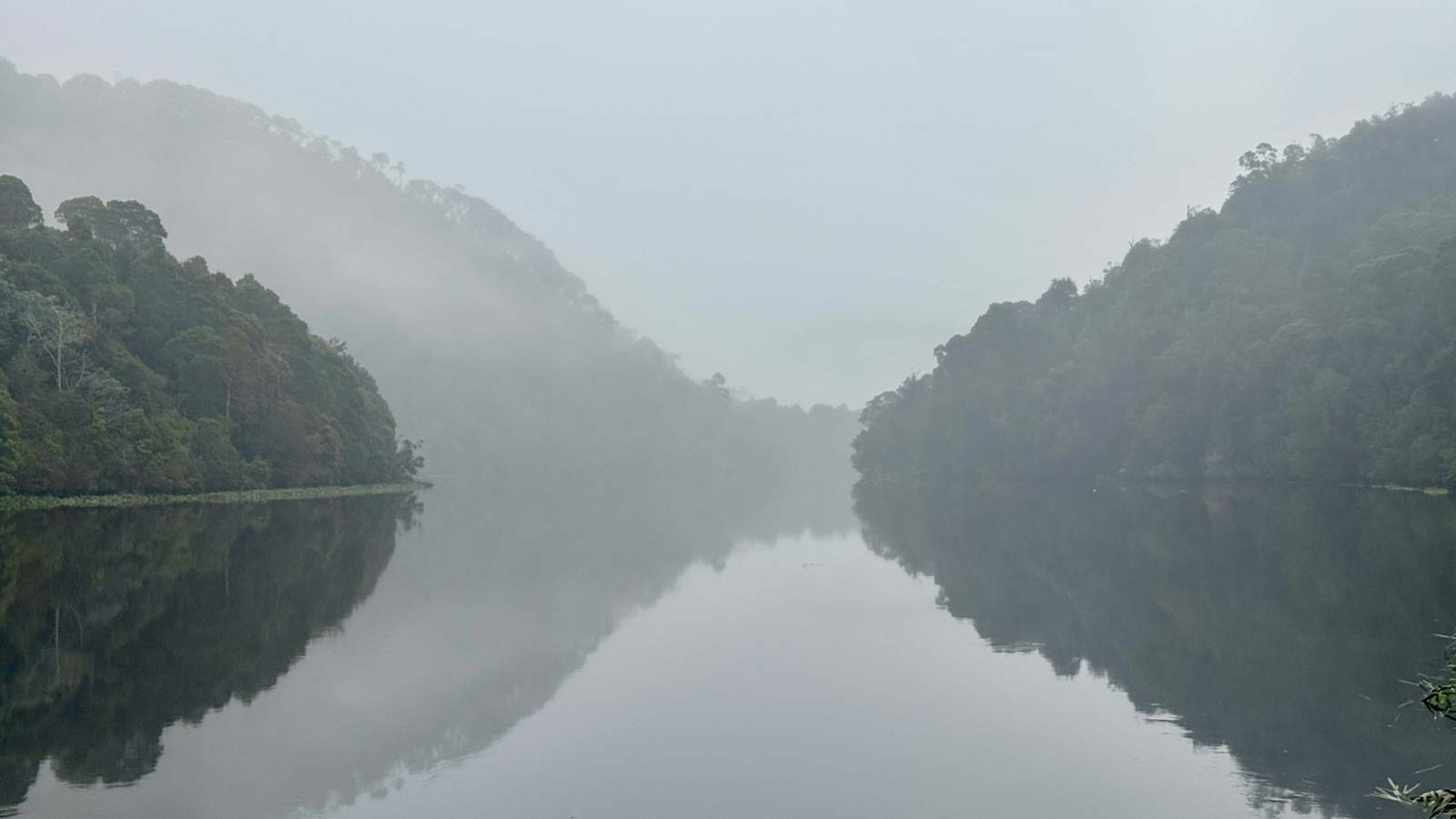
With ghostly silence, the tips of our oars were consumed by the glassy surface, slipping gracefully into the tannin-soaked depths of the Pieman River.
What lay below that layer of black silk, I could not say. Forty thousand years of history, locked away from view.
Each deliberate stroke propelled us gently forward, following the flow of the river as it snaked its way effortlessly towards the wild western coast. We moved with purpose, deeper and deeper into the dense morning mist.
Around us, everything was still. Eerily still. There was no wind, no sound from the forest, none from the sky; not even the water beneath us would whisper a word.
At the southern end of takayna/Tarkine, we entered a landscape that had stood for millennia before our arrival. We were there to experience what makes this region so special: a place shaped by deep time, and one that endures because of it. And as we paddled patiently into this place, the world that we knew simply slipped away.
To understand how we arrived in this silence, I have to take you back to the beginning.
When an email arrived in January, inviting us to Corinna Wilderness Village, I felt both excitement and a quiet anxiety. Saying yes meant taking time off: real time, away from the office, away from the inbox, away from the constant hum of work that had become my default state. For a moment I questioned whether we should go.
But the allure of somewhere remote and wild was too compelling to ignore. Corinna had generously offered to host us, and one detail in that email had already made up my mind. No mobile coverage. No internet. That sounded like bliss to me.
We departed Melbourne on a Thursday afternoon. As we boarded the plane, I switched my phone to airplane mode, deliberately, with something close to relief; I didn’t connect to the outside world again for three days.
We landed in Launceston just after 4:30pm and collected the rental car. Or tried to. Julie had the keys in her hand when she read out the make, model and colour of what we were looking for. We spent five minutes searching the carpark before I asked for the registration number. It was then she realised she was holding her own car keys, and we’d been looking for a car sitting at the airport back in Melbourne. We drove away laughing, and somewhere in that laughter was a small release of everything we’d been carrying.
The drive to Corinna took nearly four hours. By the time we left the highway behind, the sun had long set and the darkness outside was complete. We had no idea what we were driving into — no signal, no maps updating, no sense of what lay ahead. Just headlights and the road disappearing into the trees.
We arrived late, tired, and quietly expectant. Our first impression of the cottage was simple: ahhh. A fireplace warming the room, lights turned low, no television, no wifi, no noise from the outside world. We dropped our bags, settled onto the couch, and just talked. Planning the days ahead, unhurried, undisturbed.
It already felt like exactly what we needed.
Day One: Into the Pieman
We woke early on our first full day to wander through Corinna Wilderness Village itself — a small collection of rustic, miner-style cottages lining a quiet track, their weathered charm a nod to the gold rush era that first drew people to this remote corner of Tasmania. Modern and comfortable inside, yet unhurried in every other sense. From our doorstep, the rainforest pressed close, ancient and silent, as if waiting patiently for us to notice it.
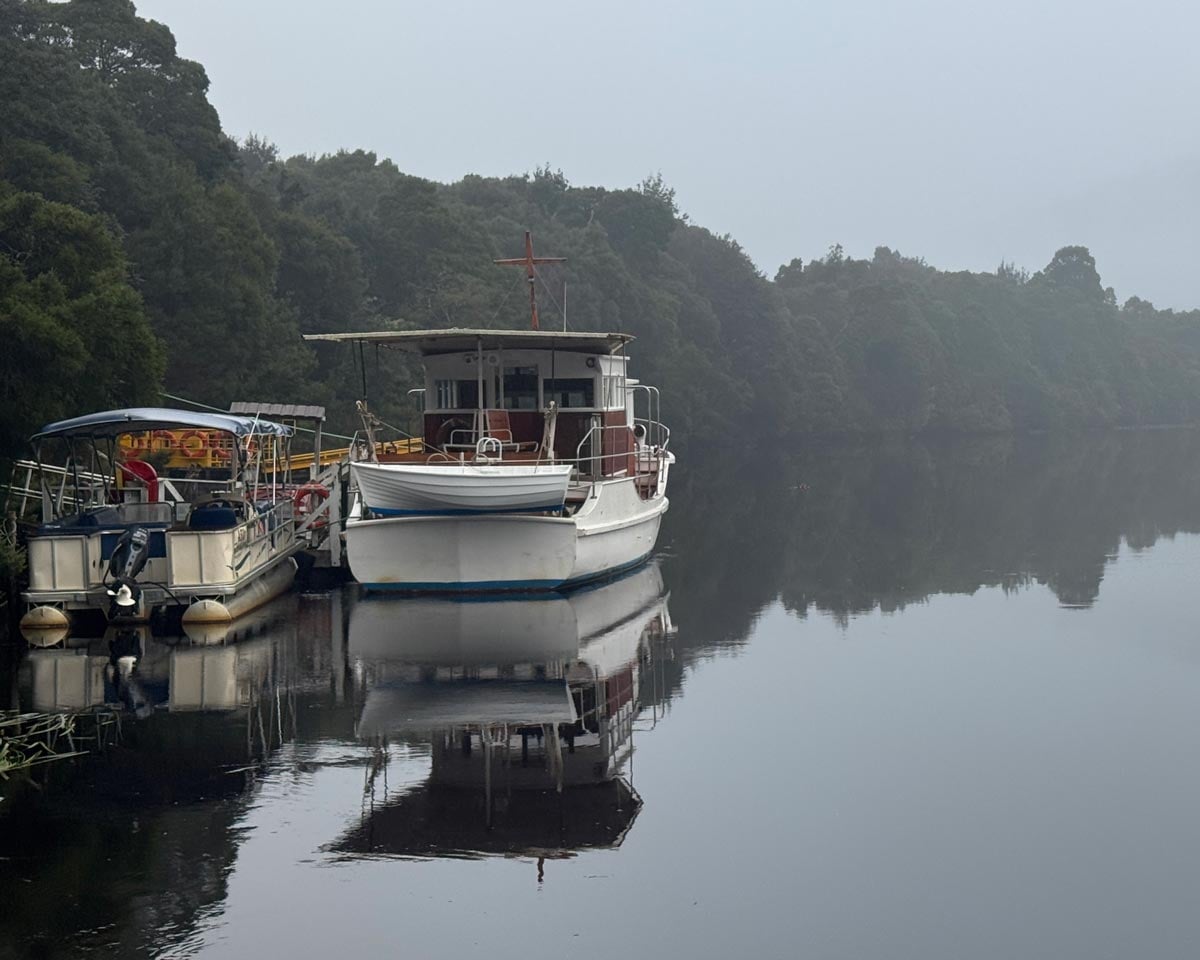
At 10am we boarded the MV Arcadia II, the famous Huon Pine river cruiser that has worked these waters in one form or another since 1939. Built in Hobart as a luxury pleasure craft, she was requisitioned during the Second World War, fitted with a Vickers machine gun and dispatched to New Guinea as a supply vessel. After the war she drifted between owners: sea cadets, scallop fishermen, charter operators — before finding her way to the Pieman in 1970, where she has cruised the black waters faithfully ever since. She is the last Huon Pine river cruiser still operating anywhere in the world, and it shows. There is something about stepping aboard a vessel with that kind of history that makes the river feel older too.
The skipper’s commentary was the finest I have encountered on any cruise, anywhere. He spoke about the region’s layered past with the ease of someone who had lived inside it — the mining operations, the logging, the fires, the ongoing fight to protect the Tarkine from development. But it was the story behind the river’s name that stayed with me longest.
Many people assume the Pieman River was named after Alexander Pearce — an Irish convict transported to Van Diemen’s Land in the early 1800s, who escaped the brutal Macquarie Harbour Penal Station and survived in this wilderness by consuming his fellow escapees. He was eventually caught with human flesh still in his pocket, and hanged. The cannibalism gave rise to a grim piece of folklore: that the river was named for a man who made “pies” of a very different kind.
The truth, as the skipper explained, is both more prosaic and more interesting. The river was named for another convict entirely: Thomas Kent, a pastry cook from Southampton transported in 1816, who earned the nickname “The Pieman” for his trade and his habit of repeatedly escaping. He was recaptured near the river mouth in 1822, and the waterway eventually took his name. Pearce and Kent were held at Macquarie Harbour at the same time, which gave the myth just enough plausible detail to take hold. Historians have since clarified that Pearce never came close to the river during his escapes and was never a baker by trade — but the legend proved too darkly compelling to die.
What struck me most, though, was something the skipper mentioned almost in passing. Before European settlers named it the Retreat River, and long before it became the Pieman, this waterway had another name entirely. To the Aboriginal Tasmanians who had lived along its banks for tens of thousands of years, it was called Corinna, meaning thylacine. The Tasmanian tiger.
The village we were staying in, the place that had drawn us here, carried the name of a vanished animal in a language that had nearly vanished too. Standing on the deck as the dark water slid beneath us, that felt like something worth sitting with.
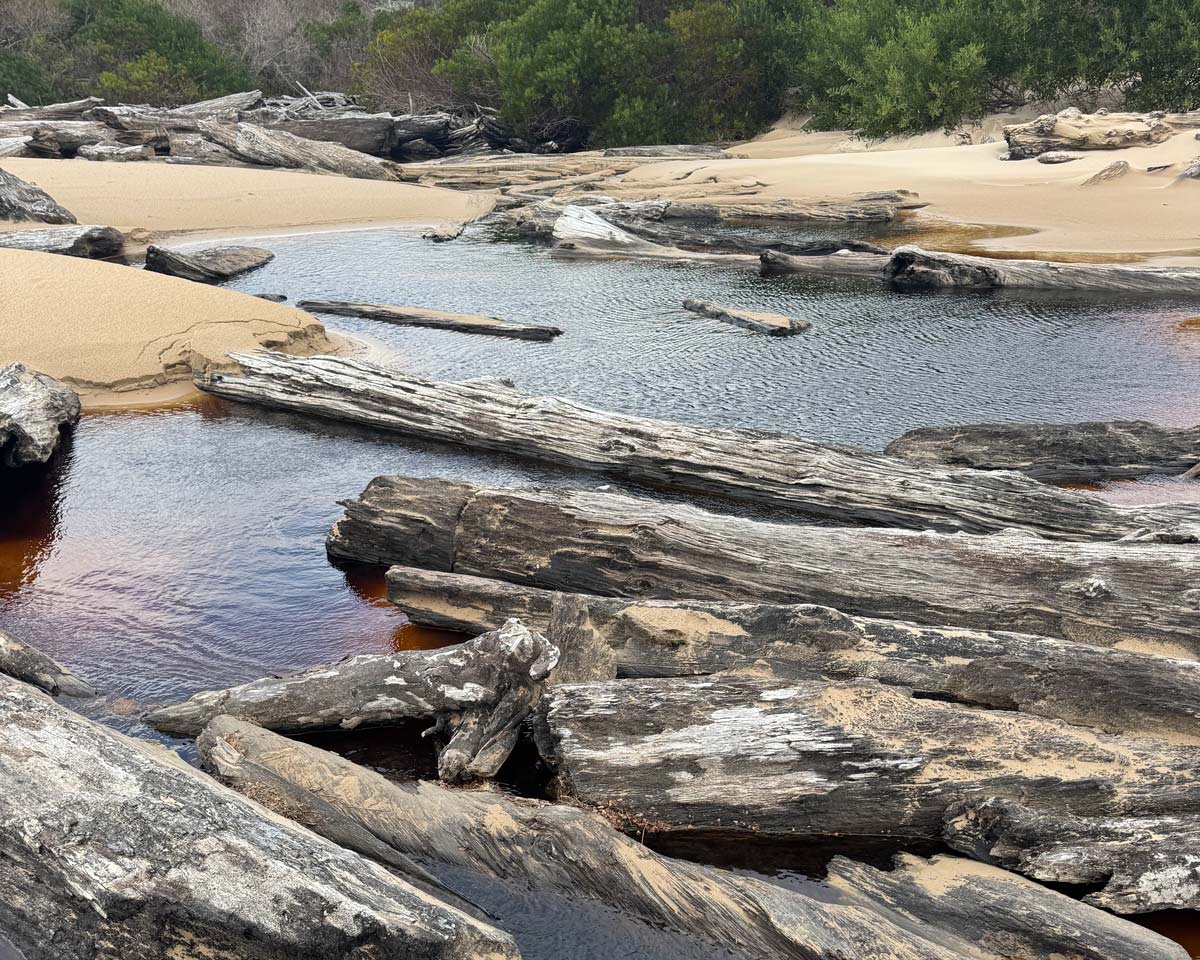
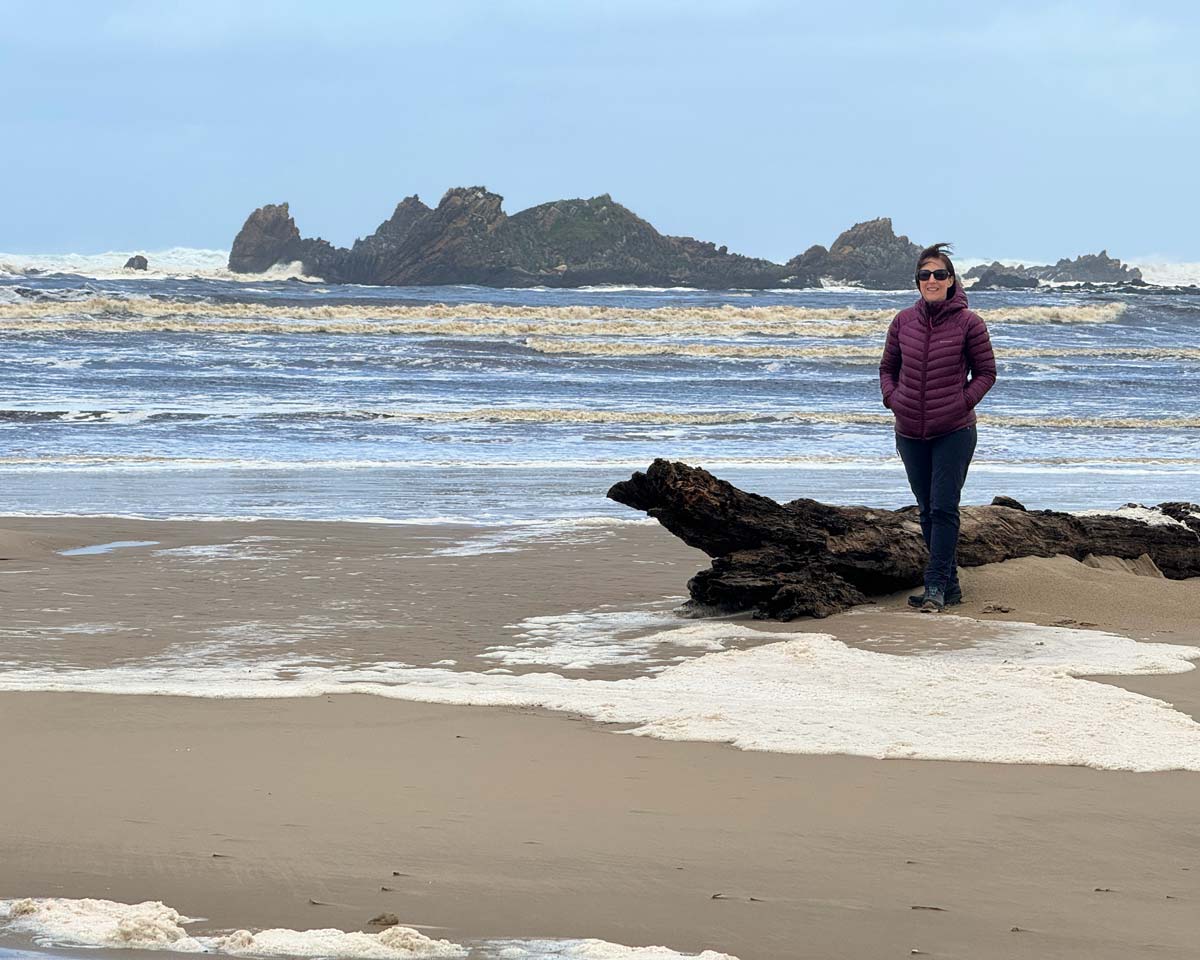
At Pieman Heads, we chose to explore before eating. It was the right decision. The coastline was raw in the truest sense; waves hammering against jagged rock sentinels that guarded the river mouth, dark water pressing against the Southern Ocean as if the two were in permanent negotiation. Ancient logs, many of them Huon Pine washed down from the river over centuries, lay scattered across the sand and pooled tannin water like bones from another era. One log had been worn and bleached by the sea until its grain looked almost like layered stone — silver-grey, striated, oddly beautiful. We walked quietly among them, and said very little.
Lunch on the return journey (a wrap, a homemade treat, something cold to drink) was simple and exactly right.
Back at Corinna by mid-afternoon, we had originally planned a short nearby walk. But Tasmania’s weather is unpredictable, and the skies were doing something generous. We adjusted our plans and headed for the summit of Mount Donaldson instead.
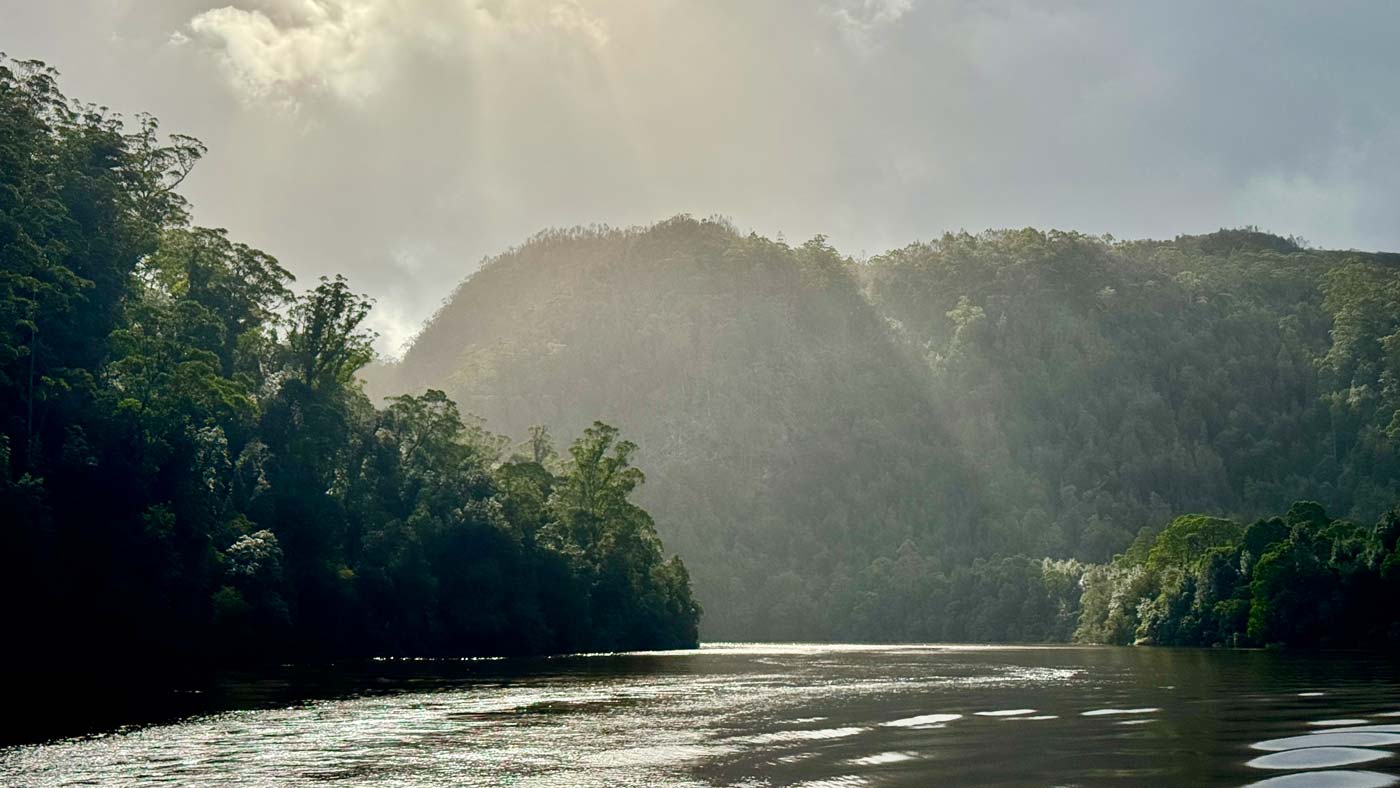
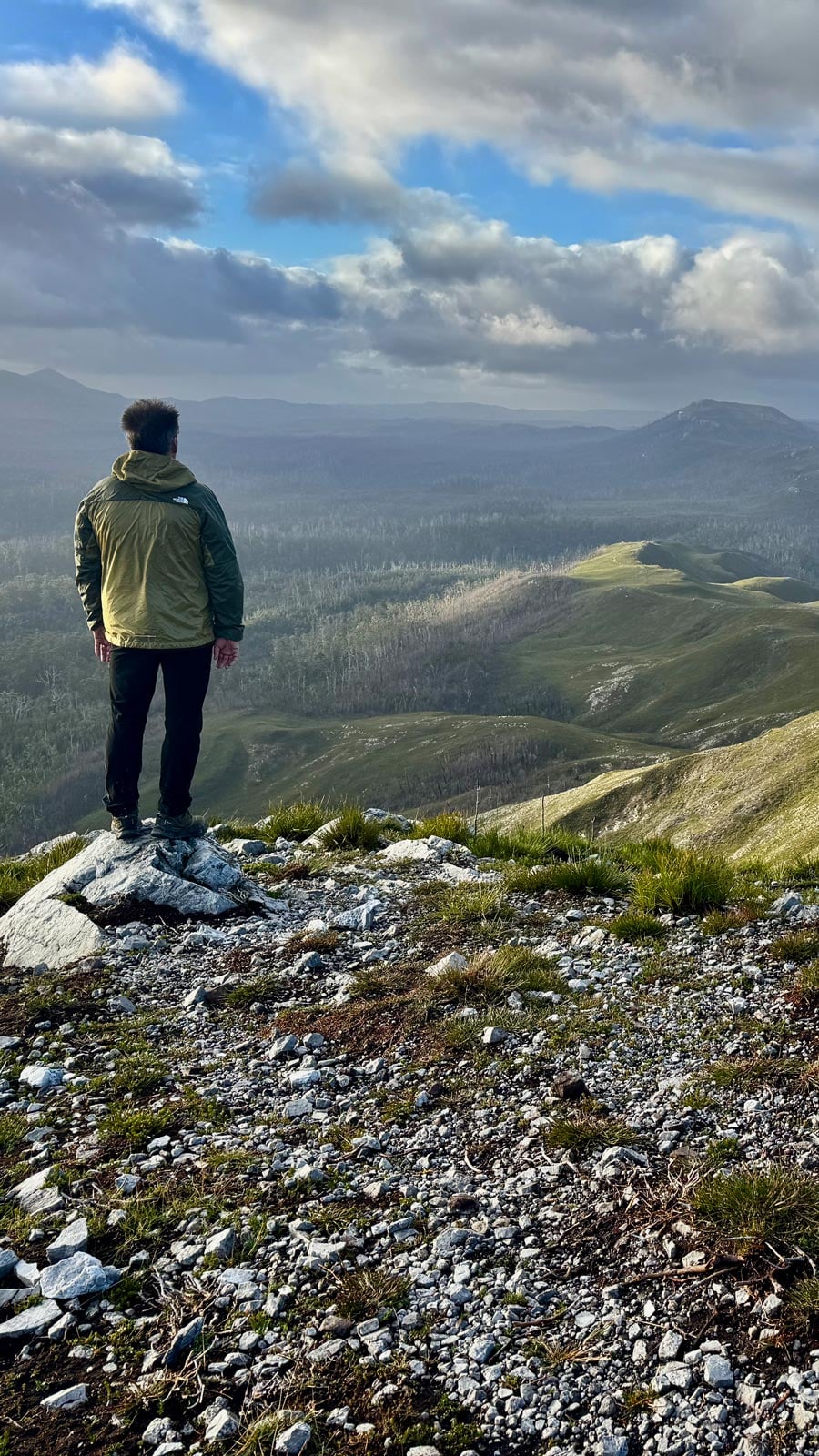
The first half of the climb led us through the dense, dripping interior of the Tarkine — myrtle, sassafras, horizontal scrub closing in overhead. Then the forest gave way, and we emerged onto the open quartzite spurs of the upper mountain. The light was falling low and golden across the ranges by the time we reached the top, throwing long shadows across the rolling ridgeline and catching the pale grass in a way that made everything glow.
Below us, the Pieman River curved through an unbroken canopy of forest. Beyond it, ridge after ridge dissolved into the haze. No roads. No towns. No signal. Just the Tarkine, stretching away in every direction to the limits of what we could see.
After a day spent moving from river to sea, we now stood above all of it. Something that had been wound tight inside me for months was beginning, quietly, to loosen.
We returned to Corinna in time for dinner at the Tannin Restaurant, tucked inside the Tarkine Hotel, a warm, timber-raftered room whose walls were lined with historical photographs and corrugated iron, the bar and general store just beyond. We ate well, talked slowly, and walked back to the cottage in the dark. The fire was waiting. We recalled the day’s moments, climbed into bed, and wondered what tomorrow would bring.
River, Sea and Summit
Day Two: Rainforest and River
Morning arrived exactly as forecast. Opening the cottage door to a light drizzle and mist-filled skies, we pulled on our wet weather gear, layered up from head to toe, and stepped out into the cool, damp morning without hesitation. This was Tasmania. We had expected nothing less.
After collecting our life vests and a double kayak, we launched onto the black ink of the Pieman and began our gentle paddle downstream towards Lovers Falls.
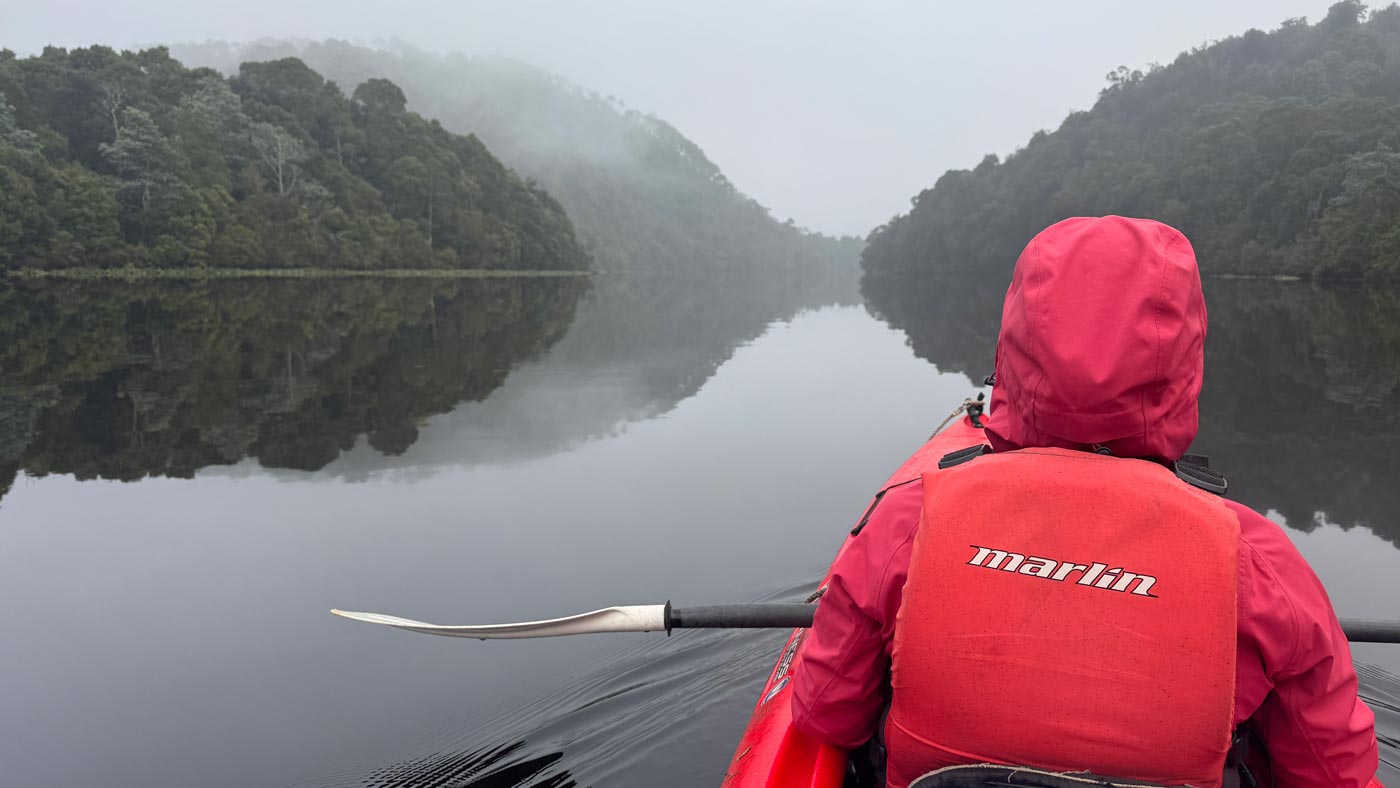
The drizzle didn’t last long. What replaced it was something harder to describe. The mist clung to the ridgelines above us, the forest rising steeply on both sides, its reflection laid perfectly across the still surface of the river. There was no wind. No current to speak of. Just the soft rhythm of our strokes and the world doubling itself beneath us. Distant shorelines emerged slowly from the shadows as we paddled deeper into the reserve, the river revealing itself gradually, bend by bend.
This was the scene I had written about in the introduction. The ghostly silence. The oars consumed by the glassy surface. The tannin-soaked depths. Now here we were, inside that moment.
Lovers Falls is accessible only by water: a 4 to 5 kilometre paddle downstream from Corinna, deep in the Pieman River State Reserve. We pulled the kayak up to the steep timber landing and followed a short path through the ancient rainforest, climbing roughly 120 steps through a staircase of towering myrtle and tree ferns (the largest we had ever seen), the timber boards slick with moisture, the air thick and green around us.
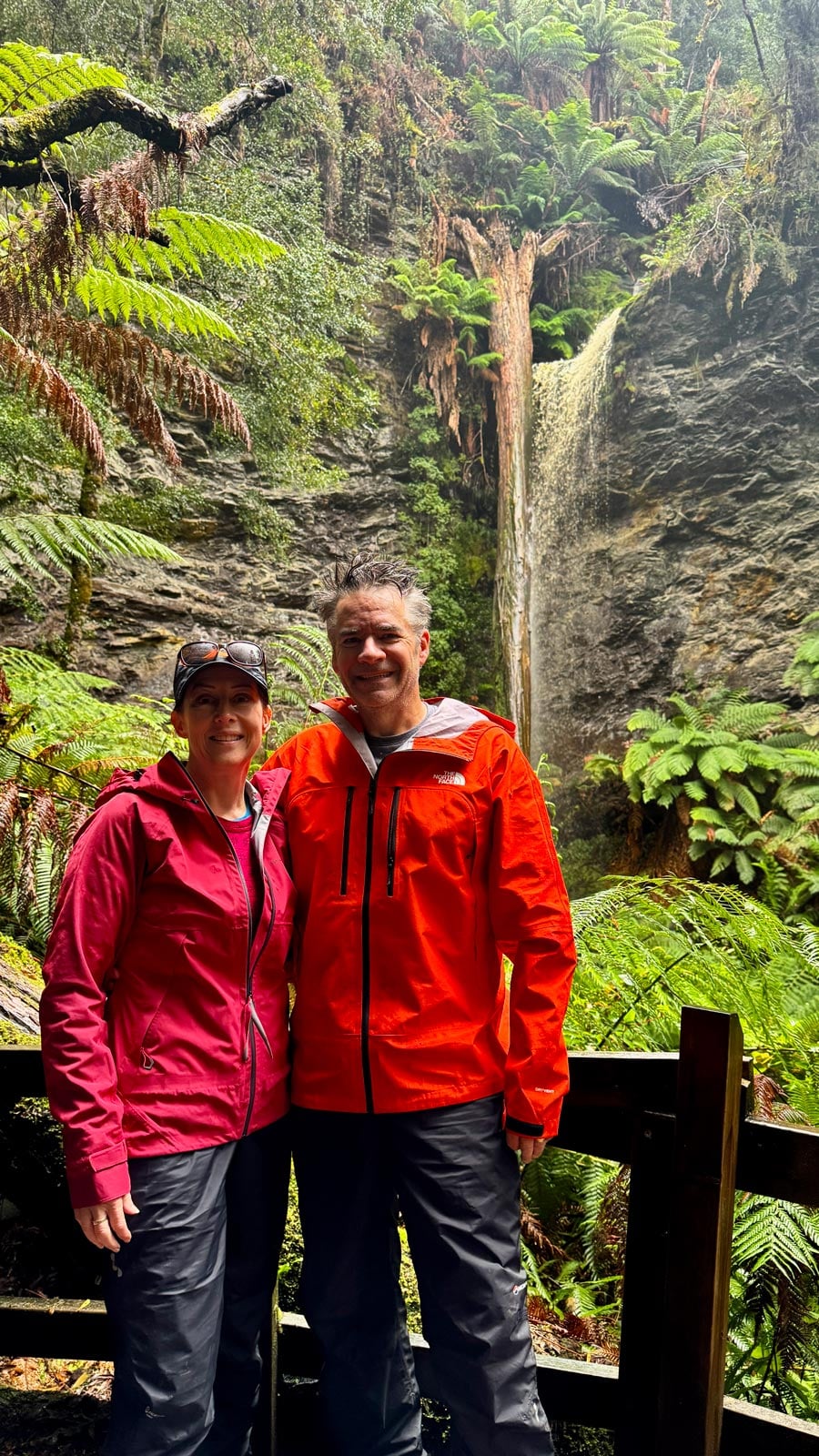
The falls emerged through the canopy without warning. A single thin ribbon of water, forty metres tall, dropping in near silence through a wall of dark rock draped in fern. The forest closed around it on all sides, muffling the sound, softening the light. It felt less like a waterfall and more like a secret the rainforest had decided, briefly, to share.
The falls take their name from a local legend. During the gold rush of the late nineteenth century, a young couple on their honeymoon reportedly discovered a massive gold nugget at this very site. They carried their fortune back to Hobart and used it to buy a hotel; a story so wildly romantic it has clung to the place ever since. Standing there in the drizzle, surrounded by rainforest so dense and remote it felt genuinely untouched, I found myself thinking less about the gold than about the people. How did they live out here for months, pushing through this wilderness on nothing but hope? They were a different kind of tough entirely.
We stood at the viewing platform for a long time. Neither of us felt any need to move on.
On the return journey, we turned briefly up the Savage River — a short paddle upstream to the ruins of the SS Croydon, a vessel that sank here in 1919 and has quietly surrendered itself to the riverbed ever since. There is something about a sunken ship in a remote Tasmanian river that feels entirely fitting for this landscape. Nothing here gives up its history easily.
We arrived back at Corinna around 12:30, peeled off our wet gear, and sat down to a refreshing salad lunch in the Tannin Restaurant — warm, unhurried, grateful.
After lunch we laced up our boots and stepped back out into the forest, this time on foot. The afternoon walk follows the Pieman downstream from Corinna to the Savage River, then turns northeast along the riverbank toward a bridge on the Western Explorer Highway — three connected sections known as the Huon Pine Boardwalk, the Savage River Walk, and the Link Walk.
It was a complete change of pace and environment. Gone was the cool, open expanse of the river at dawn, the mist and the silence and the sense of moving through something vast. This was the opposite of that. The forest closed in around the trail, the air turned oddly warm, and the world shrank to the detail directly in front of us.
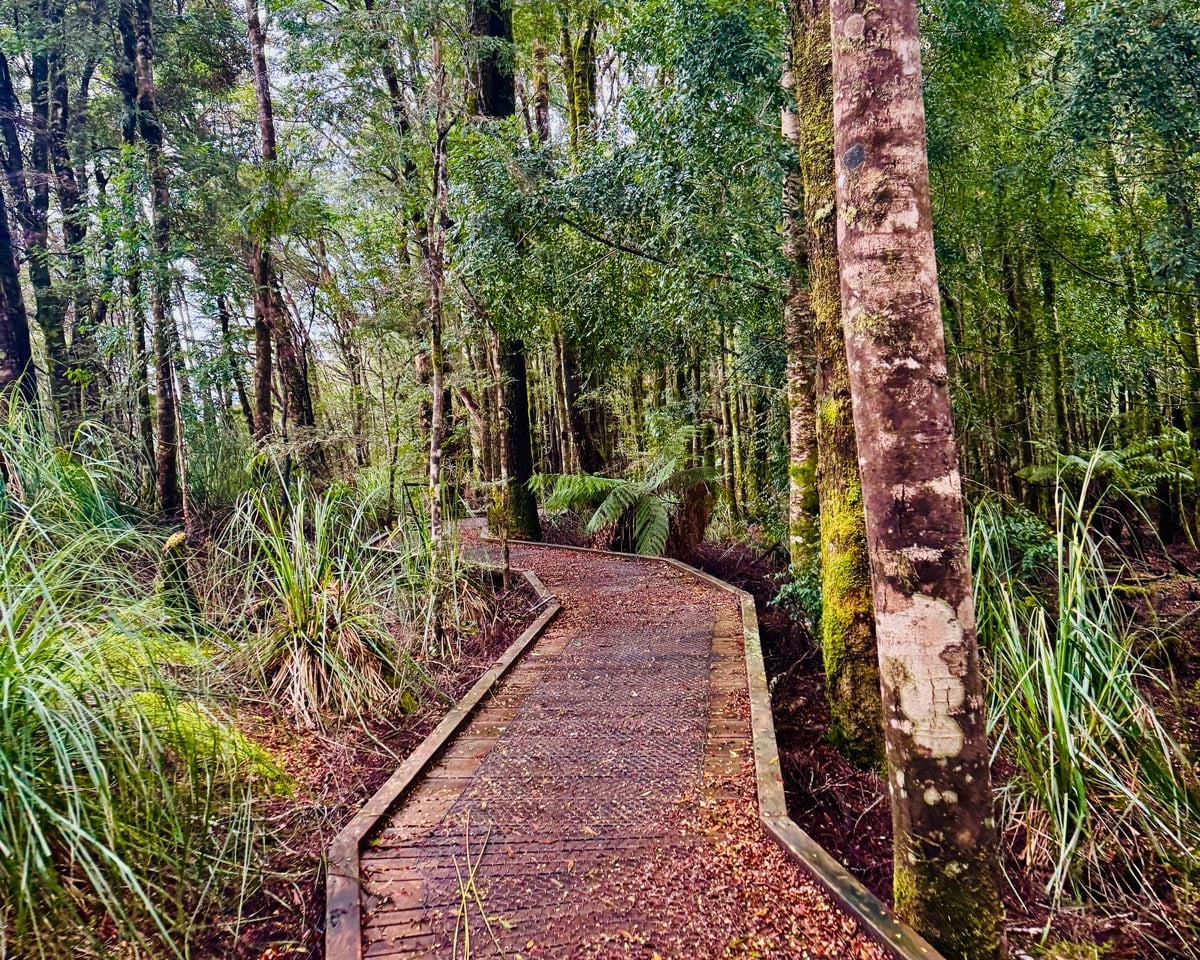
The Huon Pine Boardwalk winds along the bank of the Pieman through thick, tangled rainforest, past signed species identification for the myrtle beech and ancient Huon Pine specimens that lean out over the dark water. The vegetation climbs from the riverbank in almost every shade of green — and in the stillness, every shade is reflected back from the surface below.
Where the boardwalk ends, the Savage River Walk begins. The trail traverses primary rainforest of a different character — huge myrtle beech, old Huon Pine, ridgelines with views back over the Pieman. And it leads, eventually, to the bank of the Savage River and the site of the SS Croydon.
The Croydon sank here on the night of 13 May 1919, exactly 107 years ago this week. She had entered the Savage River three days earlier to load a cargo of logs, and by nightfall on the 12th had taken on between ten and twelve thousand feet of timber. At two in the morning, engineer Thomas Savage discovered water flooding the hull. Before the pumps could respond, the stern had gone under in thirty feet of water, held in place only by her moorings. Captain John Davis and his crew of three rowed the two and a half miles back to Corinna in the dark.
A public inquiry followed. The master believed hauling logs had sprung the rivets and opened the hull. A fireman had other ideas — he claimed the condenser pipe had been disconnected and tied with a piece of string, suggesting the vessel may have been scuttled to claim insurance. The inquiry declined to pursue the matter. The insurers, unconvinced, refused to pay. It took a court case that dragged on until 1923 before they were forced to honour the £1,619 policy. The Savage River, indifferent to all of it, kept rising.
When we had paddled past the wreck that morning, sections of the hull were still visible above the waterline. By the afternoon, the river had risen and most of it had disappeared again. The Savage River was taking it back, slowly, on its own schedule.
The Link Walk follows the Savage River upstream to complete the loop, and it was along this final stretch that the forest revealed its most extraordinary dimension. The forest had been keeping its own secrets. We had barely been paying attention to the ground when Julie stopped and crouched beside a fallen log.
Fungi. Everywhere.
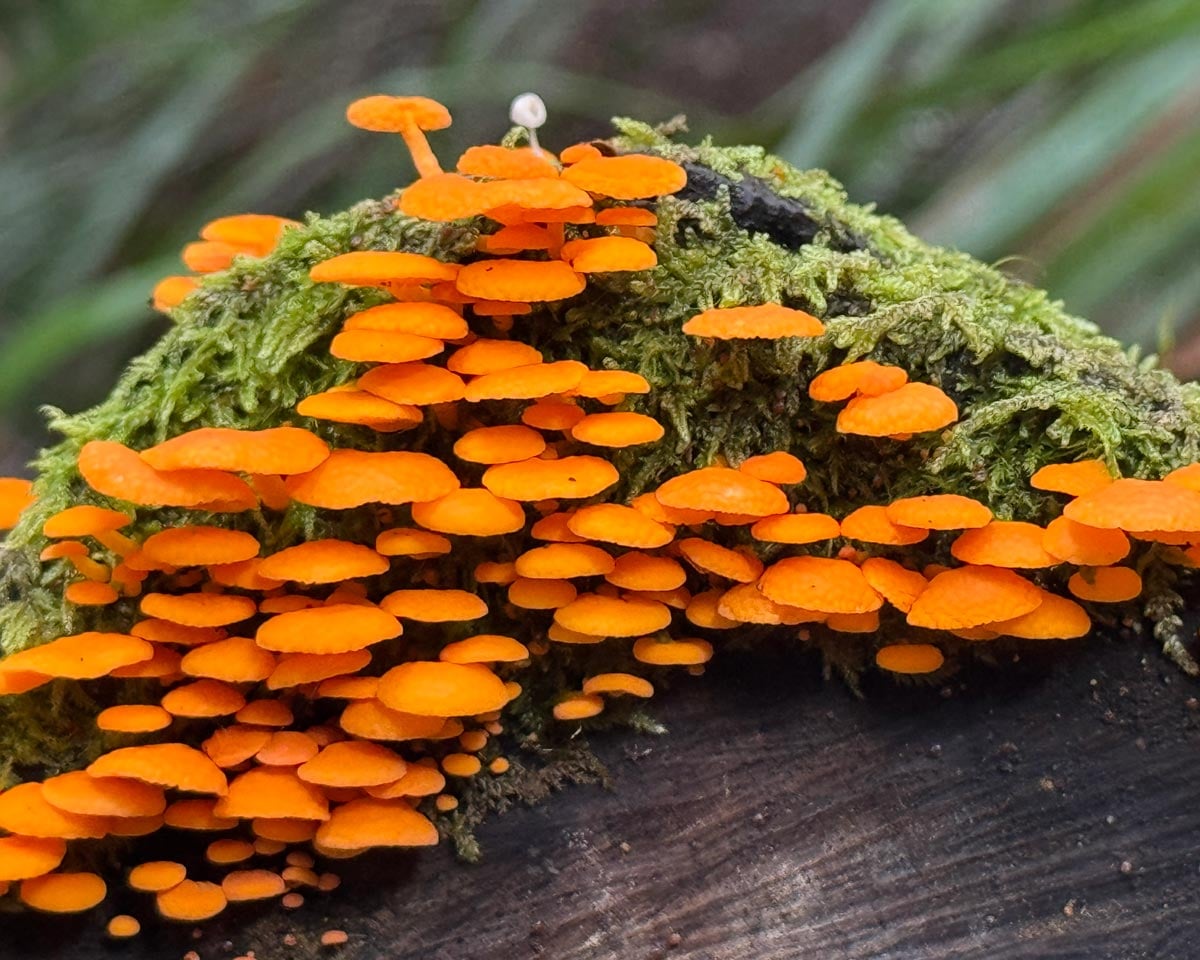
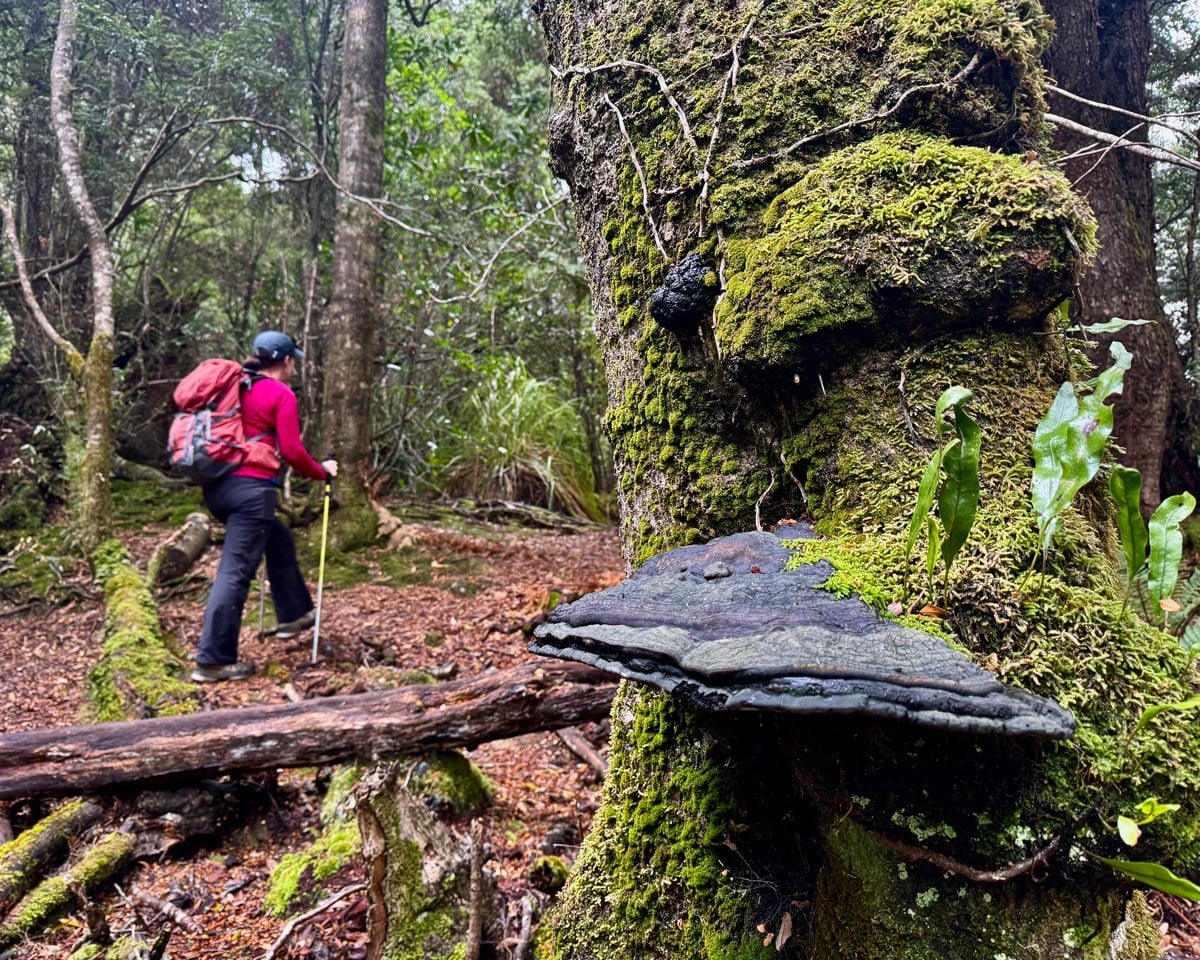
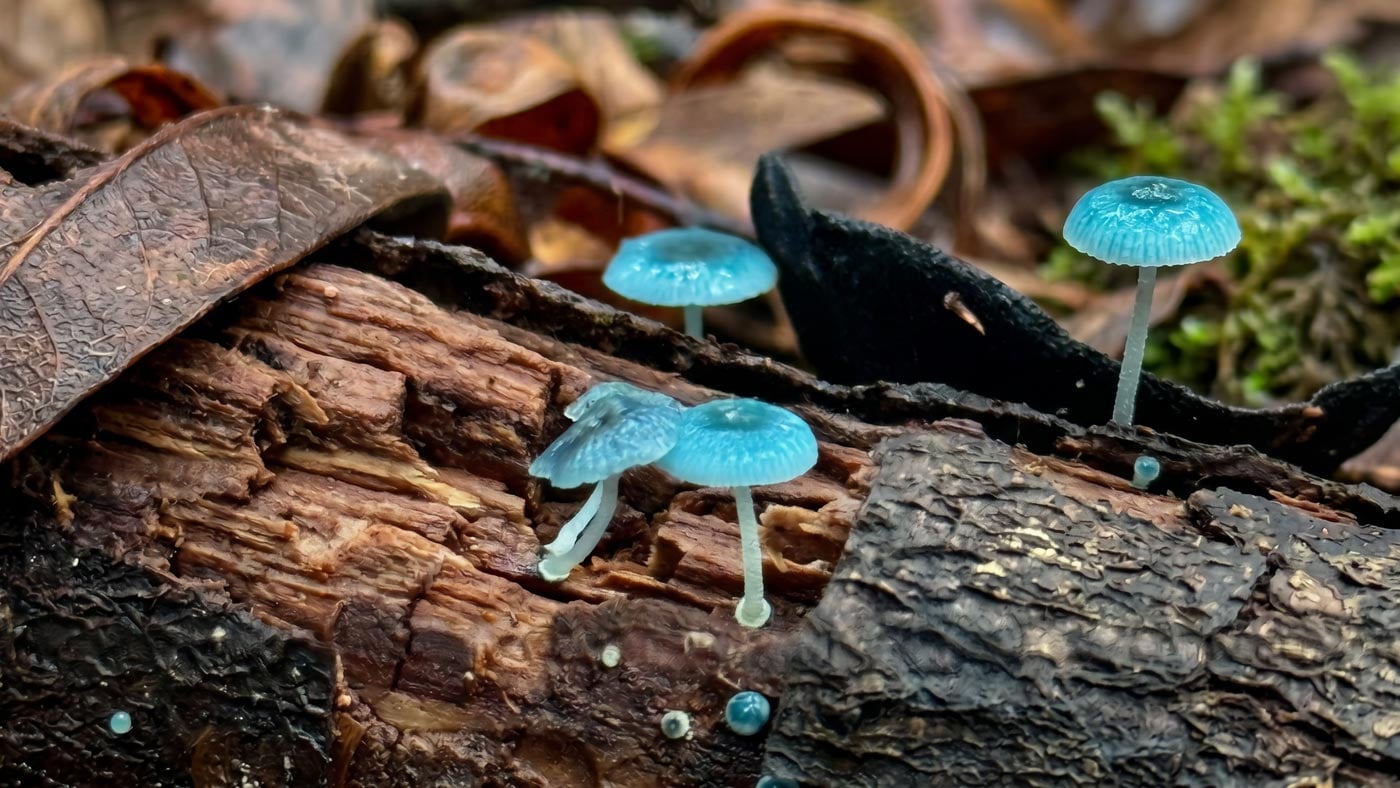
A mass of vivid orange caps, dozens of them, erupting from bright green moss like something that had no business being that colour. A single perfect brown mushroom standing alone in the leaf litter, classical in form, as if placed there deliberately. A bracket fungus the size of a dinner plate, dark and ancient-looking, fused to the side of a moss-covered trunk. Then, stopping us both completely — a cluster of coral fungi in a red so intense it seemed to glow against the dark wet earth. And smaller still, almost invisible unless you were already looking: tiny blue fungi, translucent, ghostly, and impossibly delicate, like something from the ocean floor rather than a Tasmanian forest. As silent and strange as the river had been at dawn.
We slowed right down after that. The macro world had opened up, and we couldn’t stop seeing it. Every log, every root system, every patch of moss seemed to be hosting something we hadn’t noticed before. The forest had been performing this whole time. We had just been moving too fast to notice.
By the time we emerged back at Corinna, we had covered river, sea, summit and rainforest floor in two days. We had seen this place from every angle and at every scale. We were tired in the way that only full days in nature can produce, the kind of tired that feels like something has been restored rather than depleted.
The Pieman in All Its Forms
Final Morning in Corinna
Our last morning arrived too quickly.
We rose before the mist had lifted and laced our boots one final time for the Whyte River Track — a 3km loop that follows the banks of the Pieman upstream to the mouth of the Whyte River before looping back through the forest. It started almost from our doorstep, which felt right for a final farewell.
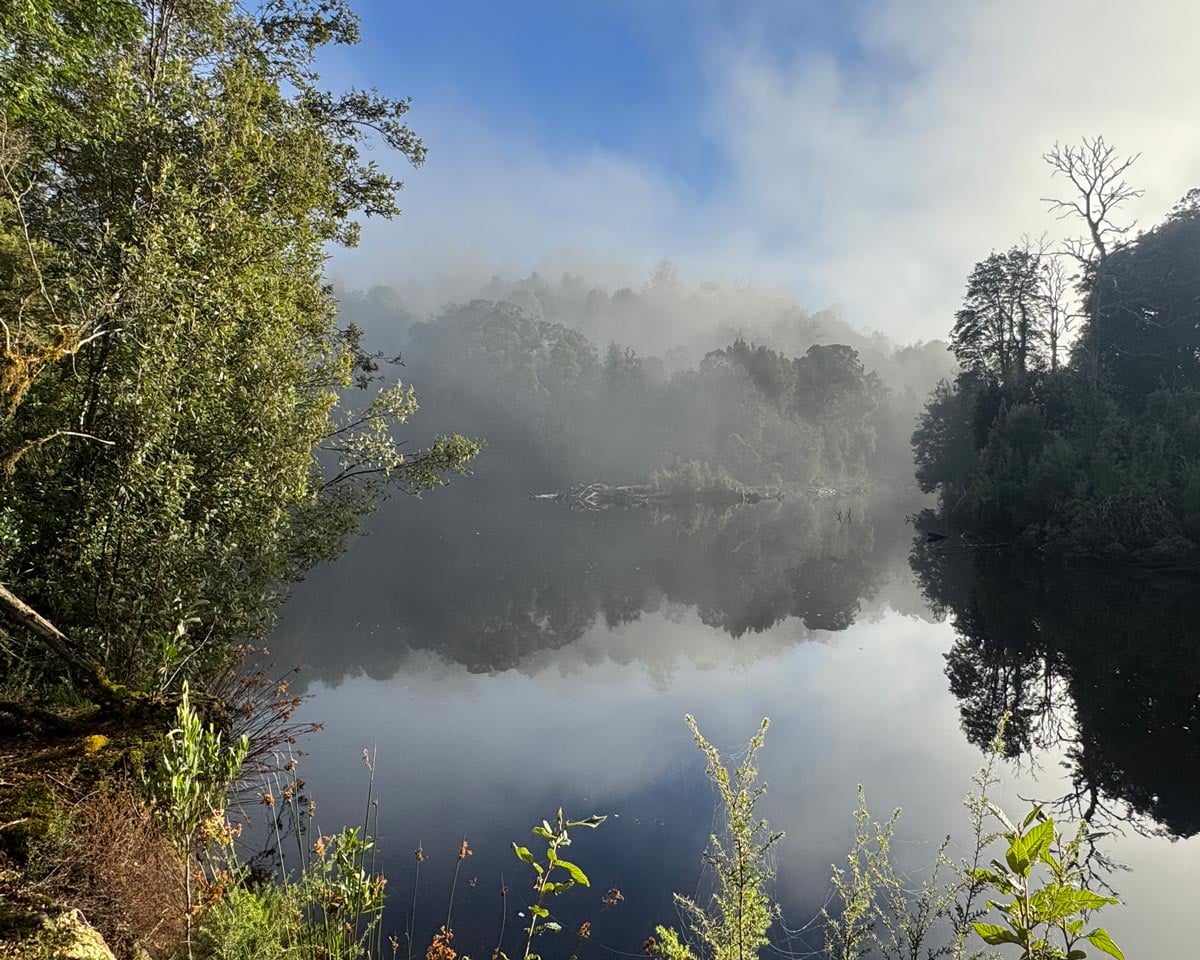
The river at that hour was something else entirely. The mist sat low over the water, the surface completely still, the forest doubled in the reflection below. We walked slowly and quietly, as though we both understood without saying so that we were trying to hold onto something.
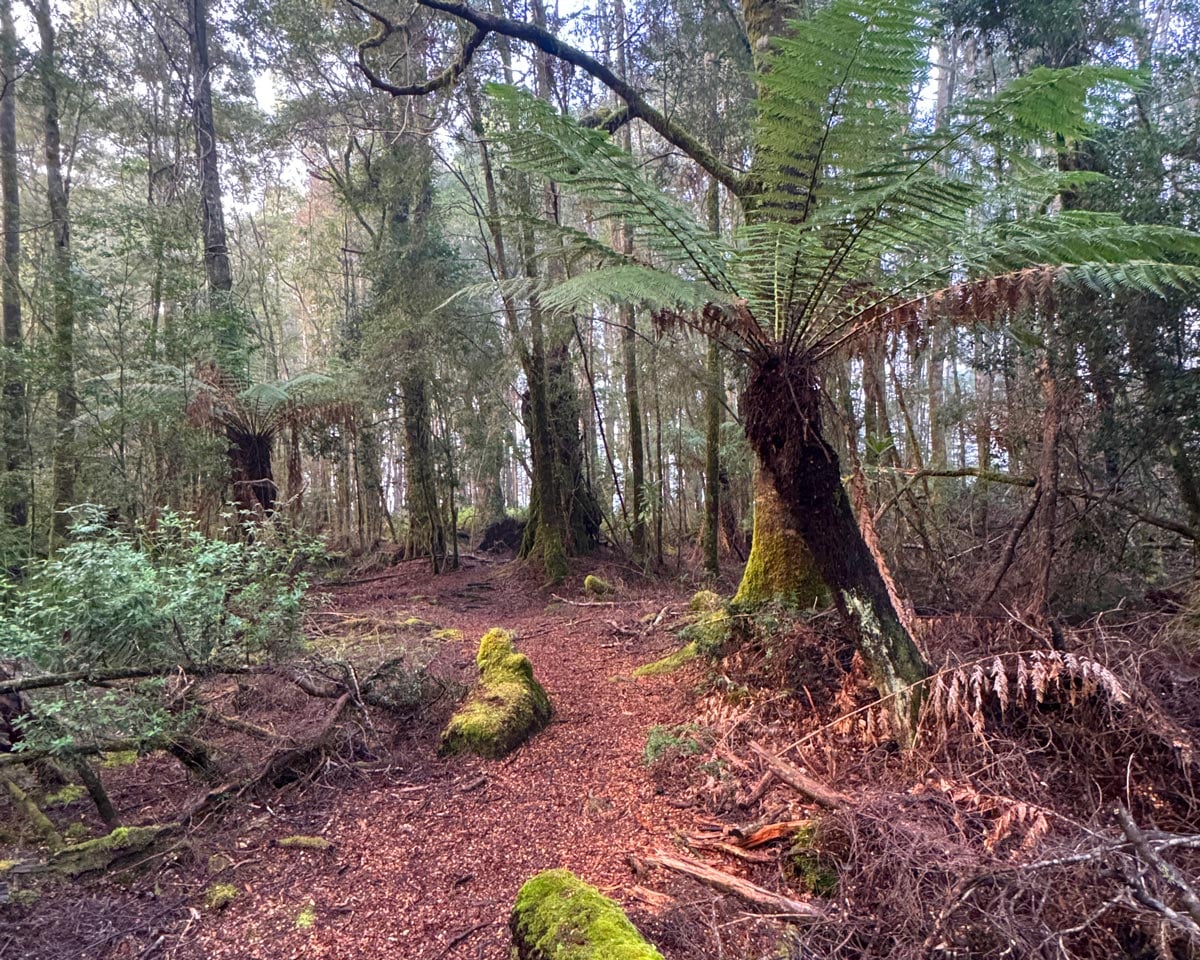
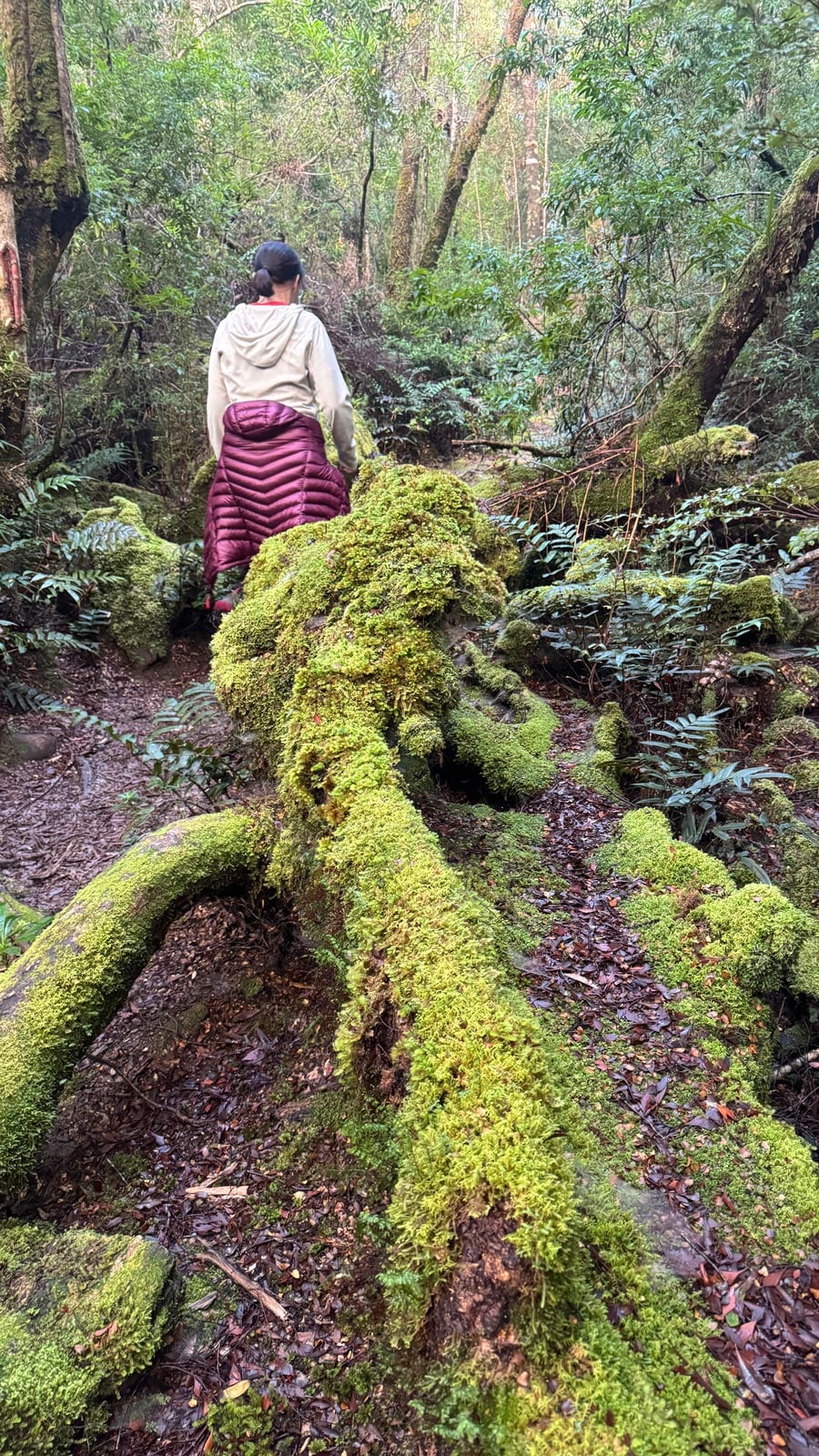
The track winds through forest that feels undisturbed in the deepest sense — not just uncleared, but genuinely ancient. Moss-covered logs stretched across the path, roots sprawled across the ground in tangled networks, and the tannin-stained streams that crossed our way glowed amber and deep orange through their shallow beds, stones lit from below like embers. Apparently, wallabies, pademelons and even platypus frequent this track at dawn and dusk. We didn’t see any — perhaps they were wiser than us and still asleep.
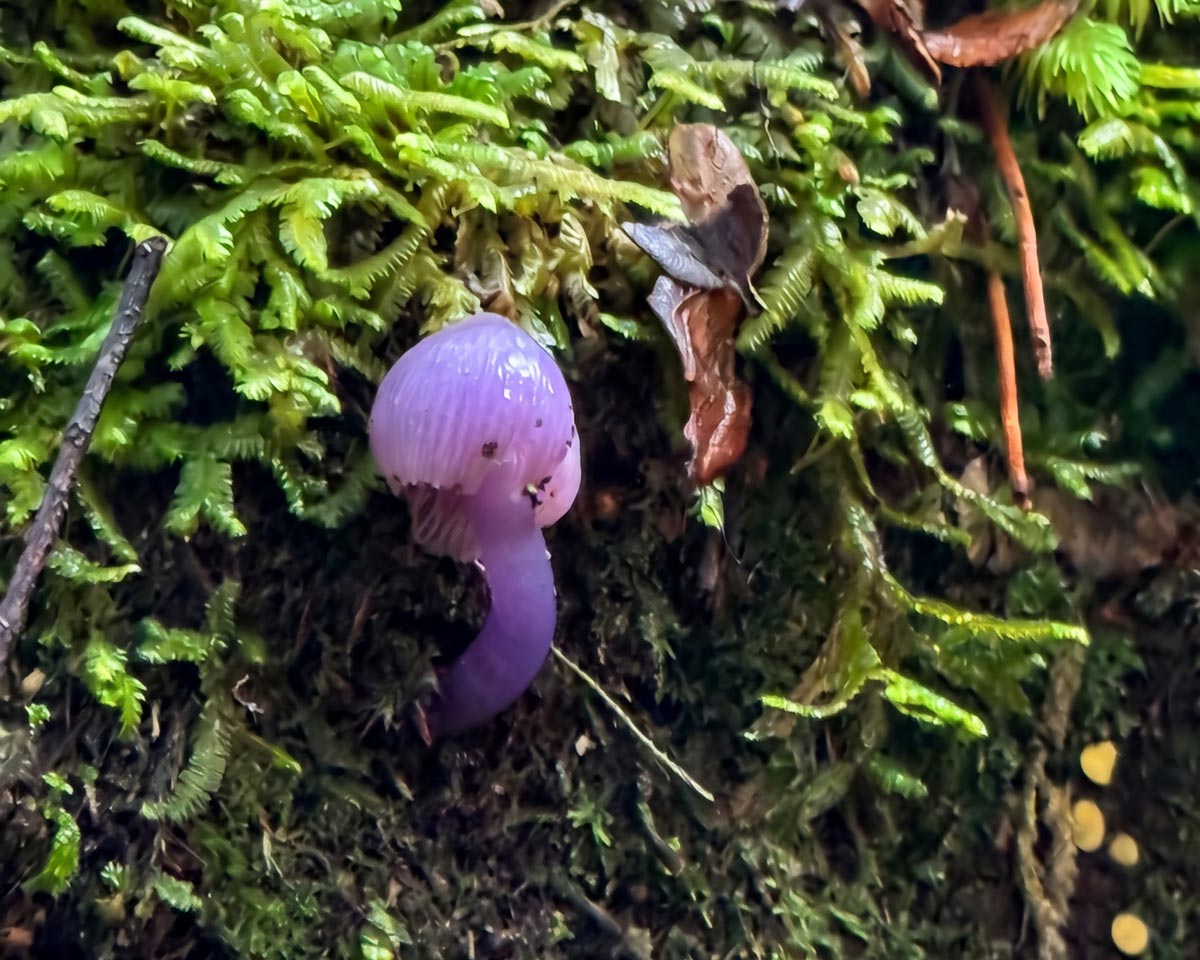
What we did find, again, was fungi. A single purple-capped mushroom pushing through bright green moss, its stem a deep violet. Two perfect red domes nestled side by side in the undergrowth. More coral fungi, vivid orange against the dark leaf litter. This forest didn’t run out of surprises. It simply kept offering them, quietly, to anyone paying attention.
After the walk, we returned to the cottage and packed in silence. There wasn’t much to say. We both knew these were the last moments in Corinna, and the last moments truly disconnected from the world outside.
Before we left, I stopped at reception to check out. I asked Matt, one of the front office team, whether he missed having internet or mobile coverage out here.
He didn’t hesitate. “No,” he said. “We actually sit around and talk.”
I’ve thought about that answer since. It sounds simple — almost too simple — but it landed somewhere. We are so busy living in an alternate universe of notifications, emails and endless scrolling that we can forget to inhabit the one directly in front of us. Matt wasn’t lamenting anything. He had found something most of us spend our weekends trying to reach for, and he lived inside it every day.
Corinna had given us three days of that. Three days of being genuinely present: on the river, at the coast, on the summit, in the rainforest. Three days of talking to each other instead of into our phones.
We drove out of Corinna in silence, the forest closing behind us as we wound our way through Savage River and Waratah, back toward the world we had left behind.
We paused at Whyte Hills lookout high above the Tarkine for one last view across the wilderness before the road continued toward Launceston. There, I switched my phone off airplane mode for the first time in three days and called my mum for Mother’s Day. It was a good call: brief, warm, and long overdue.
But the moment I hung up, the world came flooding back. One hundred and ninety-nine emails pouring in.
I was reconnected to the world in an instant — the urgency, the noise, the pull of everything waiting. And standing there above the Tarkine, looking out over the same wilderness we had moved through slowly and quietly for three days, I felt it clearly: I didn’t want to go home.
Not yet. Maybe not ever.
But that, I suppose, is exactly the point of a place like Corinna. It doesn’t just show you what you’re missing. It shows you what’s possible, if you’re willing, for a few days at least, to simply leave the world behind.
Final Impressions Along the Whyte
Plan Your Visit
If you feel the pull of the wild, Corinna is a place that rewards those who make the effort to reach it. It is a true escape where the natural world takes centre stage.
Getting There
Corinna is located in the southern end of takayna/Tarkine, roughly 1.5 hours from Zeehan or 2 hours from Burnie.
- From Launceston: Approximately a 4-hour drive.
- From Hobart: Approximately a 5.5-hour drive via the West Coast.
- The Fatman Barge: Access from the south requires crossing the Pieman River on the Fatman Barge, a small cable-operated river ferry — one of the last of its kind in Australia. Check operating hours locally as they vary by season.
Accommodation & Activities
The Corinna Wilderness Experience offers a range of rustic, miner-style cottages and a campground. While the cottages are modern and comfortable, remember there is no Wi-Fi or mobile coverage in the village.
For those who prefer to stay closer to the elements, there are also unpowered campsites suitable for tents, swags, and campervans (note: shared showers require $2 coins).
Activities include the MV Arcadia II river cruise, kayak rentals for exploring the Pieman and Savage Rivers, and numerous walking tracks ranging from easy boardwalks to the summit of Mount Donaldson.
To explore the walking tracks in the Pieman River State Reserve, from the gentle Huon Pine Walk to the summit of Mount Donaldson, visit the Pieman River State Reserve hiking trails page on Trail Hiking Australia.
Website: corinna.com.au
Additional Moments from Corinna
.jpg "Corinna: Where You Leave the World Behind")
.jpg "Corinna: Where You Leave the World Behind")
.jpg "Corinna: Where You Leave the World Behind")
.jpg "Corinna: Where You Leave the World Behind")
.jpg "Corinna: Where You Leave the World Behind")
.jpg "Corinna: Where You Leave the World Behind")
.jpg "Corinna: Where You Leave the World Behind")
.jpg "Corinna: Where You Leave the World Behind")
.jpg "Corinna: Where You Leave the World Behind")
.jpg "Corinna: Where You Leave the World Behind")
.jpg "Corinna: Where You Leave the World Behind")
.jpg "Corinna: Where You Leave the World Behind")
.jpg "Corinna: Where You Leave the World Behind")
.jpg "Corinna: Where You Leave the World Behind")
.jpg "Corinna: Where You Leave the World Behind")