Traditional rock climbing feels like a completely different world to most hikers, technical, roped, and something you’d need years to learn safely. Via Ferrata offers a way to traverse spectacular mountain faces, with all the exposure and adrenaline of a climb, but with a fixed safety system to guide you.
Welcome to the world of Via Ferrata.
Italian for “iron path,” a Via Ferrata is a protected climbing route that transforms impassable cliffs into accessible adventures. It’s the perfect bridge between challenging trail hiking and rock climbing, and while it’s famous in the European Alps, you don’t need a passport for your first taste. Australia has its very own right here in Victoria.
This is your beginner’s guide to the thrilling world of the iron path, including the essential gear, safety rules, and on-route etiquette.
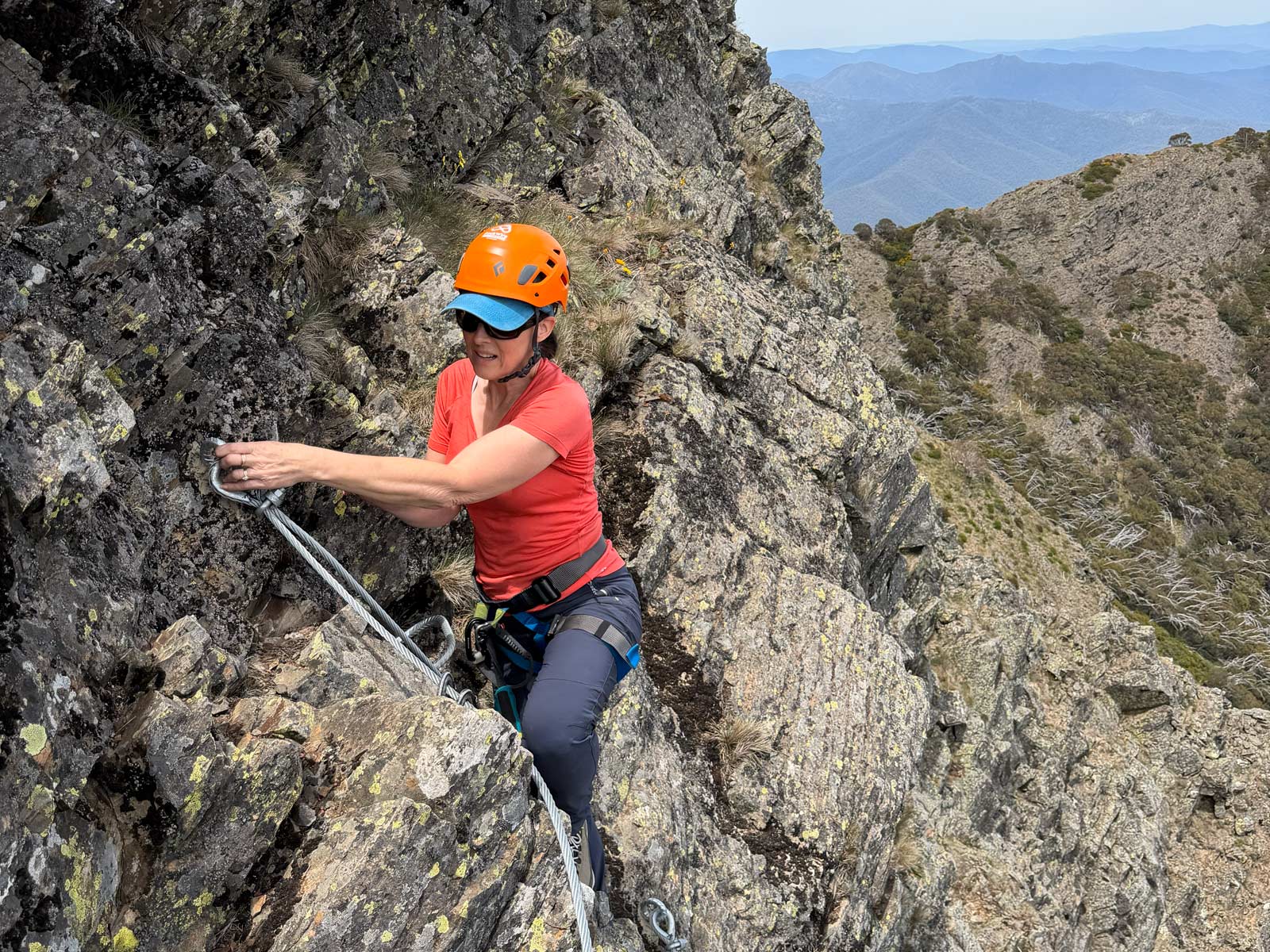
What Exactly is a Via Ferrata?
Imagine a steep, rugged mountain face made accessible by a series of ladders, steel rungs, and bridges, all linked by a thick steel cable fixed securely to the rock. Your role is to clip yourself onto this cable and follow its path, upwards and across the mountain.
You are always secured, but the feeling is anything but tame. You get all the heart-pumping exposure and jaw-dropping views of a climb, without needing the complex rope skills of a traditional climber. It’s a unique way to experience the mountains, placing you in wild positions you’d normally only see in adventure films.
The Non-Negotiable Gear and Why You Need It
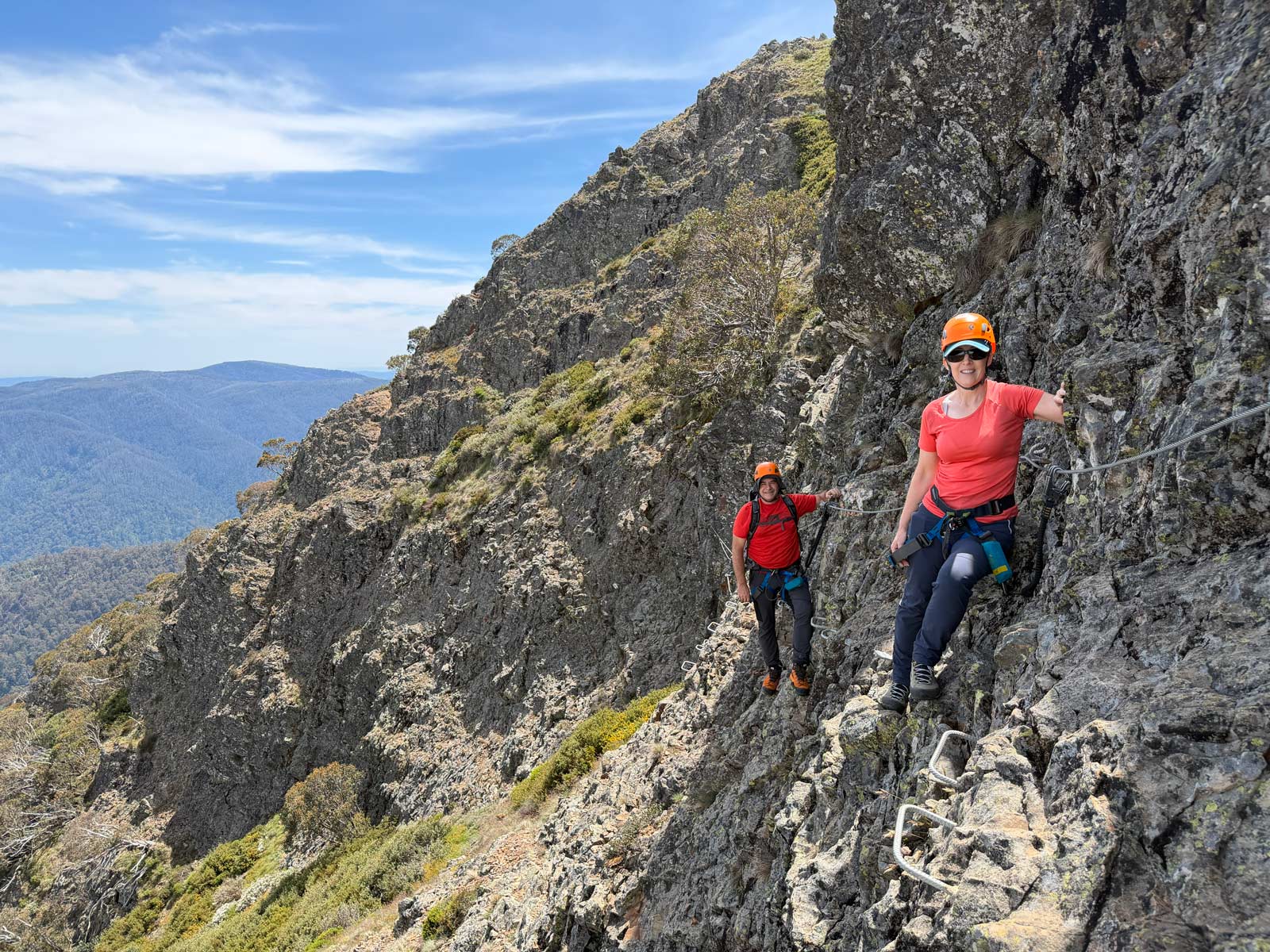
Safety on a Via Ferrata is an active process, and it starts with the right equipment. While gear is supplied on the guided tour at Mount Buller, understanding its purpose is key to your safety and confidence.
Helmet: This is your first line of defence. It protects your head from falling rocks dislodged by climbers above or natural causes, and also from impacts if you swing or bump into the rock face. Put your helmet on before entering any area with rockfall risk, ideally at the base of the route or even during the approach if terrain is loose or exposed. Keep it on until you’re completely clear of hazards.
Harness: A standard climbing sit harness is worn around your waist and upper legs. It’s the foundation of your safety system, attaching you to the via ferrata lanyard and distributing fall forces safely. Fit your harness before reaching the start of the route or any exposed terrain. Adjust it snugly above the hips, and double-back any manual buckles to prevent slippage.
Via Ferrata Lanyard (Energy-Absorbing System): This is the most specialised and important piece of kit. You cannot substitute it with simple slings or ropes. Here’s why:
- Y-Shaped Design: The lanyard has two arms, each with a special carabiner. This design allows you to stay 100% connected to the safety cable. When you reach an anchor point where the cable is fixed to the rock, you move one carabiner to the next section of cable before moving the second one. You are never fully detached.
- Energy Absorber: This is the small, zipped pouch located where the two arms meet the harness loop. In the event of a fall, this pouch rips open, deploying special internal stitching that absorbs the immense shock of the fall. It acts like a car’s crumple zone, slowing your deceleration and reducing the enormous force that would otherwise be transferred directly to your body.
- Specialised Carabiners: These are “Type K” carabiners (the ‘K’ is for Klettersteig, the German term for Via Ferrata). They have large gate openings to easily fit over the thick steel cables and locking mechanisms that are quick and simple to operate with one hand.
Gloves: While not technically a safety item, they are essential for comfort and performance. They protect your hands from blisters and cuts from the steel cable and give you a much better grip on cold, wet, or unforgiving metal rungs. Full-finger gloves are generally recommended for beginners, as they offer better overall protection, especially in rocky, cold, or high-exposure environments. Half-finger gloves provide more dexterity but leave fingertips vulnerable to abrasion and cold.
Sturdy Footwear: Your hiking boots or trail shoes with good grip are suitable for most beginner via ferrata routes. You’ll be standing on narrow rungs and small ledges, so solid traction and foot support are essential. For more technical or alpine routes, approach shoes offer sticky rubber soles (like climbing shoes) with the protection and flexibility of a hiking shoe, ideal for mixed scrambling and shorter, pack-light routes. However, if you’re tackling multi-day treks like the Alta Via’s in the Italian Dolomites with a heavy pack, well-fitted mid or high-cut hiking boots with excellent ankle support and cushioning are usually the better choice. You’ll sacrifice some grip on the cables and rungs compared to approach shoes, but you’ll gain much-needed stability and comfort over long distances and uneven terrain.
The Complete Via Ferrata Safety Guide
(For Guided Tours & Independent Climbers)
Whether you’re starting on a guided tour like the one at Mount Buller or planning your first independent trip to the Alps, these safety protocols are universal and non-negotiable. On a guided tour, your guide is your primary safety expert, listen to them. When you are on your own, you are solely responsible for your safety, which is why understanding every one of these points is critical.
Phase 1: Planning & Preparation
- Check the Weather: This is Rule Zero. Never climb if thunderstorms, high winds, or heavy rain are forecast. Lightning can turn the cable deadly, and wet rock makes footing treacherous. Cancel if storms are likely.
- Know Your Route: For independent trips, research the route’s grade, length, elevation gain, and estimated duration. Know whether it’s a loop, point-to-point, or out-and-back. Don’t assume you can retreat the way you came, descending a via ferrata can be more difficult and dangerous than continuing upward. Identify escape routes or bail-out options if available, and always start early to avoid storms and delays.
Phase 2: Gear & Personal Checks
- Harness Check: Before you even approach the route, ensure your harness is fitted snugly and that the waistbelt buckle is correctly “double-backed” if required by the design. (On a tour, your guide will check this, but it’s an important habit for independent climbing).
- Lanyard & Carabiners: Confirm you are using a modern, certified Via Ferrata lanyard with an energy absorber. Check that both
Type Kcarabiners lock correctly and that the gates operate smoothly.
Phase 3: On-Route Rules & Technique
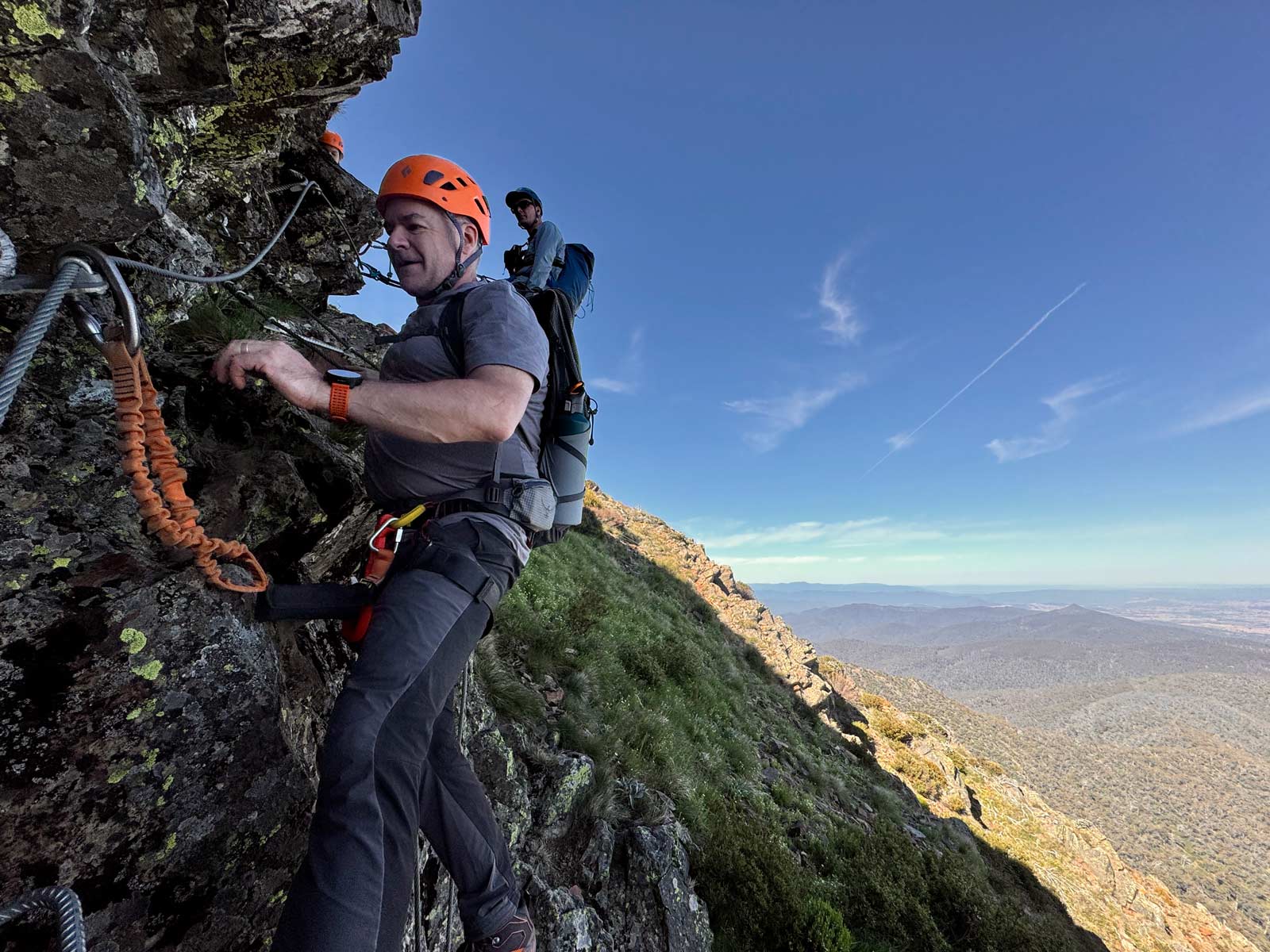
- One Person Per Cable Section: Only one person should ever be on a single stretch of cable between two anchor points. This prevents a falling climber from sliding into someone below, always maintain spacing.
- Anchor Transitions: Always move your carabiners one at a time when passing an anchor point. Securely clip the first carabiner to the new section of cable before unclipping the second one. You must remain attached by at least one point at all times. To reduce the risk of accidental unclipping, whether from user error or contact with rock or anchors, clip your carabiners in opposite orientations (one gate up, one gate down). This makes it harder to open both gates simultaneously.
- Minimise Slack: The further you fall before the energy absorber activates, the higher the impact force. Keep carabiners slightly above waist height to reduce fall distance and force.
- Test Holds First: Firmly tug on every metal rung and test every rock hold before committing your full body weight to it.
- Stay Upright & Use Your Legs: A common mistake is to pull too much with the arms. A Via Ferrata is a climb; use your powerful leg muscles to push yourself up. Stay upright and balanced, using your hands for support, not for hanging.
- Resting Safely: For short rests, find a solid foothold. For longer rests on strenuous routes, use a dedicated, non-elastic resting lanyard (often called a “cow’s tail”) attached to a rung. Never rest by hanging your full weight on your energy-absorbing lanyard, it’s designed for catching falls, not supporting weight.
- Watch for Rockfall: Step carefully to avoid dislodging loose stones. If you accidentally knock something loose or see a rock falling from above, immediately and loudly shout “ROCK!” to alert everyone below you.
- Pace Yourself: Move at a steady, confident pace. Don’t feel pressured to rush. Conserve your energy for the entire route. It’s a marathon, not a sprint, steady movement is safest.
Phase 4: What Happens If You Fall?
This is a question everyone should ask.
If you fall on a via ferrata route, your energy absorber may deploy as designed. The stitched webbing inside the absorber tears progressively to reduce the force placed on your body. It may prevent catastrophic injury, but it does not make the experience minor. Even a relatively short fall can leave you injured, winded, disoriented, or suspended in an awkward position.
Once an energy absorber deploys, your via ferrata set should generally be considered spent. It has done its job and should not be relied on to arrest another fall.
Your next priority is to stabilise yourself and assess your condition. Can you safely regain secure footing? Are you injured? Are you hanging in a position where suspension trauma could become a concern if you remain there for an extended period?
On guided routes such as RockWire Via Ferrata, guides are equipped to manage these incidents and coordinate evacuation if required.
On independent routes, particularly long alpine routes in places like the Dolomites, the situation can become far more complex. Some experienced climbers carry additional equipment for self-rescue or retreat, but that only helps if you have the training to use it properly. A resting lanyard can help you secure yourself temporarily at an anchor point, but it is not a substitute for a certified via ferrata fall-arrest system.
The real lesson is this: do not just plan for the climb itself. Understand the route, know your escape options, and ask what happens if things go wrong halfway through.
Phase 5: Mountain Etiquette
- Let Faster Climbers Pass: If a quicker party is behind you, find a safe, wide ledge or a secure anchor point to clip in and let them “play through.”
- Be Patient with Slower Climbers: Conversely, never crowd or pressure the person in front of you. Give them space to climb safely.
- Leave No Trace: The same rules as hiking apply. Pack out everything you pack in.
Australia’s Only Via Ferrata
A Taste of the Action at Mount Buller
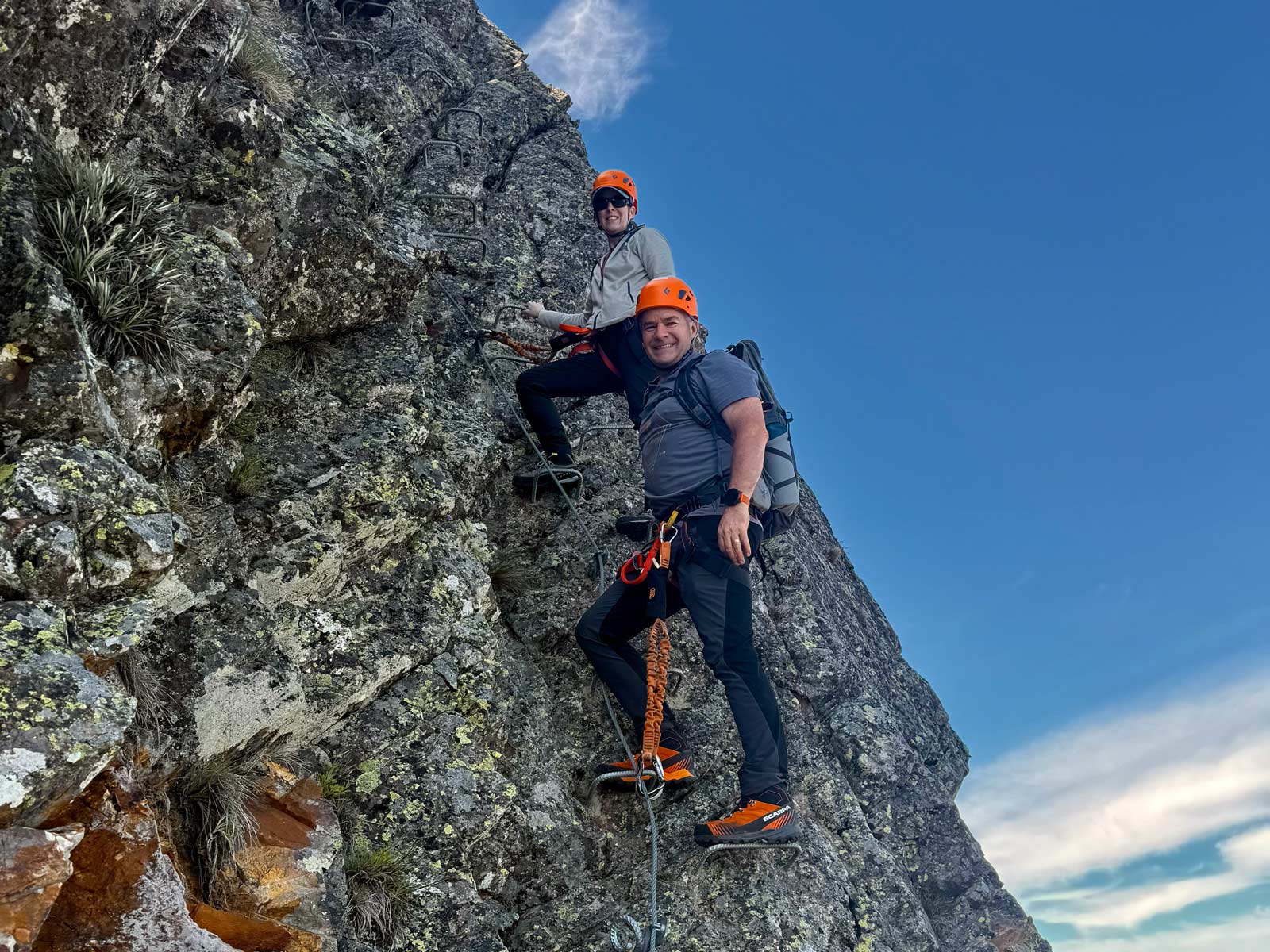
At the end of 2025, my wife Julie and I spent two full days on Mount Buller’s RockWire Via Ferrata, and it quickly became clear why this experience has become such a standout addition to Australia’s mountain adventures. We arrived curious and left genuinely impressed by both the routes and the professionalism of the experience.
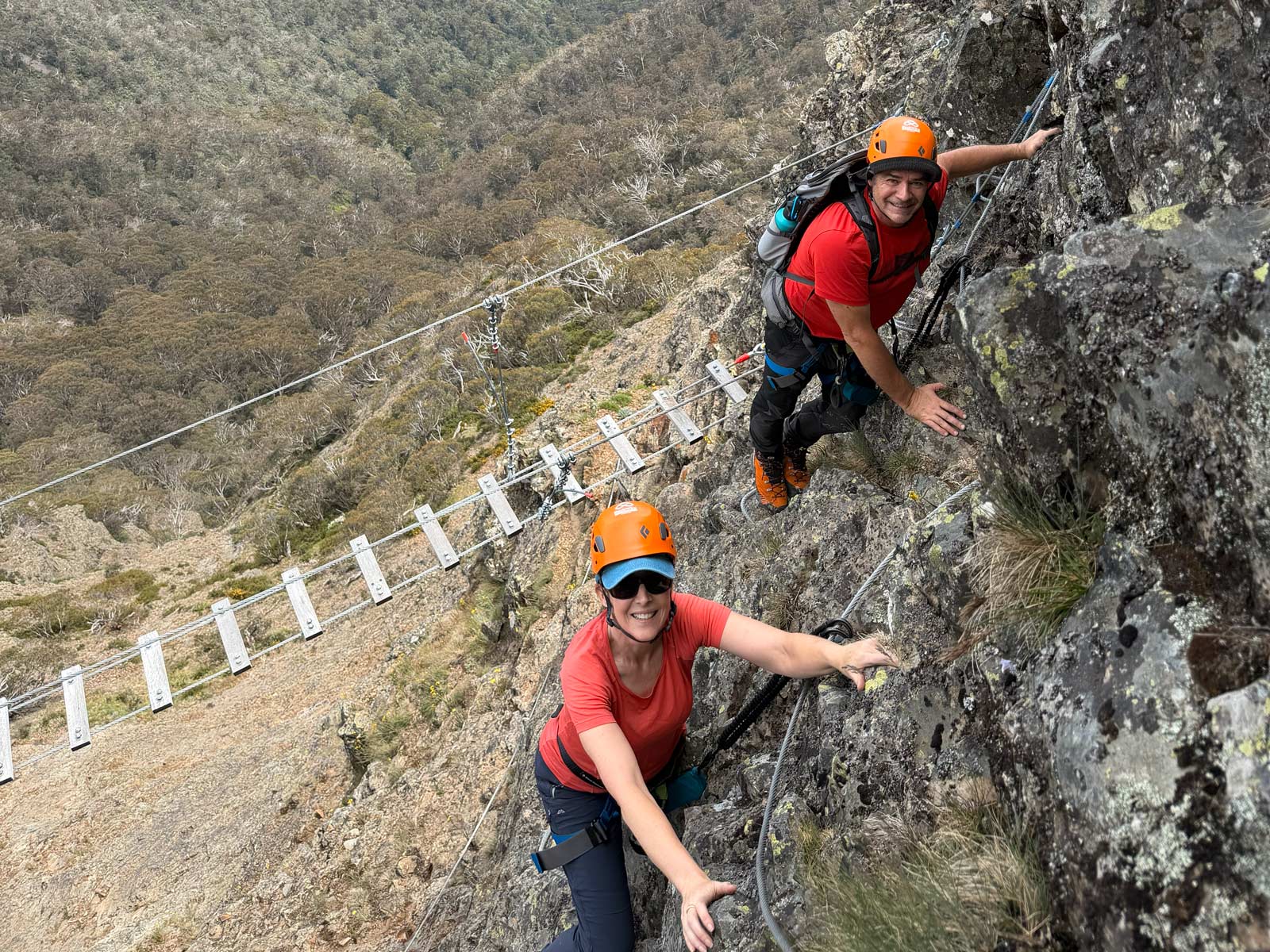
Route 1 is an ideal introduction to Via Ferrata. Designed for first timers, it uses a continuous lifeline system that adds an extra layer of reassurance and allows you to focus on movement, balance, and enjoying the exposure. The route traverses two main rock bands on the west face, linking wire ladders and suspension bridges that steadily build confidence while delivering expansive views across the alpine landscape.
Route 2 steps things up significantly. This is where the route moves fully onto the west face proper, with sustained near vertical climbing and a more traditional European style setup. RockWire uses the French anchoring system with standard Via Ferrata lanyards and double gated carabiners, creating a more technical and engaging experience for those comfortable with height and exposure. It is challenging, physical, and deeply rewarding.
What stood out most for us was not just the thrill of the climbing, but the experience of spending extended time on the rock face itself, suspended in a vast alpine setting that you would normally only glimpse from a lookout or summit. For hikers who enjoy scrambling or want to build confidence moving through steeper terrain, RockWire offers a safe and professional environment to develop those skills while doing something genuinely memorable.
As a guided experience, RockWire removes the complexity of route finding and safety management, allowing you to focus entirely on movement, technique, and the landscape around you. Whether it is your first step into vertical terrain or a way to push your comfort zone a little further, it fits naturally alongside hiking and scrambling in Australia’s alpine areas.
Is Via Ferrata For You?
Tempted to take your hiking boots vertical? Ask yourself these questions:
- Do you have a good head for heights? You will be in very exposed places with sheer drops below you. This is the biggest factor, but it’s something you can build confidence with over time.
- What’s your fitness like? You need solid hiking fitness, but also a different kind of strength in your upper body, grip, and core. You’ll be pulling on rungs, maintaining balance, and spending far more time using your upper body than you would on a normal hike.
- Are you looking for a new challenge? If you love the mountains but are ready for something more thrilling than a walking trail, Via Ferrata could be your perfect next step.
A Great Way to Prepare: Try Indoor Rock Climbing
Before you even book a trip to the mountains, the best way to answer these questions and build the right skills is to visit your local indoor rock climbing or bouldering gym. It’s a fantastic way to:
- Build specific strength in your grip, arms, and back.
- Learn basic climbing movement and how to use your feet effectively.
- Get comfortable with heights and the feeling of being in a harness in a safe environment.
If you find you enjoy the movement and challenge of a climbing gym, you’ll likely love the adventure of a via ferrata.
The “iron path” offers a unique way to connect with the mountain environment, pushing your boundaries and rewarding you with unforgettable experiences. And if you want to experience it for yourself, you can start right here in Australia, at RockWire Via Ferrata at Mount Buller.




Have you tried the RockWire Via Ferrata at Mount Buller? Or are you dreaming of tackling the classics in the Alps? Share your thoughts and questions in the comments below.
Have you tried Via Ferrata before? What’s your favourite climbing spot or outdoor adventure that really pushed your limits?
Trail Hiking Australia I did this one. It was a fabulous way for me to push my limits and challenge myself. Very rewarding.
Rachael Coutts excellent. it certainly is a lot of fun. Was much better than I had expected to be honest.
You’ve talked a lot about how to use a Via Ferrata safely but I have one question. Let’s say you have a fall, go zipping down the cable then the lanyard pulls you up safely, with the tape in it unravelling to absorb excessive force. What do you do next?
(It seems to me to be a real problem because you no longer have a functioning lanyard, at least in terms of its energy absorbing capacity and your still stuck up on a mountain side.)
Hey James, excellent question.
You’re correct that once a via ferrata energy absorber deploys, that set should be considered spent. It has done its job, but it’s no longer something you should trust for another significant fall.
What happens next depends on the situation. First priority is checking for injury, stabilising yourself, and getting onto secure footing if possible. If you’re on a guided route like Mount Buller, your guides would manage the rescue and evacuation process.
On independent routes, this is where things become much more serious. Some experienced climbers carry additional equipment for self-rescue or retreat, but that requires proper training and shouldn’t be improvised. A resting lanyard can help you stabilise yourself at an anchor point, but it is not a substitute for a proper via ferrata fall system.
This is also one of the reasons route choice matters. On long alpine via ferratas, you need to think beyond just “can I climb this?” and ask “what happens if something goes wrong halfway through?”
Great question. I’ll likely update the article to include a section on this because it’s an important point.