Ancient Gorges and Iron-Rich Ranges of Karijini
Overview
Karijini National Park sits in the Hamersley Range in the Pilbara and covers 627,444 hectares, making it one of Western Australia’s largest national parks. It lies inland from the Pilbara coast and centres on a high plateau cut through by deep gorges, escarpments and watercourses that give the park its striking shape.
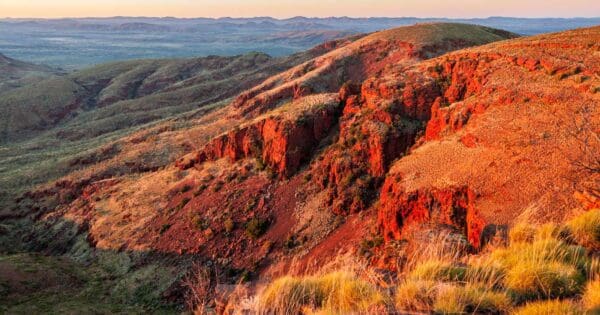
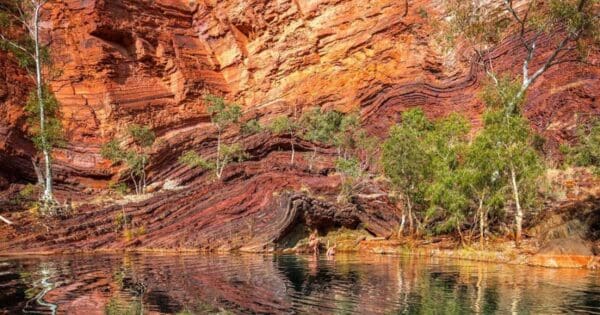
What sets Karijini apart is the age and structure of the country itself. Much of the exposed rock is around 2,500 million years old, and the park’s character comes from hard, iron-rich layers that have been carved into sheer-sided gorges, terraced cliffs, pools and waterfalls over immense time.
Highlights
The big draw here is the landform. Karijini is known for its deep gorge system, where narrow chasms suddenly open below the plateau and reveal bands of red and orange rock, ledges, cliffs and permanent pools. Across the park, erosion has cut through banded iron formations, dolomite, shale and chert to create some of the most distinctive inland scenery in Western Australia.
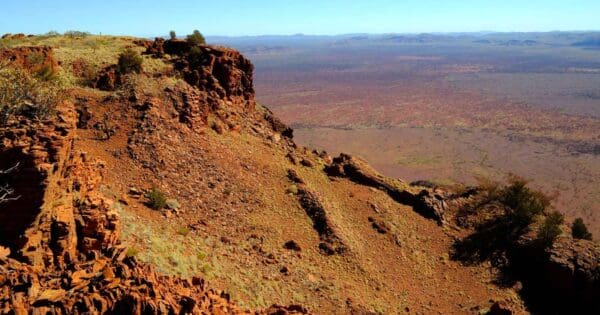
Beyond the gorges, the wider landscape has just as much presence. Mountains and escarpments rise above broad valleys, and the high country is marked by exposed ridgelines, stony plains and terraced rock faces. It is a place where geology shapes almost every view.
Best Time to Visit
The more comfortable months are generally the cooler part of the year, when winter temperatures are moderate rather than intensely hot. Summer in Karijini is usually very hot, with rainfall falling mainly between November and April and January and February tending to be the wettest months. September and October are typically the driest.
Plants and Animals
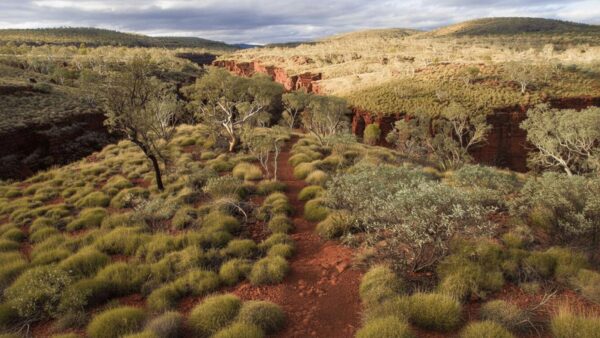
Karijini sits in an important transition zone between mulga country and Triodia grasslands, so the vegetation changes noticeably from the uplands to the valleys and gorges. Snappy gum is a dominant tree on the higher country, while valley plains support mulga shrublands with gidgee, Senna and Eremophila. In sheltered gorges, permanent water and shade allow a different set of plants to persist, including river red gum, coolabah and paperbark along some watercourses and pools.
The park supports a rich fauna assemblage, with at least 30 native mammal species, 133 bird species, 90 reptile and amphibian species, and eight fish species recorded. Hummock grasslands, mulga woodlands and the vegetation fringing pools and streams each provide different habitat, and that variety is a big part of why the animal life here is so diverse. Species recorded in the park include Spinifex Pigeon, Zebra Finch, Painted Finch, Pilbara Ningaui, Little Red Antechinus and Flat-shelled Tortoise.
Culture and Heritage
Karijini has strong and continuing cultural connections for Aboriginal people with traditional responsibility for this country. The park is associated specifically with three major language groups: Panyjima, Kurrama and Yinhawangka. In broad terms, the northern part of the park lies within Panyjima country, the southern part within Yinhawangka country, and the western central area includes Kurrama interests shared in part with Yinhawangka.
These connections are not just historical. Traditional ties, law and cultural beliefs remain closely linked to the area, and sacred sites within the park continue to be respected. The park is also archaeologically significant, with evidence of long Aboriginal occupation and cultural material including petroglyphs.