Hike at a Glance
Max elevation: 0m
Min elevation: 0m
Total Ascent: 0m
Important info
Walkers should always be well prepared before setting out in Tasmania’s parks. Check the conditions, carry suitable equipment, let someone know your plans, and be ready to adjust them if the weather changes.
Hike overview
The Mount Duncan Track offers a rewarding day walk through the heart of the Dial Range Reserves in northwest Tasmania. Stretching for about 8 kilometres return, this Grade 3 trail typically takes around four hours to complete and is well-suited to walkers with some bushwalking experience. Beginning at the Mount Gnomon carpark, the track gradually winds its way uphill toward the highest peak in the range, surrounded by a beautiful mix of forest and ferns.
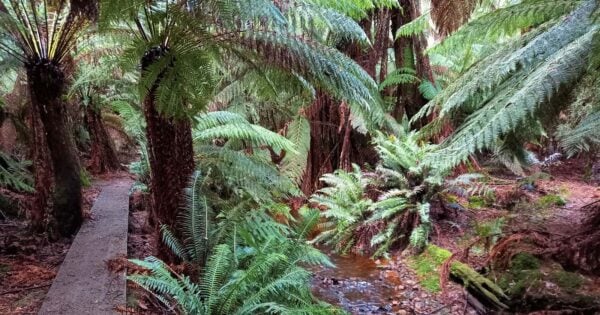
The walk begins by following Dial Road for roughly 500 metres until it meets the Tall Trees Track. This linking route sets the tone for the experience ahead, drawing you into a landscape rich with the scent of eucalypts and the soft murmur of the bush. You’ll soon find yourself beneath towering trees, descending gently through a shaded understorey of lush tree ferns before tracing the path of Dial Creek. The cool, damp air of this section contrasts with the drier slopes above, revealing how the vegetation shifts with changes in elevation and light.
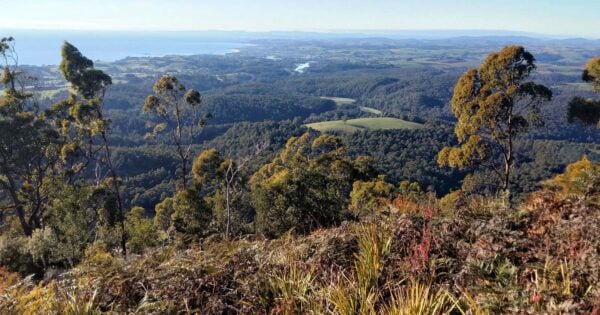
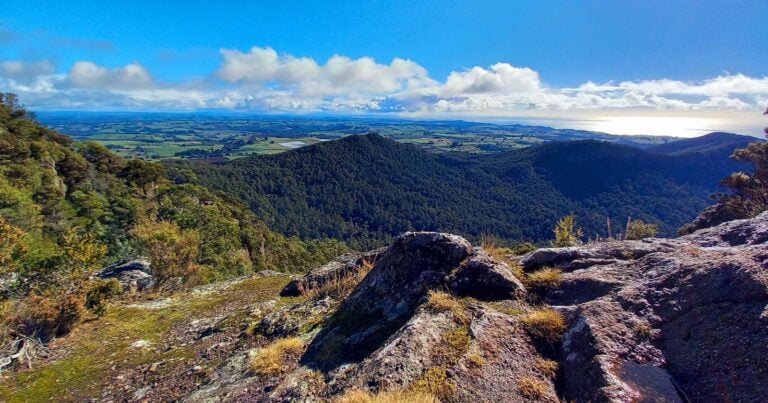
As you climb higher, the forest opens up and glimpses of the surrounding peaks and coastline begin to appear through the canopy. The Tall Trees Track continues to a signed junction where you can choose to return the way you came or continue along the route to the summit of Mount Duncan. From this point, the track steepens slightly, gaining about 300 metres of elevation from the carpark to the top, but the effort is well rewarded.
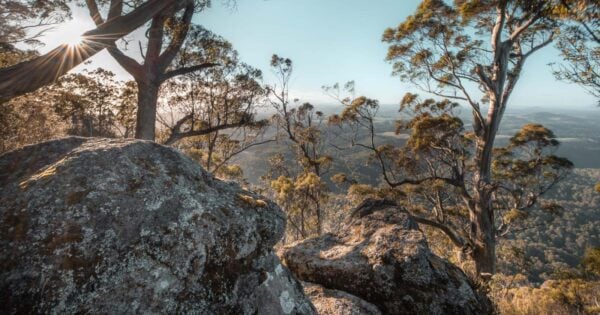
At the summit, you’ll stand on the highest point of the Dial Range, surrounded by views that stretch across to other nearby peaks and out toward the north-west coast. On a clear day, the landscape unfolds in every direction, while on misty days, clouds drift across the ridgelines and weave through the trees, giving the mountain a quiet, otherworldly feel.
The return journey retraces your steps, offering a chance to notice details you might have missed on the way up, the changing textures of bark, the calls of birds hidden in the canopy, and the gentle trickle of the creek below. For those looking to extend their adventure, the Mount Duncan walk can easily be combined with the Mount Gnomon Lookout Track, which starts from the same carpark, providing another perspective on this diverse and scenic reserve.
Tips
- Dogs, horses, mountain bikes, and motorbikes are not permitted on the track.
- There are no toilet facilities along the route. The nearest public toilets are located about six minutes away at the Ferndene Gorge State Reserve picnic area.
Track grade
Grade 3 (Moderate) - Walks for Most Fitness Levels: Grade 3 on the AWTGS represents moderate walking tracks. These are ideal for walkers with some fitness who are comfortable with some hills and uneven terrain. While suitable for most ages, some bushwalking experience is recommended to ensure a safe and enjoyable experience. Tracks may have short, steep hill sections, a rough surface, and many steps. The total distance of a Grade 3 walk can be up to 20 kilometers.
Walk map and GPX file
Max elevation: 658 m
Min elevation: 152 m
Total climbing: 927 m
Total descent: -928 m
Content use
Please don’t copy GPX files or content from this site to AllTrails or other platforms. Each trail has been personally mapped, documented, and refined to support Australia’s bushwalking and hiking community. While some details come from land managers, every listing reflects significant personal effort. This is a free, community-driven initiative—your respect helps keep it that way.
Gallery
Got any photos from this hike? Your photos can help others plan. Share shots from along the trail so fellow hikers know what to expect.
Click to add your photos >>
Getting there
Getting to the trailhead: Dial Range Reserves.
The Mount Duncan walking track begins from the Mount Gnomon carpark, about a 25-minute drive from Ulverstone, roughly 20 kilometres away. To get there, head west towards Burnie along the A1 Bass Highway and take the South Road exit towards Penguin. From there, turn onto Sports Complex Avenue, then left onto Ironcliffe Road, and continue for approximately 8.6 kilometres. The final 1.7 kilometres of the road are unsealed but generally suitable for most vehicles. Parking is available at the trailhead, located at the junction of Ironcliffe Road and Dial Road. When travelling through these reserves, try to avoid driving at night, as native wildlife is often active on the roads. Take it slow and keep an eye out for animals to ensure a safe journey.
Need a rental car to get you to the hike? Find one here.
About the region
Dial Range Reserves
Tucked away in northwest Tasmania, just south of the coastal town of Penguin, the Dial Range Reserves span a rugged 52 square kilometres of diverse terrain. This striking landscape tells a geological story of ancient volcanic activity and sedimentary processes later reshaped by early mining efforts. The result is a dramatic mix of peaks and valleys, with Mount Gnomon standing out on the northern skyline. Walkers can explore a wide variety of trails that wind through forests, over ridgelines, and across rocky slopes, revealing ever-changing views and vegetation shaped by altitude, aspect, and soil type.
The range offers something for everyone, from gentle forest walks to steep climbs that lead to panoramic coastal and inland views. Trails transition through dry eucalypt forests, damp gullies filled with swamp gums and blackwoods, and heathlands that come alive with colour in spring. Popular peaks such as Mount Dial, Mount Montgomery, and Mount Duncan provide unique vantage points, while shared paths also cater to trail runners and mountain bikers. Whether you’re after a short stroll or a challenging full-day hike, the Dial Range Reserves promise a rewarding experience rich in natural beauty and variety.
Mount Dial Nature Recreation Area
Nestled within the Dial Range of northwest Tasmania, around six kilometres south of the coastal town of Penguin, the Mount Dial Nature Recreation Area is a gateway to some of the region’s most scenic forested walks. Managed by the Parks and Wildlife Service Tasmania, it sits among neighbouring reserves such as Mount Montgomery and Ferndene, forming a connected network of protected landscapes that highlight the diversity of Tasmania’s natural environment. The range stretches for about 14 kilometres, featuring a series of distinctive peaks including Mount Gnomon, Mount Duncan, Mount Riana, and Mount Lorymer. Mount Dial itself lies near the centre, offering a convenient starting point for exploring the surrounding trails, which vary from gentle forest walks to more challenging climbs that reveal sweeping coastal and inland views.
The landscape here tells a story of ancient volcanic forces and human history. The mountain slopes are shaped by layers of conglomerate, dolerite, sandstone, and volcanic rock, with remnants of early mining visible in places such as Ferndene State Reserve. Vegetation shifts with the terrain, ranging from dense wet eucalypt forest to open grassland and heath, supporting an abundance of wildlife and several threatened plant communities, including Eucalyptus amygdalina forest and woodland on sandstone. Whether you’re seeking a short stroll beneath tall eucalypts, a day-long bushwalk through rugged country, or a connected hike linking multiple peaks, the Mount Dial Nature Recreation Area offers a rich and varied experience for walkers of all levels.
Let someone know
Heading out? Fill in a trip intentions form so someone knows your plans. If things go wrong, they can raise the alarm fast, giving you peace of mind on the trail.
Similar walks nearby
Looking for more walks in or near Dial Range Reserves? Try these trails with a similar difficulty grade.
Suggest an edit
Notice something different about this trail? Whether it’s a new feature, a route change, or a closure, share your update so we can keep our info accurate and helpful for fellow hikers.
Click to suggest edits >>
Explore safe
Plan ahead and hike safely! Carry enough water, pack layers for changing conditions, and bring safety gear like a torch, PLB, and reliable communication device. Check official sources for trail updates, closures, and access requirements, and review local weather and bushfire advice. Most importantly, share your plans with someone before you go. Being prepared makes for a safer and more enjoyable hike! Stay Safe, Explore More, and Always #ExploreSafe.
Packing checklists
What you carry in your pack depends on factors like weather, terrain, and your adventure type. Not sure what to bring? My free planning, food, and packing checklists are a great starting point, covering day hikes, overnight trips, and multi-day adventures. Use them to customise your kit and always prioritise safety.
Acknowledgement of Country
Trail Hiking Australia acknowledges the Traditional Owners of the lands on which we hike and pay respects to their Elders, past and present, and we acknowledge the First Nations people of other communities who may be here today.