Registration and Permits
Registering for the Frenchman's Cap Track helps the Parks and Wildlife Service manage visitor numbers and minimise the impact on the sensitive remote bushwalking environment. Daily departures are limited to a maximum of 10 people. Registration is required only for the day of departure. Walkers must move to the next campsite each day. The maximum stay is three nights, with the itinerary typically being one night at Vera Hut, one night at Tahune Hut, and a final night back at Vera Hut. If plans change and the walk will no longer be undertaken, it is essential to cancel the registration. This allows others the opportunity to book the track. Instructions for cancellation can be found in the confirmation email. A valid national parks pass is required for the hike. This can be purchased online in advance via this link.
Hut Accommodation
The Frenchman's Cap hike features two huts: Vera Hut at Lake Vera, which accommodates 20 people, and Tahune Hut at Lake Tahune, which can sleep 24. Both locations offer tent platforms for additional accommodation. In the event that a hut is fully occupied or if an emergency arises between huts, such as an injury or severe weather, hikers are required to carry a tent for shelter. Vera Hut and Tahune Hut are open with limited capacity and use of huts cannot be booked. All walkers must carry a quality tent (3-4 season rating with inner and outer layer). Each hut and camping area is equipped with a rainwater tank and a toilet. Neither hut provides mattresses or cooking facilities. This area is designated as a Fuel Stove Only Zone; open fires are prohibited. For further information on fuel stove regulations, refer to the Fuel Stove Only Areas webpage. While there are no permanent rangers stationed on the track, a track ranger is present at one of the huts during the summer months. The start of the track lies in the heart of the Tasmanian Wilderness World Heritage Area. There is no accommodation or facilities. The closest hotels and other facilities are at Derwent Bridge or Queenstown.
When to walk
The months of December-April have long daylight hours and warmer average temperatures. However, walkers are warned that rapidly changing weather conditions can occur at any time of the year. These can include howling winds, sleet, snow, relentless rain and blazing sun. All of these varied conditions can be experienced even within a single day. Weather forecasts can be obtained from the Bureau of Meteorology.
What to bring
Weather conditions in Tasmania, particularly in alpine areas, can change rapidly and unpredictably. Snow, rain, wind, and sun can all occur at any time of the year, with bushfires also posing a risk between October and March. When visiting alpine regions, it is important to be well-prepared beyond basic walking gear. Essential items include a waterproof jacket with a hood and storm front (made from seam-sealed and breathable fabric such as Gore-Tex), waterproof over-trousers (also seam-sealed and breathable), sturdy walking boots, and warm clothing, including a fleece or woollen jumper, thermal base layers, hat, and gloves. There have been fatalities due to inadequate preparation in cold, wet, and windy conditions. Vulnerable groups, including children, older adults, and those with health issues or disabilities, are particularly at risk in such environments.
Maps
The 1:50,000 scale map called 'Frenchmans Cap Map And Notes' is needed for this walk. It shows the track, huts, plus walking notes and safety information on the reverse. You can get the map from outdoor gear shops, and online at TASMAP.
Walker Logbooks
For your safety please record your trip intentions in the log book at the Franklin River (near the start of the walk) and also in the logbook at each hut. Accurate logbook information also provides the statistical basis for proper management of the area. Please remember to sign out at the end of your walk. Your entries may save your life should you become lost or overdue. However, the books are not checked regularly and a search will only be mounted if someone reports you as being overdue. Leave details of your trip with a reliable friend or relative. If this is not possible, a trip intentions form can be completed and left at the visitor centre at Lake St Clair, or you may wish to register and de-register your trip at a Tasmanian Police Station.
Water
Few places on Earth have water as pristine as in the Tasmanian wilderness. Of course, the water within our national parks is not treated. It may therefore not meet the National Health and Medical Research Council's Guidelines for drinking water. The Tasmanian Department of Health and Human Services thus advises that as a precautionary measure, untreated water should be boiled (1-3 minutes) before drinking or being used for food preparation. Other forms of water treatment (iodine, water filters) may also be used. Take special care to keep water supplies clean, particularly around the huts. Always wash 100m away from streams and lakes, and do not use soaps and detergents. Don't throw food scraps into streams or lakes. Both huts have tanks for collection of rainwater.
Toilets
Modern composting toilets have been installed near both huts. To ensure efficient operation of the toilets, please follow the instructions provided. In areas away from the toilets, faecal waste must be buried 100m away from any watercourses or campsites. Carry a lightweight trowel in your pack, dig a hole 15 cm deep and bury your waste and toilet paper. Cover it well to deter animals.
Fuel Stove Only Area
You will require fuel stoves for cooking as the entire track is within a Fuel Stove Only Area. Heavy fines can be imposed for lighting of fires in these areas. Devastating wildfires have ravaged the Frenchmans Cap area twice in recent decades. In 1966 much of the area around Artichoke Valley and Lake Tahune was burnt. Regeneration of alpine plants is extremely slow and, in the case of the King Billy pines there are still no young seedlings in localities where all the parent trees were killed. In 1980 a campfire at Lake Vera caused more than 6000 ha of the Franklin-Gordon Wild Rivers National Park to be burnt. Both of these wildfires were the result of carelessness and could have been avoided. Fires are permitted only in the heating stoves at Tahune and Lake Vera Huts.
Walk softly
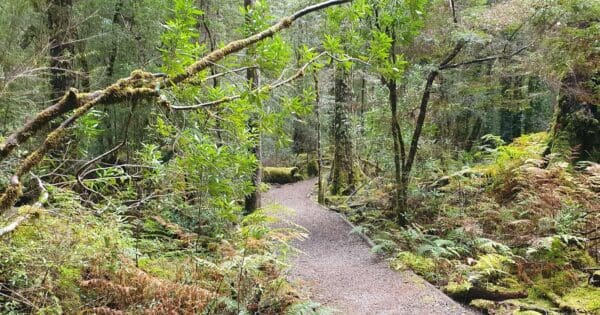
Keep on track: Recent track work has greatly improved access across the once notorious 'Sodden Loddens', an area infamous for its mud. (James Calder complained about the mud in 1840!) There are still muddy patches, however, as is typical of wilderness walks in southwest Tasmania. You can keep some mud out of your boots by wearing gaiters, but don't bother trying to keep your boots dry, it's a waste of effort! Try and minimise your impact with every step you take. Always walk in the centre of the track and be prepared to walk through the mud - attempting to skirt bogs only makes them bigger and causes more environmental damage. It is also usually much quicker to walk straight through. In places you will notice many young King Billy pines regenerating where once was trampled earth, so please stay on the track!
Beyond Philps Lead, the track is either fairly firm underfoot, or has boardwalks or steps.
Track upgrading is occurring in places, mostly at high altitudes where trampled vegetation is slow to regenerate. The alpine vegetation above Lake Tahune is particularly sensitive to trampling and is extremely slow to regenerate. You can assist in minimising damage by stepping on rocks, rather than vegetation, whenever possible.
Group size: Keep your party size to no more than 6 people. Large groups can be difficult to accommodate at huts and campsites and have greater social and environmental impact.
Phytophthora root rot: Phytophthora cinnamomi is a fungus that kills many of our native plants. Mud and soil, which is carried on vehicles, boots, gaiters and toilet trowel, helps to spread the disease.The Frenchmans Cap Track is currently free of Phytophthora. To prevent infecting this area your boots and all gear that comes in contact with the soil should be cleaned of any mud or dirt prior to your walk. You will come across a washdown station about 20 minutes from the start of the walk. It is vital that you use this facility. Please follow the directions at the washdown station. For further details see our Phytophthora root rot pages.
Campsites: Do not camp within 30 metres of lakes and streams as these areas erode most easily. Carry something for collecting water so as to limit the number of trips that need to be made for water (a well rinsed, empty wine cask bladder is recommended). Do not dig drains around tents.
Dishwashing: Use hot water and a scourer to clean plates and cookware. Soaps and detergents are not welcome in the bush. Despite their name, biodegradable products still impact on water-life. Dish washing should be done 50 metres away from water and the waste water scattered.
Keep wildlife wild: Animals such as possums and native mice can carry disease by licking your cookware and cause rubbish to be scattered when they break into garbage bags. At night, hang your food and rubbish in the huts or stow securely in your packs. The vestibule of your tent is not a secure place. Rigid plastic containers are useful for storing food. Do not feed animals and ensure that no food scraps are left in huts or outside. Processed food is not part of their natural diet and, in some cases, can lead to the death of native animals, as well as result in unnaturally high populations occurring in the vicinity of huts. See our web pages on keeping wildlife wild for more details.
Rubbish: All rubbish must be carried out with you. Rubbish includes cigarette butts!
- Do not attempt to burn any rubbish in the hut stoves. Much of it will fall through the stove grates and be discarded as litter outside the huts.
- Please don't put any rubbish into the composting toilets, as this restricts the composting process. Used sanitary pads, tampons, condoms and baby nappies are items of litter and must be carried out.
- Please leave the huts clean and tidy. Don't leave unwanted food and clothing in the huts.
- For more information on walking softly, please read the Essential Bushwalking Guide and Trip Planner.





/Frenchmans-Cap-Hike_154.jpg "Frenchmans Cap Hike (46km)")
/Frenchmans-Cap-Hike_103.jpg "Frenchmans Cap Hike (46km)")
/Frenchmans-Cap-Hike_86.jpg "Frenchmans Cap Hike (46km)")
/Frenchmans-Cap-Hike_45.jpg "Frenchmans Cap Hike (46km)")
/Frenchmans-Cap-Hike_124.jpg "Frenchmans Cap Hike (46km)")
/Frenchmans-Cap-Hike_76.jpg "Frenchmans Cap Hike (46km)")
/Frenchmans-Cap-Hike_40.jpg "Frenchmans Cap Hike (46km)")
/Frenchmans-Cap-Hike_111.jpg "Frenchmans Cap Hike (46km)")
/Frenchmans-Cap-Hike_57.jpg "Frenchmans Cap Hike (46km)")
/Frenchmans-Cap-Hike_175.jpg "Frenchmans Cap Hike (46km)")
/Frenchmans-Cap-Hike_187.jpg "Frenchmans Cap Hike (46km)")
/Frenchmans-Cap-Hike_85.jpg "Frenchmans Cap Hike (46km)")
/Frenchmans-Cap-Hike_166.jpg "Frenchmans Cap Hike (46km)")
/Frenchmans-Cap-Hike_34.jpg "Frenchmans Cap Hike (46km)")
/Frenchmans-Cap-Hike_36.jpg "Frenchmans Cap Hike (46km)")




9 Reviews on “Frenchmans Cap Hike (46km)”
Danielle Bartlett keen when its get warmer? ??
Fantastic walk!
Nathen Bush
Need to move to Tasmania.
Peter Fisher omg yeah??
Steven Anderson
Yessssssssss!!! ????