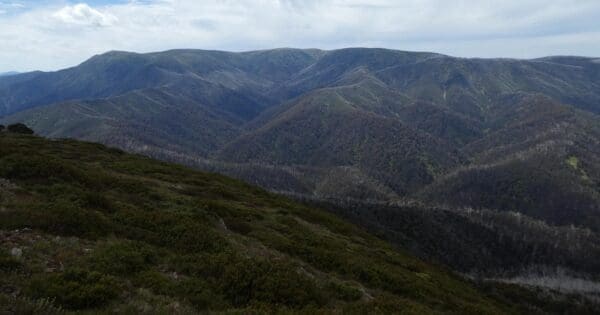
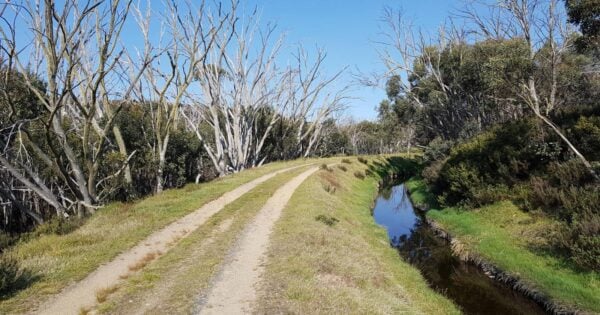
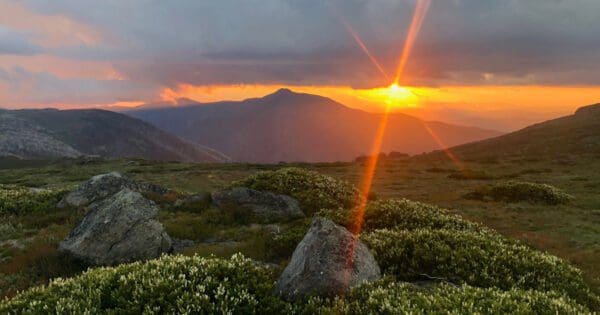
The Bogong-Hotham Alpine Circuit is a 155 kilometre interconnected alpine hike linking Falls Creek, Mount Bogong, Mount Hotham, Harrietville and Mount Feathertop. It combines extended high-country ridge travel above 1700 metres with major valley descents to Big River and Harrietville, followed by sustained re-ascents via defined spur systems. The route demands strong fitness, sound navigation skills and careful weather planning.
This is not a conventional single-loop walk. It incorporates multiple major alpine sub-loops connected by the Bogong High Plains and the Australian Alps Walking Track corridor. Elevation changes are significant, including a descent to approximately 1050 metres at Big River and to around 500 metres at Harrietville, followed by long climbs back to the alpine plateau. Exposure, river crossings and extended spur ascents define the character of this circuit.
Due to variable water availability, alpine weather and dispersed camping conditions, this route is presented in terrain-based sections rather than a fixed day-by-day itinerary. Camp locations across this region are dispersed and condition-dependent. Alpine huts are emergency shelters only and must not be used for overnight accommodation, although camping is permitted in the surrounding area.
The section breakdown below outlines the terrain, elevation profile, key junctions and navigation considerations for each part of the circuit, enabling walkers to plan their own staging based on fitness, conditions and seasonal factors.
Section 1 – Falls Creek to Mount Nelse North (approx. 24 km)
Direction of travel: Clockwise
The route departs Falls Creek at approximately 1600 metres and descends north-west toward Howmans Gap, losing elevation to cross Rocky Valley Creek below the gap. After the creek crossing and ford, the major climb begins. The ascent follows the Spion Kopje Track before joining the wider Spion Kopje Firetrail, climbing from roughly 910 to 1835 metres at the Spion Kopje summit. Contours are tightly packed on this spur, indicating a sustained and physically demanding ascent.
From Little Spion Kopje the route gains the crest and transitions to exposed ridge travel. The alignment follows Grey Hills Track eastward across open alpine terrain, remaining largely above 1700 metres. Vegetation shifts from snow gum woodland on the lower slopes to alpine heath and snowgrass on the exposed tops. Wind exposure increases significantly once clear of the treeline.
The Rocky Valley Creek crossing near Howmans Gap can be affected by heavy rainfall or water releases and should be assessed carefully. Beyond the climb, water becomes less reliable across the plateau until reaching upper catchments that feed toward the Big River system further east. Navigation across the broad high plains between Spion Kopje and Mount Nelse West relies on clear track awareness and pole markers, particularly in low cloud where terrain features flatten visually.
The section concludes near Mount Nelse North, where several major tracks intersect, including the Australian Alps Walking Track and routes descending toward Big River and Mount Bogong. Elevation remains high across the final kilometres, positioning walkers at the junction that marks the beginning of the Mount Bogong circuit.
Section 2 – Mount Bogong Circuit (approx. 38 km)
Direction of travel: Counter-clockwise
From Mount Nelse North the route heads north-west toward Camp Valley before climbing onto the Mount Bogong massif. Elevation increases from the high plateau near 1700 metres to the 1986 metre summit via the Eskdale Spur alignment. Contours tighten progressively through this section, indicating sustained and continuous ascent. The summit ridge extending toward West Peak is broad and fully exposed, with alpine heath and snowgrass dominating above the treeline.
From the summit area the circuit descends west and south via Quartz Ridge toward the Big River catchment. Contour spacing shows a long and decisive drop, with elevation falling to approximately 1050 metres at the Big River crossing. This descent is sustained and physically demanding under full pack weight, with forested slopes replacing open alpine vegetation as the route drops below the plateau.
The Big River crossing is a key safety point on this loop. In moderate conditions the ford is often knee-deep. After heavy rainfall it can become fast-flowing and hazardous. Water is generally reliable through this lower catchment, but route selection across spur junctions requires attention as multiple ridgelines branch toward the river.
From the river the circuit commits to a major re-ascent via defined spur lines back toward the high country near Mount Nelse West. This climb regains roughly 800 metres of elevation, returning to the 1800 metre saddle before reconnecting near Mount Nelse North. The length and vertical gain of this ascent make it one of the most demanding components of the entire 155 kilometre route.
Section 4 – Pole 333 – Mount Hotham – Harrietville – Feathertop Circuit – Pole 333 (approx. 56 km)
Direction of travel: Clockwise
From Pole 333 the route follows the Australian Alps Walking Track south-west across the Bogong High Plains toward Mount Loch and the Mount Hotham ridgeline. Elevation remains largely between 1700 and 1850 metres across open alpine grasslands and snow gum woodland. Navigation through the Mount Hotham area requires attention due to intersecting management tracks and ski infrastructure, though AAWT markers are generally clear.
From the Hotham heights the circuit commits to the Bon Accord Spur for a sustained western descent toward Harrietville. This drop from approximately 1750 metres to around 500 metres represents one of the largest elevation losses of the entire route. The spur is long and consistently steep, with extended downhill loading and limited water availability. Careful descent pacing is essential.
At Harrietville the route turns east and begins the major ascent via the Bungalow Spur Track. This historic packhorse route regains approximately 1200 metres in elevation to reach the Federation Hut area below Mount Feathertop. While the climb is significant, the gradient is comparatively well graded and consistent. Water may be available from creeks lower on the spur, but sources become limited higher on the ridge.
Rather than traversing the full length of the Razorback back toward Mount Hotham, the circuit intersects near the Feathertop–Razorback junction before trending north-east. The route descends via Diamantina Spur into the upper Kiewa catchment before climbing again to regain the Bogong High Plains. This eastern return bypasses the southern Razorback and Mount Hotham village area, ultimately reconnecting with the high plains network and returning to Pole 333 to complete the loop.
Section 5 – Pole 333 to Falls Creek via Mount McKay (approx. 15 km)
Direction of travel: Clockwise
From Pole 333 the route heads north-east across the Bogong High Plains, following the Australian Alps Walking Track toward Pretty Valley. Elevation remains largely between 1700 and 1800 metres across open alpine grassland with scattered snow gum woodland. The terrain is gently undulating and exposed, with broad visibility in clear conditions but minimal shelter in poor weather.
The track descends gradually toward Pretty Valley Pondage and the Pretty Valley Camping Area, dropping to approximately 1600 metres. Minor creek crossings occur in this section and may carry flow after rain or snowmelt. Several vehicle tracks intersect near the campground and pondage, requiring attention to AAWT markers and directional signage.
Beyond Pretty Valley the route climbs toward Mount McKay via the Mount McKay Track, regaining approximately 150 to 200 metres to reach around 1840 metres. The surface is predominantly firm management track. East of Mount McKay the route passes the distinctive Ruined Castle rock formations, a prominent landmark above Falls Creek and a reliable indicator that the village is near.
From the Ruined Castle ridge the track descends approximately 200 metres into the Falls Creek village bowl. The gradient is steady rather than steep, following management tracks and ski-run corridors. Multiple intersecting roads and service tracks require attention to signage to remain on the designated walking route into Falls Creek.