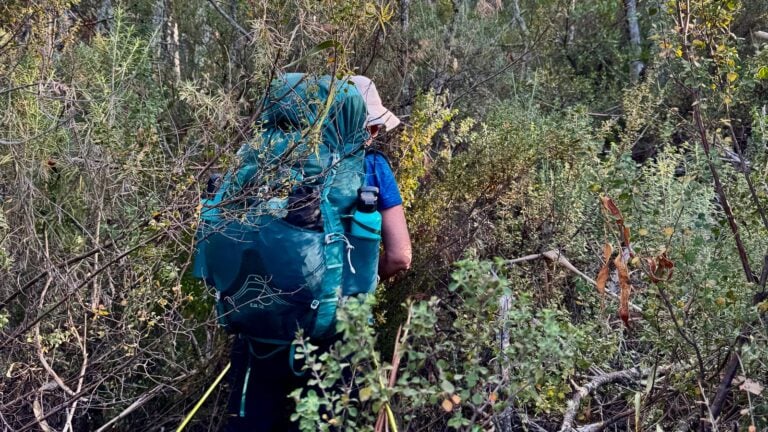
The trailhead feels like an escape, a place where the noise drops away and things become simple again. But as a search and rescue volunteer, I’ve seen the other side of that promise. The peace at the start is deceptive. When you step into the bush, you’re entering something entirely indifferent to your schedule, your gear, or your intentions. The Australian bush doesn’t care about your plan. Moving through it safely isn’t a checklist of items to buy. It’s a form of respect for a country that will shift the terms of your engagement without announcement.
In search and rescue, we rarely find victims of recklessness. Most incidents come from a series of decisions that were, in isolation, entirely sensible. People checked the distance, looked at the forecast, and felt confident. The danger was never a single catastrophic mistake. It’s a quiet erosion of buffer. The problem is a kind of psychological inertia, where hikers keep solving problems inside a static mental model of the hike, one that’s stopped reflecting what’s actually happening. The terrain gets thicker, the pace slows, the heat rises, and the plan stays unchanged anyway. Not recklessness, not ignorance, just a series of sensible decisions that failed to keep pace with changing conditions, until perception and reality quietly stopped being the same thing. Failure happens when the margin for error evaporates while you’re still solving for a version of the day that no longer exists.
Part of that gap comes from how the Australian Walking Track Grading System actually works. Grades 1 to 5 describe physical characteristics, not a safety guarantee, and the most dangerous misunderstanding sits right at the transition from Grade 3 to Grade 4. On a Grade 3 track, the environment is trail-guided, formed tracks and clear signage doing most of the navigational work for you. On a Grade 4 track, that responsibility shifts entirely onto you. Signage thins out, tracks go indistinct, and hazard identification and route-finding become your job, not the track’s. A Grade 4 rating doesn’t just mean harder. It means a different category of responsibility altogether. Someone who’s completed a Grade 4 coastal walk in the sun isn’t remotely prepared for a Grade 4 alpine route where the footpad disappears and the weather closes in. The grade is really just an invitation to ask what the number isn’t telling you about the conditions you’ll actually face today.
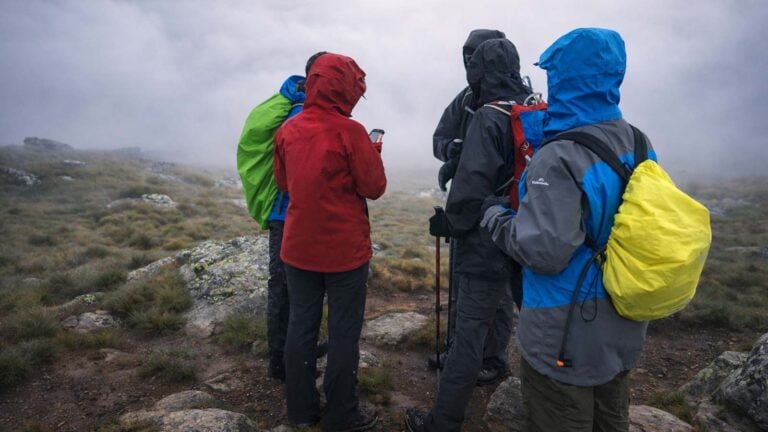
Weather in the Australian bush isn’t background, it’s an active participant. Hikers check a forecast and treat it as fixed, but terrain reshapes the atmosphere in ways a regional forecast simply can’t capture. I’ve stood at the base of Mount Anne in Tasmania under a clear blue sky, only to be met minutes later by horizontal hail and freezing fog, one side of my body staying dry while the other got hammered by ice until it felt frozen through. We turned back. As we descended, the sun returned and lit the peak up in brilliant light, which at first glance looks like a wasted trip. It isn’t. That clearing wasn’t evidence we should have stayed. It was evidence of exactly how volatile the conditions actually were. The weather doesn’t owe you confirmation that you made the right call. Turning back was the right decision because it preserved margin, regardless of what the sky did twenty minutes later.
Most hikers build linear plans: start at A, hold pace X, arrive at B. That structure is fragile. It breaks the moment reality diverges from the assumptions it was built on. What actually holds up expects friction and builds in conditional pathways instead. During a scramble on the Eagle Peaks Circuit, our group hit a near-vertical rock wall we’d defined as a decision point weeks earlier. I watched one hiker struggle, wide-eyed, breathing rapid, the stillness of a genuine threat response. When I asked if she was okay, she said yes, and it was the “yes” of ambition, not reality. Because we already had a rule in place, if any member isn’t comfortable, we turn back, we retraced our steps. Planning that can actually flex means asking three questions before the first step: where do things narrow, where does commitment increase, and what would make this a bad choice today?
One of the more counter-intuitive things about the trail is that the environment disables your internal sensors before it disables your body. Under stress, the brain defaults to the path of least cognitive resistance. Low on fuel and water, thinking narrows, reassessing a plan takes effort the brain’s no longer willing to spend, and you stop seeing nuance and start making simplified choices instead. I learned this in the shin-deep mud of the Overland Track. I was exhausted, the rain was relentless, and I genuinely couldn’t understand why I was there anymore. My judgement had collapsed into a single point of misery. After Julie forced me to sit down and eat, the world changed. The rain became weather again. The mud became a navigational challenge rather than a personal affront. Food and water aren’t just physical fuel. They restore the judgement actually needed to navigate a problem, which is exactly why eating and drinking on a schedule matters, because the hunger signal can’t be trusted once real stress arrives.
In high-stakes environments, smoothness and silence are warning signs, not reassurance. On a stretch of the Great Ocean Walk, I once watched a group that looked perfectly content. In reality, several members were out of water, and one woman’s lips had gone blue, she’d stopped perspiring entirely. The leader wasn’t looking for those signals because he believed a quiet group was a safe group. That’s the trap of shared optimism and diffused responsibility, where nobody wants to disrupt the group or admit they’re struggling. A group that’s actually functioning needs distributed, honest observation, structured check-ins, and a culture that values accuracy over social comfort. Silence is the signal. If a group’s stopped questioning the plan, the buffer has usually already gone.
Preparation doesn’t guarantee an easy day. It guarantees options, and on the trail, options are what actually keep you safe. The real question was never whether you have a plan. It’s whether you’re ready to recognise the moment that plan has stopped matching reality.
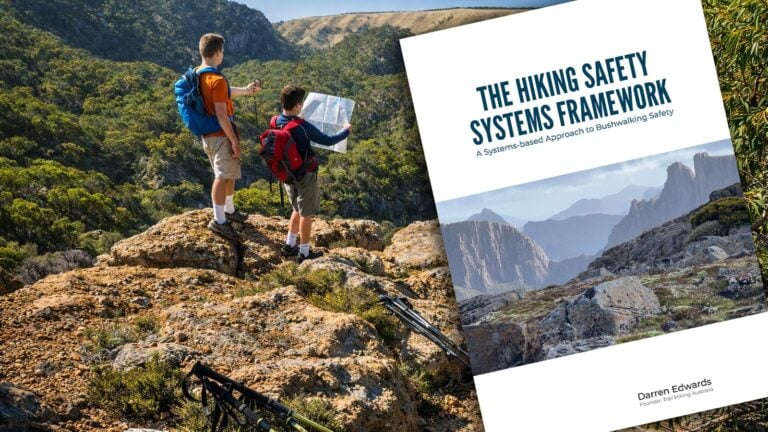
This article reflects the ideas explored in Hiking Australia: Before You Go and On the Trail, and the broader Hiking Safety Systems Framework. If you want to go deeper, explore the full framework, or apply it through structured scenarios and training, visit the Trail Hiking Australia resources hub.
This essay is part of the Hiking Safety Systems in Practice series, exploring how interconnected systems shape safety, decisions and outcomes on the trail. Explore the series →
The Safety Systems Series
If this way of thinking is new to you, these resources go further into how risk develops across a hike, and how to manage it more effectively:



The Australian bush doesn’t care about your plan, whereas the New Zealand alps will read your plan and say ” You think so? Here hold my beer Cuzzy Bro”….
🤣🤣🤣🏔
Dan McNab 😂 so true.
Valuable insights
Al Morkans Thank you, appreciate that.
I feel ego comes into play as well. This is not an insult on people, but a natural thing. Turning around can make you feel horrible in the moment even when you know it’s the right thing to do. Relief of doing so comes a bit later. When hiking alone especially I always have mapped out contingency plans (I can be a pessimist). Doesn’t mean I don’t feel blah walking back down the mountain or backtracking. I do try to focus on the fact it is just a different kind of adventure than the one I planned
Liz Marr you’re spot on. That moment of turning back often feels like failure, even when it’s actually good judgement. The relief usually comes later, once you’re out of the pressure. I’ve had those moments. What you’re describing is exactly where a lot of decisions go wrong. Not because people don’t know what to do, but because it doesn’t feel good to do it.
Trail Hiking Australia having just gone over the Viking last week with a friend after having to pull out early from my AAWT solo last November, I was belatedly super glad last year dint work out. As it was I needed a bum push to get me started up the chimney. I can’t imagine how I would have gone solo , although I am sure I would have made it work somehow. The snow that came in though was the real clincher. It is always only a walk after all. Better to reconfigure your adventure than die
Liz Marr that’s a great reflection.
Excellent article – we’ve all been in these moments – developing the skill of good judgement is possibly more important than any other bush skill!
Thank you Darren for all the work you do 💚
Horizon Guides thank you 🙂
Nathan Recklies