There’s been growing discussion across Australia about the rise in bushwalking rescues, particularly in alpine and remote environments. The usual explanations, increased participation, social media influence, a lack of preparation among less experienced hikers, aren’t wrong. They’re just incomplete. What’s missing is a clear understanding of how incidents actually develop in the outdoors. Rescues are rarely the result of one mistake. They’re the outcome of several small failures building over time, often unnoticed, until the situation becomes genuinely difficult to recover from.
In most reported incidents, the story focuses on the final moment: a hiker caught in a storm, a group stranded without gear, a rescue triggered by exhaustion or exposure. Those moments aren’t the cause. They’re the result. Incidents in the outdoors typically start much earlier, when decisions that seem minor begin placing pressure on different parts of the hike, a late start, a slightly underestimated forecast, a lighter pack that skips insulation, relying on a single navigation method. Each of these looks reasonable on its own. Together, they start shifting the balance of the whole trip.
Every hike depends on a set of interdependent systems working together: navigation and positioning, environmental protection, hydration and fuel, load carrying and mobility, injury and medical response, communication and rescue, equipment reliability, and decision-making and judgement. None of these operate in isolation. When one starts to weaken, it puts extra pressure on the others, and that’s where incidents actually begin to form.
Take a scenario that reflects a lot of recent alpine rescues in Australia. A group sets out later than planned, already narrowing their margin for error. Weather’s forecast to change, but conditions look manageable at the start, so to move faster they carry minimal insulation and rely on their phones for navigation. As the day goes on, the weather deteriorates earlier than expected.
Wind and cold push energy expenditure up, fatigue sets in sooner than planned, and progress slows. With visibility dropping and a phone battery draining, navigation gets uncertain. The group stops to reassess, but stopping means more heat loss, and decision-making gets harder under stress and fatigue at exactly the moment it needs to be sharpest.
By this point there’s no single failure to point to. Environmental protection is insufficient for the conditions, navigation is compromised, energy reserves are depleted, and decision-making is degraded, all at once. The situation gets progressively harder to reverse. A manageable hike has become a rescue.
It’s tempting to frame this as a lack of personal responsibility, but that assumes people were making decisions with a clear, accurate understanding of the actual risk. In reality, most people act on what they genuinely believe is sufficient. If someone underestimates alpine weather, overestimates their own pace, or believes a phone is an adequate navigation tool on its own, their decisions will reflect that belief, reasonably, from the inside. The real issue isn’t just behaviour. It’s the mental model guiding that behaviour, and you can only prepare for the risks you actually recognise as risks.
Part of the problem is how hiking information usually gets taught: gear lists, top ten tips, basic safety advice, highlight reels on social media. All of it’s useful in isolation, but it teaches hiking as a series of separate tasks rather than a connected system. It doesn’t show how decisions interact with each other. It doesn’t show how pressure actually builds. And it doesn’t prepare anyone to recognise the moment a situation starts degrading rather than just continuing. That gap between perception and reality is where a lot of incidents genuinely start.
Reducing bushwalking incidents means moving past checklists and understanding how these systems behave under real pressure, recognising that minor decisions accumulate, that conditions change faster than expected, that the systems involved are interdependent rather than isolated, and that early warning signs often go unnoticed simply because nobody’s looking for them. When hikers can actually see how pressure moves across these systems, they’re far more likely to make a better decision earlier, while the situation’s still genuinely manageable.
Before your next hike, it’s worth thinking not just about what you’re bringing, but how the whole plan holds together: where the margin for error actually sits, what happens if conditions change earlier than expected, which part of the plan is most likely to come under pressure first, and what the actual response is when that happens.
Rescues aren’t random. They follow patterns. The more clearly those patterns are understood, the better equipped anyone is to avoid becoming part of one.
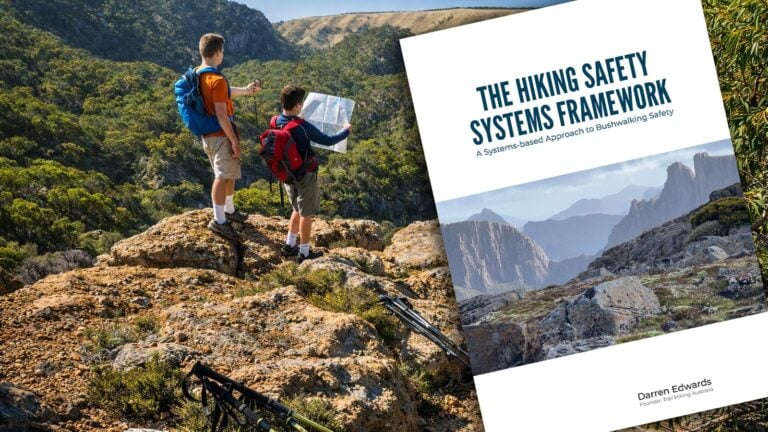
The Safety Systems Series
If this way of thinking is new to you, these resources go further into how risk develops across a hike, and how to manage it more effectively:



You said the magic word again! 😁
Having led quite a few hikes, you can spot the ones who’ll get totally lost and end up having to eat leaves and drink their own piss and still not get rescued.
I still remember the looks on some faces when they ask if I’ve ever hiked a particular trail that I was leading and I blankly said, “Nope. And even if I did, I don’t remember.”
“What if we get lost?”
I just smiled and said, “That’s why I’m the guy with the map.”
And compass, and GPS, and directional fix, and has been counting out our pace for the last 3 hours, and has done this in the dark over unfamiliar terrain more times than I can remember.
But, of course I didn’t tell them that.
😁
#systems
Murky Murk that’s a great point, and having someone who can navigate properly makes a huge difference, especially when things start to drift.
Where it gets interesting is that even strong navigation doesn’t always prevent issues. Fatigue, heat, timing, and small decisions can still shift the situation around it.
That’s what I’ve been seeing more and more, it’s not one thing failing, but how everything starts to interact over the course of a hike.
Trail Hiking Australia 💯 Systemic failure is the surest path to catastrophic failure.
I think we’ve discussed this here before. Systems build on each other and they go out in rings.
Survival, Personal, and Mission.
Remember the P’s
Piss Poor Performance is caused by Poor Planning
Everyone complains when a hiker gets rescued but it’s crickets when an idiot with no helmet on a e-scooter costs us a $100,000 putting their head back together if they live at at all
Jeff Kirtland yeah, there’s definitely a lot of emotion around rescues.
This article is more about how situations actually develop out there, most aren’t one bad decision, but a build-up of smaller factors that go unnoticed.
It would be nice to see some actual data about rescues and their causes. Some people might be surprised at how easily things can go wrong.
James McIntosh I agree. Better data would be incredibly valuable, especially if it helped show how these incidents actually develop over time.
One of the challenges is that most reporting tends to focus on the final outcome, “lost”, “dehydration”, “injury”, rather than what was happening across the hike leading up to that point.
That’s where it gets interesting. It’s often not one big mistake, but a gradual build-up of smaller factors that aren’t recognised early.
Trail Hiking Australia if you haven’t already, it’s worth a read of ANAM annuals (Accidents in North American): it’s mountaineering focussed, but always fascinating understand the causes of some serious/fatal accidents. If you do enough outdoors stuff, you end up seeing/being part of some crazy stuff.
Greg Robinson I haven’t read that one, I’ll check it out. I’ve looked at a few incident reports over time and they’re always interesting, especially seeing how situations actually unfold, not just the final outcome.
Trail Hiking Australia yep, it’s interesting. Denali is always different, lots of international climbers, unfamiliar with the risks. Reading them since the 90s changed my concepts of risk.
It would also be good to break down knowledge versus experience in a hiking environment. Knowledge helps before a hike with gear/logistic/bail choices, weather forecasting. Experience is during a hike. Social media accelerates people through the knowledge phase seeing that great pic or watching that waterfall, and then a lack of experience during the hike becomes the failure point.
Greg Robinson that’s a really good way to frame it. Knowledge gets you to the trailhead, but experience is what helps you adapt when things start to change.
And once you’re in the field, it’s how those elements interact, not just knowledge or experience on their own, that tends to shape the outcome.
Greg Robinson I think experience allows wisdom to make better decisions. Good choices in difficult situations is key. This sometimes requires multiple facets of input to decide output.
Dunning Kruger at work 😂
….
Nick Wright Haha yeah, that definitely plays a role.
What’s interesting though is a lot of incidents aren’t just overconfidence, it’s things slowly drifting even when people think they’re making reasonable decisions.
That’s where it gets a bit more complex.
Trail Hiking Australia yes…easily done….push through in mild blizzard conditions when really should have stopped and hunkered down..
Ive had times when I been exhausted (postca Covid bout) and decided it was safer to set up the tent rather than try and push on to a hut (in the snow) …. knowing your limits helps but gets trickier when with others!!
Nick Wright Julie and I had a moment like that on the Du Cane Range last year. We knew the weather was going to turn so so crawled into our tent on the plateau as sat it out for 24 hours. I was grateful we’d added a contingency day to our plans.
Also, speaking from personal experience (um, never had to be rescued yet, but got lost a few times mostly when younger, because I am stupid and impatient and have no sense of direction), people need to be willing to turn back if they are unsure of where a trail goes, stay in place if they are completely lost, or bale out if they are capable and say, slightly injured or the weather is changing. Basic bushcraft is really useful though. And the amount of people who solely rely on phones is worrying. I was hiking in South Africa, and there was a perfectly clear and obvious path through the waist high heathland (it would be really really really difficult to get lost) and this one group barely looked at the view and spent the whole time peering at the GPS on their phones! Picture of the path (Harold Porter Reserve, Bettys Bay, South Africa)Media: https://www.facebook.com/photo.php?fbid=2567018420420884&set=p.2567018420420884&type=3
Heather Shearer great pic. Thanks for sharing. That’s a great reflection too, and there’s a lot in there that makes a real difference in practice.
The turning back point is a big one. Most of the time it’s not that people don’t know what to do, it’s recognising when to do it before things escalate.
And I agree on the GPS point too. It’s a great tool, but if it narrows attention instead of supporting awareness, it can actually work against you.
Trail Hiking Australia I just use it if I feel that I am going the wrong way, some hikes have random signage at obvious places but not junctions…
Heather Shearer I love that you said “if I feel”. It’s these early signals, and making a quick location check, that can make all the difference before things start to drift.
I’m not an expert, but I try to plan around scenarios, what ifs. You can’t always account for everything but you can certainly plan for the basics. And don’t panic if things aren’t going as planned. There’s always plan b.
Gerard White that’s a good, grounded approach. Having a Plan B is important, and recognising early when you need to switch to it is what really makes the difference.
Recognising the dangers is important to me. What if I get caught in a blizzard, bitten by a snake, run out of water, get lost. All this needs to go into your planning. It might seem like overkill but it’s an important part of preparation.
Gerard White totally hear you. It’s asking yourself these questions, before you leave, that make all the difference. Not overkill at all.
Looking at the amount of fuckups, rescues, and deaths on the larapinta would be interesting . And most people doing this walk are experienced and prepared – although I did take one group in that had beer to keep cool in the ‘ mountain streams ‘ wtf
To apply an OHS lens, newer hikers may have bias by social media promoting the glossy version of hiking, and we don’t dive into incident or near miss narratives that could allow the whole community to learn.
Darren Hocking I have commented on one of those influences pages that they were putting people’s lives in danger. Secret spots etc. Their answer was that people will check the dangers. The problem is most don’t. They set off in thongs and no water on a 35 degree day. I’ll shut up 😉
There’s definitely a gap between what people see and what they actually prepare for. What’s interesting is it’s not always a lack of knowledge. Often it’s how quickly small things people don’t notice, like heat, navigation or fatigue, start to stack up once they’re out there.