Hike at a Glance
Max elevation: 1562m
Min elevation: 508m
Total Ascent: 2082m
Essential information
This hike crosses exposed alpine plains and ridges with little shelter, where conditions can change quickly and fog is common. While not overly difficult, it should not be attempted in winter without strong alpine experience and proper snow gear. Walkers must have sound navigation skills, reliable equipment, good fitness, and self-reliance, and should take full responsibility for being thoroughly prepared in all seasons.
Hike overview
Combining all the highlights of the Victorian alps including expansive plains, epic views, lush forests and Victoria's only natural alpine lake, this 4-night (5-day) walk is ideal for hikers with some overnight experience looking to extend to multi-day walks. Highly adaptable, hikers can choose their own adventure, but the recommended route slowly builds in difficulty and challenge. Camp can be made by early to mid-afternoon, leaving ample time for relaxing and soaking in nature. The first and last days are short enough to permit travel to/from Melbourne, providing an exceptional high-country experience over five days.
Suggested Itinerary
Suggested times are based on the author's experience at a slow/moderate walking pace and include breaks. Individual results may vary.
Day 1 (8.3km, 2-3 hours)
Beginning at McFarlane Saddle carpark, fill in the intentions book and head out along the well-marked trail into Wellington Plain. The trail meanders alongside expansive fens and can be quite damp in places. Conditions on the plain can change quickly and walkers must be prepared for blazing sun and fierce winds. At the 6km mark, Moroka Gap Track heads off to the left. Walkers can leave their packs and head up to bag Mt Wellington (not shown on GPX file). Otherwise, continue south to Nyimba campsite. This is a large, open site with a toilet and rainwater tank. If the tank is dry, a seasonal creek is 50m to the west and Nigothoruk Creek 400m to the east (with a steep climb). Water from both these sources must be treated. If Nyimba campsite is full (or noisy), alternatives include Old Riggalls Hut site (400m west) and a sheltered site 100m past Nigothoruk Creek.
Day 2 (12-14km, 7-8 hours)
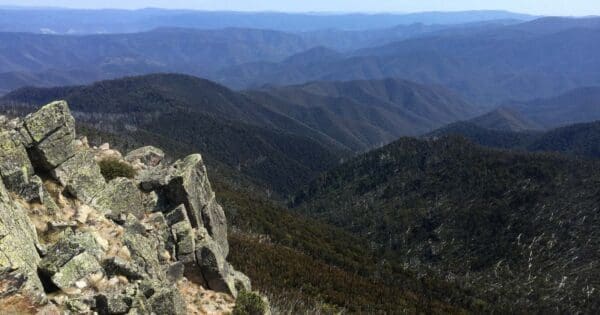
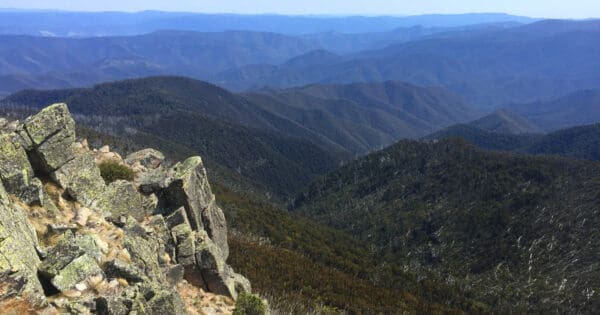
Day 2 is a day walk to the Sentinels. Leaving your camp set up, turn left leaving Nyimba to head east along Millers Hut Track. Cross the creek and continue to Millers Hut. Rejoin the track behind the hut and pass through open woodland and regenerating forest with sections of multi-directional spectacular views. Roughly 3km past the hut, keep to the right as Gable End track heads off to the left (south) across the plain - ruins of the old sign can be seen. It's another 1.5km to the Sentinels, where you can enjoy a leisurely lunch absorbing the expansive views and listening to the call of the birds and frogs echoing across the rocks. If you choose to make your way to the cliff edge, walk carefully and gently through the delicate fens which surround them. There is no path up to the Sentinels proper and the views from the saddle are just as good, with the added ability to admire the rocky formations themselves.
Return via the same route to Millers Hut. If time and energy allow, Taylors Lookout is a 2km round trip along the road and provides excellent views of the Sentinels. Return to the campsite for the night.
Day 3 (10.6km, 6hrs)
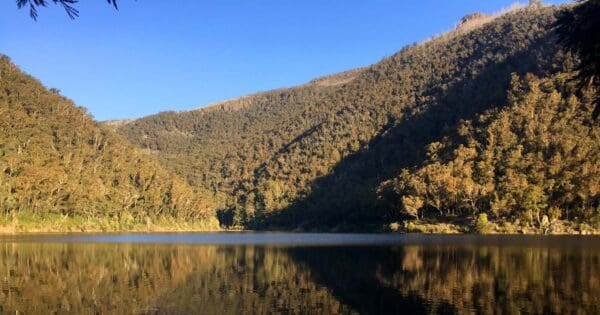
Pack up camp and follow the signs from Nyimba to Tali Karng along Gillios Track, keeping left at the junction with Riggalls Spur track. While the track itself is distinct, it is rapidly becoming overgrown as the forest regenerates from bushfires. There are many fallen trees to contend with and the track becomes increasingly steeper until you reach the lake itself (4.2km). After an optional dip in Victoria's deepest natural lake, follow an at times indistinct track anticlockwise around the lake, following signs for 400m to Clive Lanigan Track (Riggalls Spur / Wellington River) by keeping left at the junction with Echo Point track. Cross the campsite to leave the lake and enter the wonderfully named Valley of Destruction, formed by the same landslide which created the lake itself. The clear but rocky track drops steeply into a world of lush, fern-filled forest, where the first trickles of the Wellington River weave together with the chorus of birdsong. Continue through the valley to a large unsigned campsite, where the path becomes a 4WD track heading uphill. This track winds through recently burnt forest providing a fascinating insight into forest regeneration. 6km after leaving the lake, keep right at the intersection with the management track and right again 200m to descend steeply to a beautiful forest campsite adjacent to the river. Make sure you have repellent for the mozzies and enjoy a peaceful night in the valley.
Day 4 (9km, 5-6hrs)
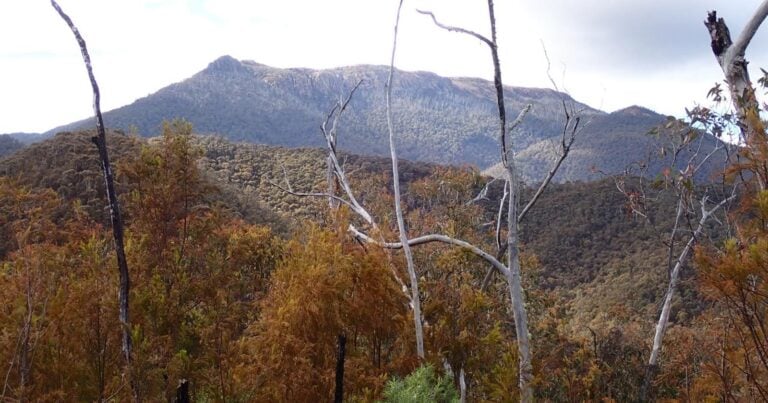
Take a hearty breakfast and fill up on water before crossing Wellington River to head up Riggalls Spur. There is no water between the river and Nyimba and the climb is long, steep and at times exposed. The track climbs steadily with your effort rewarded with dramatic views improving with each step. Undulating over several steep hills as the spur winds steadily upwards, follow the track for 5km to the junction with Echo Point Track. A small clearing just past this junction is a nice spot for a break. Continue upwards, climbing over many fallen trees and pausing to take in the views at your back, before returning to Nyimba campsite (or stopping at Old Riggalls Hut site).
Day 5 (8.3km 2-3 hours)
Return to McFarlane Saddle via Wellington Plains. Sign out the intentions book and try to stay strong as you contemplate your inevitable return to reality.
Optional adjustments
- The Sentinels day trip (day 2) can be omitted, reducing the walk to three nights, or completed at the other end of the trip. The suggested itinerary however uses this trip to build fitness for the day 4 climb.
- There is no reliable water source on the walk to the Sentinels: walkers should carry enough water for the entire day.
- Day 3 can also be completed as a day trip by taking Echo Point Track to join Riggalls Spur track and back to Nyimba. This would remove a day/night from the walk.
- Walkers experienced with navigation and off-track walking can attempt the Spion Kopje trail to return to Wellington Plains. This trail is shown on maps but is no longer signposted. There are some markers on trees however the track is indistinct and should not be attempted in low visibility. The trail begins just after Old Riggalls Hut site (coming from Nyimba) and the posts from the old sign can be seen.
Traditional Owners
The first occupiers of this area were the Gunaikurnai people, most likely member of the Brayakaulung clan. Aboriginal people guided many European explorers and gold miners through the mountains along well used pathways, which eventually formed some of today’s road and track network. Tali Karng is a sacred place to the Gunaikurnai and in keeping with their law, Aboriginal people are forbidden to go there. Aboriginal people do not oppose non-indigenous people visiting Tali Karng as long as they treat the area with respect. Camping at the lake is disrespectful to Aboriginal people, so please treat the area with care as you pass by the lake and camp elsewhere.
Respecting the Culture
The Gunaikurnai people welcome respectful visitors to Tali Karng. Camping at the lake is disrespectful, similar to camping in a cathedral. Please treat the area with care as you visit. Campgrounds are available nearby, as detailed in the "Camping and Facilities" section below.
Camping and Facilities
Walkers should respect the Gunaikurnai people by not camping at the lake itself. Nyimba Camp is the recommended campsite above the lake at the southern end of the Wellington Plains. Below the lake, there are numerous informal campsites at the base of the Valley of Destruction and along the Wellington River. It's a reasonable walk from Nyimba Camp to Tali Karng and back without heavy packs.
Tali Karng is a fuel stove only area. Campfires are not permitted within a 1km radius of the lake. Fires are allowed within fireplaces at Nyimba campsite (near Riggall Old Hut site) and at designated fireplaces along the Wellington River. Always supervise fires and extinguish them completely with water before leaving.
Firewood supplies are limited, especially in the alpine areas. Camping stoves are preferred. There are no toilet facilities at the lake or nearby campgrounds. Nigothoruk Creek is a nearby water source, but always treat all water before consumption.
Planning Your Trip
The best time to visit is November through to April. Always carry and know how to use a map and compass, as weather conditions can change rapidly in alpine areas. Snow can fall any time of year, and water can be scarce. Be prepared with:
- Warm clothing
- Wind and waterproof jacket
- Gloves, hat, sunglasses, and sturdy footwear
- First-aid kit and sunscreen
- Plenty of food and water
- Compass and topographical map
Before you go, inform someone of your trip itinerary and expected return date. Keep your group size small (4-8 people) and register your trip in the intentions book at the trailhead. Larger groups must register with Parks Victoria's Heyfield office by calling 13 1963.
Track grade
Grade 4 (Hard) - Challenging Walks for Experienced Walkers: Grade 4 on the AWTGS signifies challenging walking tracks. Bushwalking experience is recommended for these tracks, which may be long, rough, and very steep. Directional signage may be limited, requiring a good sense of navigation. These walks are suited for experienced walkers who are comfortable with steeper inclines, rougher terrain, and potentially longer distances.
Practical information
- Poles are highly recommended for navigating the steep sections of track.
- The plains and Nyimba campsite can become very cold even in summer.
- Treat all water from streams and rivers.
- This walk includes a day hike and optional side trips. Walkers must carry a day pack with rain gear, navigation equipment, water, provisions and first aid kit at all times.
- This walk includes exposed plains and ridges with limited shelter from the elements.
- Conditions in the alpine region can change rapidly and walkers must be prepared for all weather conditions at all times of year. The plains are often covered in fog.
- While this is not an overly challenging hike, do not attempt this circuit during winter unless you are experienced in Alpine conditions and have the necessary equipment for hiking and camping in snow. This hike requires that you have a sufficient level of navigation experience, equipment (in good working order), fitness and self-reliance. It is vital that you take personal responsibility for ensuring you are prepared.
Trail features
- Gravel Track
- Rough Track
- Well Marked Track
- Alpine Region
- Lakes
- Rivers
- Scenic Viewpoints
- Alpine Huts
- Exposed Ledges
- Steep Terrain
- River Crossings
- Drinking Water
- Untreated Water
- Swimming Spots
- Overnight Campsites
Walk map and GPX file
Max elevation: 1562 m
Min elevation: 508 m
Total climbing: 2082 m
Total descent: -2082 m
GPX files, maps and content are copyright Trail Hiking Australia. Not to be copied, redistributed or uploaded to other platforms including AllTrails.
Explore safely
Planning this hike? Most incidents develop before you even start. Safe outcomes depend on how navigation, hydration, environment, load and judgement work together. Small oversights can compound quickly in Australian conditions. See how it happens in the Hiking Safety Systems Foundations. Then use the Hiking Safety Systems, planning calculators, and make sure a trusted contact has your trip plan before heading out.
Leave a trip plan
Before you go, complete a trip intentions form and share it with a trusted contact. Agree on a Late-Back Time and ask them to call 000 (Police) if you have not checked in. A clear trip plan is one of the simplest and most effective safety steps you can take.
Planning checklists
Download the hiking preparation and safety checklists before leaving home to help you think through your plans. They help ensure important considerations are not overlooked and support safer decision-making on the trail.
Getting there
Getting to the trailhead: Alpine National Park.
Roughly 5-5.5 hours from Melbourne, the walk starts 1.5 hours past Licola. Just before the bridge leading into the village, take Mount Tamboritha Rd to the right. Sealed for the first 10km, the road then turns to well-formed gravel suitable for 2WD vehicles in good weather. Follow this road for 46.7km to Arbuckle Junction to turn right onto Moroka Rd. McFarlane Saddle car park is a further 2km on your right.
Need a rental car to get you to the hike? Find one here.
Access conditions
- 2WD Access
- 4WD Access
- Bitumen Road
- Gravel Road
- Winding Road
- Large Car Park
- Public Toilets
- Campfire Pit
- Camping Area
Accommodation nearby
Find accommodation close to the trailhead including hotels, cabins, and campgrounds. Use the interactive map to explore available options in nearby towns.
Nearby towns: Briagolong, Coongulla, Glengarry, Heyfield, Licola, Maffra, Rawson, Stratford, Toongabbie
About the region
Lake Tali Karng lies deep within Victoria’s Alpine National Park in the Gippsland High Country, nestled in a steep glacial cirque below the Wellington Plains. It is the only natural deep lake in the state, formed thousands of years ago when a massive landslide from Mt Wellington dammed the Valley of Destruction. Fed by snowmelt and mountain streams, its icy, crystal-clear waters are surrounded by dense forest, snow gum woodlands, and rugged alpine terrain. The lake holds deep cultural significance for the Gunaikurnai people and ecological value for its diverse flora and fauna. Accessible only by foot along demanding walking tracks, it retains a reputation as a remote and sacred place.
The Alpine National Park, stretching across 646,000 hectares of the Central Highlands and Alpine regions, is Victoria’s largest national park and home to the state’s highest peaks, including Mount Bogong (1,986 m) and the Bogong High Plains. Sharing a boundary with Kosciuszko National Park in New South Wales, it protects vast alpine and subalpine landscapes. This is an adventure-lover’s playground, offering everything from multi-day hikes and horseback journeys through wildflower-strewn plains, to world-class mountain biking, white-water rafting, four-wheel driving and cross-country skiing through snow gum forests.
Similar walks nearby
Looking for more walks in or near Alpine National Park? Try these trails with a similar difficulty grade.
Suggest an edit
Notice something different about this trail? Whether it’s a new feature, a route change, or a closure, share your update so we can keep our info accurate and helpful for fellow hikers.
Click to suggest edits >>
Acknowledgement of Country
Trail Hiking Australia acknowledges the Traditional Owners of the lands on which we hike and pay respects to their Elders, past and present, and we acknowledge the First Nations people of other communities who may be here today.




/Day%201%20Wellington%20Plain.jpg)
/Day%201%20Wellington%20Plain%20fog.jpg)
/Day%202%20Millers%20Hut.jpg)
/Day%203%20Tali%20Karng.jpg)
/Day%201%20Nyimba.jpg)
/Day%204%20Riggals%20Spur%20forest.jpg)
/Day%202%20views.jpg)
/Day%203%20fire.jpg)
/Day%204%20dead%20wood.jpg)
/Day%202%20lunch.jpg)
/Day%203%20leaving%20Nyimba.jpg)
/Day%204%20Riggalls%20spur.jpg)
/Day%203%20lake.jpg)
/Day%203%20Valley.jpg)
/Day%204%20views.jpg)


1 Review on “Tali Karng, Sentinels, Wellington River Circuit (50km)”
This remote circuit links the iconic alpine lake Tali Karng with the rugged Sentinels and the wild Wellington River corridor. Expect long days, sustained climbs and descents, river crossings, and limited navigation aids. The route moves between high ridgelines and deep river valleys, offering a true wilderness experience in one of Victoria’s most isolated sections of the Alpine National Park. Strong navigation skills, careful planning, and self-sufficiency are essential.