Sorry, no records were found. Please adjust your search criteria and try again.
Sorry, unable to load the Maps API.
Hikes and walks in St Helens
Here you’ll find every hike we list in St Helens, Tasmania. Each listing has the distance, grade and time it takes, so you can pick one that suits you. You can also search hikes across Australia.
Discover 3 hiking trails in St Helens
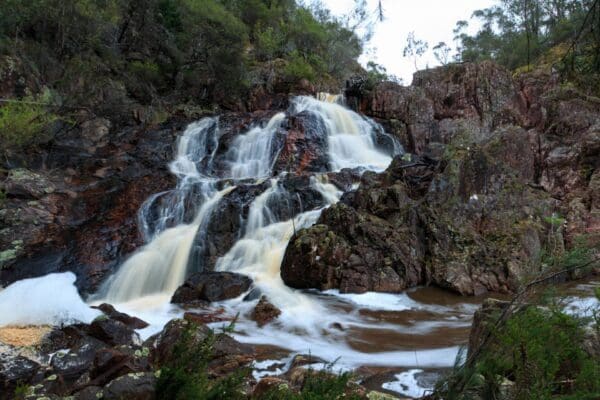

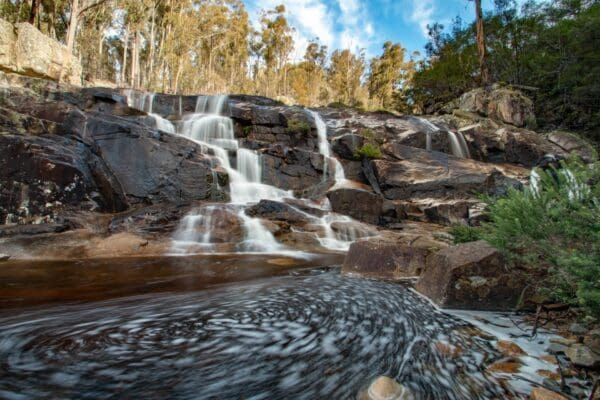

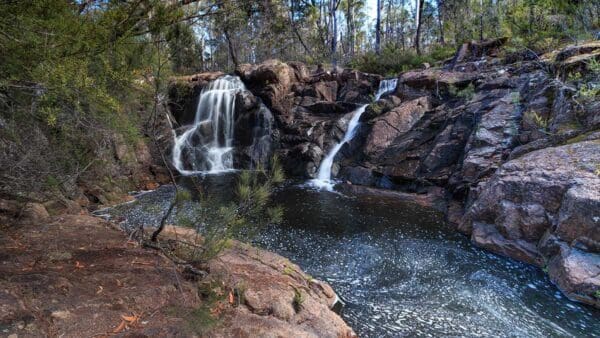

Where Georges Bay Meets the Bay of Fires
Overview
St Helens sits on Tasmania’s north-east coast, centred on Georges Bay and close to the southern end of the Bay of Fires. It is the main town in this part of the state and a useful point of reference for a landscape that shifts quickly from sheltered estuary to open beaches, granite headlands and offshore islands. From Hobart, it is roughly 300 km away by road, which helps explain why the area feels tied as much to the coast as to the state capital.
What makes St Helens distinctive is that mix of calm water and exposed shoreline. Around town and north toward Binalong Bay, the country opens into pale sand, clear water and granite outcrops stained orange with lichen. Nearby reserves also protect parts of the bay edge and small islands off the coast, giving the area a character that is both scenic and ecologically important.
Highlights
The scenery around St Helens is shaped by contrast. Georges Bay brings broad, quiet water and low-lying shores, while the coast to the north becomes more rugged and open, with white beaches tucked between rocky points. The southern end of the Bay of Fires is especially striking for its bright orange lichen-covered granite, clear turquoise water and long curves of sand.
Just offshore, St Helens Island adds another layer to the coastal picture. Together with other small north-east islands, it helps define the seascape here, giving the coast a broken, windswept feel rather than one long uninterrupted beach.
Best Time to Visit
St Helens works well in different seasons for different reasons. The warmer months usually show off the coast at its clearest, when the water colour, beaches and rocky headlands are at their sharpest. This is also the time of year when the bay and open coast feel most inviting for a slower day outdoors.
Cooler months can be rewarding too, especially if you are more interested in atmosphere than swimming weather. The coast often feels quieter, and whale sightings along the Bay of Fires are possible when humpback and southern right whales are moving along the east coast.
Plants and Animals
The vegetation around St Helens ranges from coastal heath to dry sclerophyll forest, with estuarine and marine habitats adding to the variety. In the Bay of Fires hinterland, blue gum forest provides breeding habitat for the critically endangered swift parrot in the warmer months.
Birdlife is a strong part of the area’s character. Hooded plovers, sooty and pied oystercatchers, gulls and white-bellied sea eagles are all associated with the coast, while dolphins and seals are regularly seen offshore. On land, wallabies and possums are common, with spotted-tail quolls and Tasmanian devils present but much less often seen. The small islands off the north-east coast are also important breeding sanctuaries for seabirds.
Culture and Heritage
The coast around St Helens has a long Aboriginal history. Along the Bay of Fires, larapuna was a meeting place for the Panpe-kanner, Leener-rerter and Pinter-rairer family groups, and midden sites in the dunes show strong evidence of hunting, gathering and food preparation. On the small north-east islands, including St Helens Island, there is also evidence of Aboriginal use in the form of artefact scatters or shell middens.
European history is present here too, though it sits more quietly in the landscape. Parts of the Bay of Fires coast were used for fishing, grazing and timber cutting, and some of the small north-east islands later saw whaling activity.
Find more places to explore…
Help expand the trail collection!
Know of an official trail not listed on Trail Hiking Australia? I’m focused on showcasing the best tracks managed by land managers, and I’d love your help! Sharing a trail adds to our community and helps others discover safe, new adventures.
Submit your trail here