Sorry, no records were found. Please adjust your search criteria and try again.
Sorry, unable to load the Maps API.
Explore stunning hiking trails of Mount Coolum National Park
Discover the diverse trails of Mount Coolum National Park, Queensland, offering hikes and walks for all skill levels and interests. Find your perfect adventure today.
Discover 1 hiking trail in Mount Coolum National Park
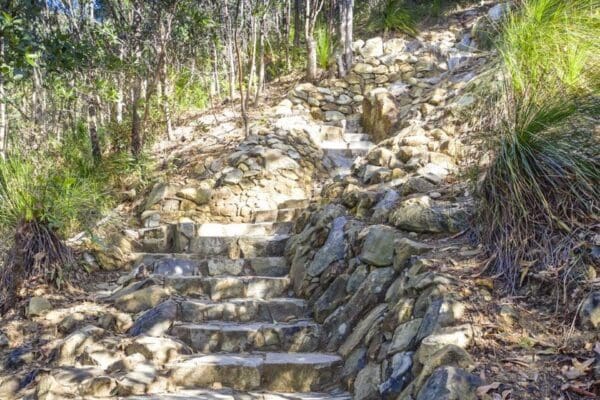

An Ancient Volcanic Dome on the Sunshine Coast
Overview
Mount Coolum National Park protects a compact but striking part of the Sunshine Coast landscape, centred on Mount Coolum itself, a steep-sided volcanic dome rising 208m above sea level. The park covers 363ha and sits between Coolum Beach and Marcoola, roughly midway along the coast north of Brisbane. Although it is relatively small, it holds a strong sense of contrast, with a prominent rocky peak above low-lying wetlands and coastal country.
Geologically, Mount Coolum is much older than it first appears. It formed about 26 million years ago as a laccolith, where magma pushed upward beneath the earth’s surface and cooled into a dome-shaped mass. That volcanic origin still shapes the character of the park today, from its rugged upper slopes to the large hexagonal cooling columns visible in the rock.
Highlights
The defining feature here is the mountain itself, one of the Sunshine Coast’s most recognisable landforms. From higher on the slopes and summit, the outlook stretches across the coastal plain to Point Cartwright and the Glass House Mountains in the south, the Blackall Range to the west and Noosa Heads to the north. It is a broad, open coastal panorama that helps explain why Mount Coolum stands out so clearly from surrounding suburbia.
The park is also interesting for the way its landscapes shift over a short distance. Open forest on the lower slopes gives way to woodland, shrubland and finally low montane heath near the top. Beyond the mountain section, the park also includes wet heath communities in the Marcoola area and forms part of the Coolum Creek and Lower Maroochy River nationally important wetland setting.
Best Time to Visit
The cooler months from autumn to spring are usually the most pleasant time to be here, especially if you want clear air and broader coastal views. Winter and spring can be particularly rewarding, with flowering heath plants adding colour on the upper slopes and migrating whales sometimes visible offshore.
Late autumn through winter is also a good season for seeing some of the summit heath at its best, including golden candlesticks banksia flowering mainly between May and August.
Plants and Animals
Despite its modest size, Mount Coolum National Park protects a surprising range of plant communities shaped by altitude, exposure and soil depth. The summit supports low montane heath, where harsh sun, wind, poor soils and high evaporation keep vegetation close to the ground. These conditions create a specialised flora quite different from the lower slopes.
The park is especially important for threatened plants. Two endangered she-oaks grow here, the Mount Coolum she-oak and the Emu Mountain she-oak, and the Mount Coolum she-oak is found nowhere else. Birdlife is another strong point, with honeyeaters commonly associated with the heath and resident peregrine falcons seen overhead.
Culture and Heritage
Mount Coolum has recognised Aboriginal cultural heritage values, and park management includes work with the Kabi Kabi First Nation to protect cultural heritage on the mountain and include cultural stories in interpretation. Managing foot traffic around the summit area is part of protecting those places and values.
Find more places to explore…
Help expand the trail collection!
Know of an official trail not listed on Trail Hiking Australia? I’m focused on showcasing the best tracks managed by land managers, and I’d love your help! Sharing a trail adds to our community and helps others discover safe, new adventures.
Submit your trail here

