Sorry, no records were found. Please adjust your search criteria and try again.
Sorry, unable to load the Maps API.
Explore stunning hiking trails of Douglas-Apsley National Park
Discover the diverse trails of Douglas-Apsley National Park, Tasmania, offering hikes and walks for all skill levels and interests. Find your perfect adventure today.
Discover 1 hiking trail in Douglas-Apsley National Park
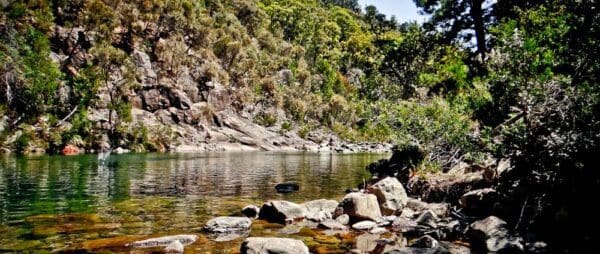

Dry Forest, Deep Gorges and Clear East Coast Rivers
Overview
Douglas-Apsley National Park sits on Tasmania’s east coast near Bicheno, protecting a large stretch of dry forest between the Douglas and Apsley rivers. What makes it stand out is the contrast within a relatively compact area. Quiet marshes and open forest give way to steep gorges, clear river pools and pockets of wetter vegetation tucked into gullies. The park also protects one of the last substantial areas of uncleared dry sclerophyll forest on this part of the coast.
Highlights
The park’s scenic character comes from water cutting through dry country. Deep river gorges, calm waterholes and the dolerite-capped plateau above them create a landscape that feels more varied than you might expect from the east coast bush at first glance. Apsley Gorge is one of the defining features, with rock walls, clear pools and a rugged sense of enclosure that changes with the light and season.
Elsewhere, the mix of marshland, heath, forest and wet gullies gives the park a shifting texture rather than one single look. That variety is a big part of its appeal. You can move from open eucalypt country into sheltered, greener pockets in a short distance, which gives the whole area a strong sense of contrast.
Best Time to Visit
Douglas-Apsley can be rewarding at different times of year, but the milder months are often the most pleasant for appreciating the park’s scenery and vegetation. Spring is especially good for seeing wildflowers and orchids through the heathlands and forest, while warmer weather brings the rivers and waterholes to the forefront of the landscape. After wetter periods, the gorges and river sections tend to feel at their most vivid.
Plants and Animals
This park protects an unusually rich mix of plant life for a dry east coast landscape. Forests and heathlands support seasonal wildflowers, native orchids and a notably broad spread of eucalypts and other trees, with 14 tree species recorded. More common trees include Tasmanian blue gum, white peppermint and brown-topped stringybark, while Tasmanian ironbark and Barbers gum are among the less common species found here.
Birdlife is a major drawcard. The park supports 11 of Tasmania’s 12 endemic bird species and is recognised as an Important Bird Area. Birds such as the wedge-tailed eagle, spotted quail-thrush and painted button-quail are part of that mix, and the endangered swift parrot passes through on migration. In the rivers, the endangered Australian grayling survives in this catchment, adding to the park’s conservation importance.
Culture and Heritage
This area is associated with two bands at the northern end of the Oyster Bay nation. The Leetermairemener are linked with country between St Patricks Head and the Douglas River, and the Plangermairemeener with country from the Douglas River south to the mouth of the Swan River. Family groups moved through their own territories as well as across the country of other friendly bands.
More recent history in the park includes farming, mining and trapping, which form part of the human story of this stretch of the east coast.
Find more places to explore…
Help expand the trail collection!
Know of an official trail not listed on Trail Hiking Australia? I’m focused on showcasing the best tracks managed by land managers, and I’d love your help! Sharing a trail adds to our community and helps others discover safe, new adventures.
Submit your trail here

