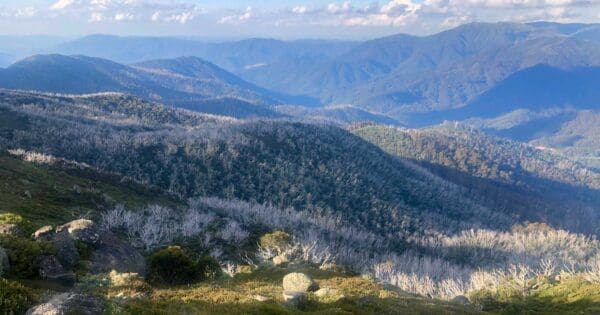
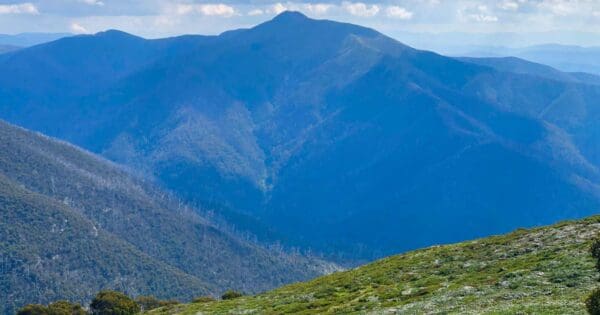
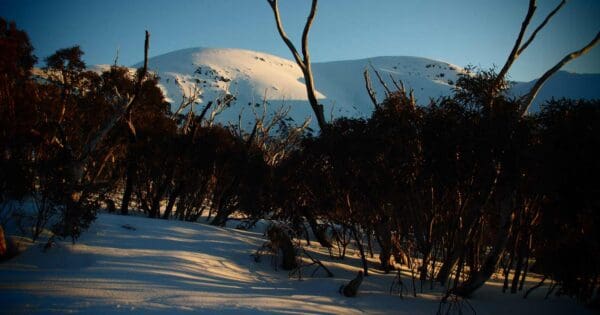
This seven-stage adventure from Mount Beauty to Harrietville crosses some of Victoria’s most spectacular high country, linking the state’s two highest peaks, Mount Bogong and Mount Feathertop. The route follows the Great Dividing Range through a remarkable variety of alpine landscapes, from tall mountain ash forest and snow gum woodland to open high plains and rugged ridgelines.
Traversing the heart of the Alpine National Park, this is a challenging yet rewarding long-distance hike that captures the essence of Victoria’s alpine wilderness, a true immersion in vast, windswept country where weather, light, and landscape are always shifting.
Stage 1: Mount Beauty to Mountain Creek Camping Area (13.5 km)
Leaving Mount Beauty, the trail follows the quiet Moncrief Gap Track, heading southeast through open farmland before entering the forested foothills of the Alpine National Park. The gravel road climbs gently over low ridges, offering occasional views back across the Kiewa Valley and toward Mount Beauty township. Near the park boundary, the route joins Mountain Creek Road, continuing through tall mountain ash forest beside Little Bogong Creek.
The walking is mostly easy, with gradual elevation gain and long shaded stretches that make this an ideal warm-up stage before the steep ascent of Mount Bogong. The stage ends at the well-equipped Mountain Creek Camping Area, a peaceful clearing beside Mountain Creek that provides flat campsites, picnic tables, a shelter, toilets, and reliable water, a comfortable base for the climb ahead via the Staircase Spur Track.
Stage 2: Mountain Creek Camping Area to Cleve Cole Hut via The Staircase (12.5 km)
From the Mountain Creek Camping Area, the track crosses Mountain Creek via a small bridge and follows the creek briefly before turning onto the Staircase Spur Track. The ascent begins immediately, climbing steeply through tall forest and dense fern gullies as the spur rises toward Mount Bogong’s northern slopes. The climb is steady and unrelenting, gaining more than 1,300 metres over 6 kilometres.
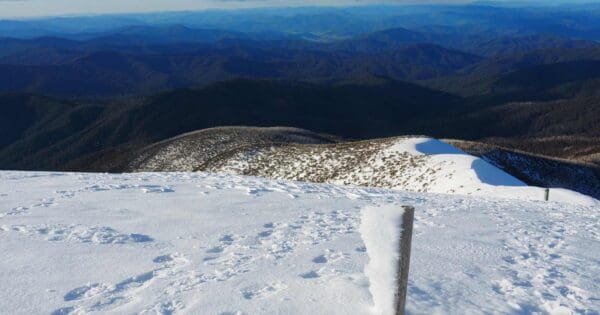
About halfway up, you’ll reach Bivouac Hut, a small timber shelter set among snow gums that provides a good rest stop before the final ascent. Beyond the hut, the vegetation opens and the landscape becomes increasingly alpine, revealing expansive views across the Kiewa Valley and toward Mount Emu. The final section traverses the exposed upper slopes to reach the summit cairn of Mount Bogong (1,986 m), Victoria’s highest peak, offering panoramic views in every direction.
From the summit, the route continues south along a broad ridgeline before descending gently toward Cleve Cole Hut, located in a sheltered snow gum hollow. The hut provides water, a camping area, and dependable protection from alpine weather, a welcome retreat after a demanding climb.
Stage 3: Cleve Cole Hut to Ropers Hut (10.3 km)
From Cleve Cole Hut, the route follows the Australian Alps Walking Track south along Long Spur, beginning with a short climb out of the sheltered snow gum hollow before easing into a gradual descent through open woodland. The trail soon breaks out onto the ridgeline, where broad grassy plains and scattered snow gums replace the denser forest of the previous stage. The walking here is gentler, offering a welcome change of pace after the steep ascent and descent of Mount Bogong.
The track passes the Maddisons Hut site, a small grassy flat that marks the remains of one of the region’s early grazing huts, before continuing along the undulating spur. Expansive views open across the Bogong High Plains and toward Mount Nelse and Spion Kopje, with occasional patches of lingering snow or boggy ground early in the season.
The route remains well defined and follows the crest of Long Spur before gently dropping to reach Ropers Hut, rebuilt after the 2003 Alpine fires. Set in a sheltered grassy clearing surrounded by snow gums, the hut provides a water source nearby and several flat campsites, making it an ideal overnight stop before entering the open high plains ahead.
Stage 4: Ropers Hut to Cope Hut Camping Area (17.6 km)
From Ropers Hut, the trail continues south along Long Spur, following a gentle ridgeline through snow gum woodland and open grassy clearings. The track gradually descends to meet the management vehicle track near Big River Fire Track, before climbing again onto the open expanse of the Bogong High Plains. The landscape opens dramatically here, wide snow plains dotted with twisted snow gums and colourful alpine wildflowers through summer and early autumn.
The route passes a number of minor creek crossings before reaching Langford Gap, where it crosses the Bogong High Plains Road. This area provides a convenient rest point, with nearby water channels flowing from Rocky Valley Storage. From here, the trail follows the Australian Alps Walking Track south-west along an old aqueduct and management trail toward Wallace’s Hut and Cope Hut, two of the most iconic and accessible cattlemen’s huts in the region.
Both huts offer a glimpse into early alpine grazing history and are popular short walks for visitors accessing the High Plains by road. The section between the huts is mostly level and provides expansive views over the plains toward Mount Nelse and Spion Kopje. The stage concludes at the Cope Hut camping area, where you’ll find tent platforms, toilets, and a reliable water supply from the nearby creek.
Weather here can change rapidly, with fog, snow, and strong winds possible at any time of year, even in summer, so always be prepared for alpine conditions.
Stage 5: Cope Hut Camping Area to West Branch River (Beyond Westons Hut) (14.1 km)
Heading south from the Cope Hut Camping Area, the route follows the Australian Alps Walking Track across the open Bogong High Plains, passing the well-known Pole 333, a historic navigation marker in this vast alpine landscape. The track gently undulates across open snow grass plains dotted with snow gums and alpine wildflowers, offering sweeping views toward Mount Bundara and Mount Jim.
As the trail continues, it skirts the upper catchment of the West Kiewa River, crossing a few small creeks before the terrain begins to change character. The open plains give way to steeper, more rugged slopes as the path descends toward Westons Hut, a remote but well-maintained shelter nestled among snow gums near the edge of the escarpment. This hut provides reliable water and a good rest stop before the next descent.
Beyond Westons Hut, the route continues downhill through snow gum forest, dropping steadily toward the West Branch of the Ovens River. A grassy clearing beside the river provides an excellent campsite, with fresh water, flat tent sites, and partial shelter from the surrounding woodland.
Stage 6: West Branch River to Federation Hut via Mount Feathertop (11.5 km)
This is one of the most spectacular and demanding sections of the entire traverse. From the West Branch of the Ovens River, the track immediately begins its steep ascent up Diamantina Spur, climbing more than a thousand metres over a relatively short distance. The gradient is unrelenting, with several false summits along the spur, and requires both endurance and care, particularly in hot or windy conditions.
As you ascend, the vegetation shifts from dense snow gums and mountain ash to low alpine heath, opening up expansive views back across the Bogong High Plains and eastward toward Mount Jaithmathang. The route passes High Knob and the twin rises of Twin Knobs, where the track briefly narrows along exposed ridgelines before easing onto Mount Feathertop’s northern ridge.
From here, the trail joins the Razorback Track, where a side trip to Mount Feathertop’s 1,922-metre summit rewards walkers with breathtaking 360-degree alpine views across the Victorian Alps, from the Bogong massif in the east to Mount Hotham and the Dargo High Plains in the south.
After taking in the views, descend carefully along the Razorback ridge to reach Federation Hut, beautifully situated on grassy terraces beneath Little Mount Feathertop. The hut provides reliable water, sheltered camping, and one of the most scenic overnight stops in the Alpine National Park.
Stage 7: Federation Hut to Harrietville via Bungalow Spur (10 km)
The final stage of the traverse descends steadily along Bungalow Spur, one of the most popular and well-graded tracks on Mount Feathertop. From Federation Hut, the path drops through groves of snow gums, soon entering taller alpine ash forest as it loses elevation. The track is firm underfoot and easy to follow, with a consistent gradient that allows for a comfortable descent after the rigours of the previous stages.
Along the way, you’ll pass several points of historical interest, including the sites of early mining huts and shelters that once supported walkers and prospectors exploring the upper Ovens Valley. Interpretive signs mark key locations, and the changing vegetation provides a vivid reminder of the mountain’s dramatic altitude zones, from subalpine woodland to cool temperate forest.
As you approach Tobias Gap, views briefly open across the valley before the forest closes in again. The descent continues past Picture Point, where a small clearing offers a final glimpse back toward Mount Feathertop’s summit. From here, the trail winds gently down to the Bungalow Spur trailhead, just outside Harrietville.
The temperature rises noticeably as you reach the valley floor, signalling the end of the alpine country. Harrietville offers accommodation, food, and supplies, an inviting place to rest and reflect on your journey across the high country.




/Mount%20Beauty%20to%20Harrietville%20Alpine%20Traverse%20(7).jpg "Mount Beauty to Harrietville Alpine Traverse (90km)")
/Mount%20Beauty%20to%20Harrietville%20Alpine%20Traverse%20(26).jpg "Mount Beauty to Harrietville Alpine Traverse (90km)")
/Mount%20Beauty%20to%20Harrietville%20Alpine%20Traverse%20(20).jpg "Mount Beauty to Harrietville Alpine Traverse (90km)")
/Mount%20Beauty%20to%20Harrietville%20Alpine%20Traverse%20(8).jpg "Mount Beauty to Harrietville Alpine Traverse (90km)")
/Mount%20Beauty%20to%20Harrietville%20Alpine%20Traverse%20(5).jpg "Mount Beauty to Harrietville Alpine Traverse (90km)")
/Mount%20Beauty%20to%20Harrietville%20Alpine%20Traverse%20(11).jpg "Mount Beauty to Harrietville Alpine Traverse (90km)")
/Mount%20Beauty%20to%20Harrietville%20Alpine%20Traverse%20(21).jpg "Mount Beauty to Harrietville Alpine Traverse (90km)")
/Mount%20Beauty%20to%20Harrietville%20Alpine%20Traverse%20(1).jpg "Mount Beauty to Harrietville Alpine Traverse (90km)")
/Mount%20Beauty%20to%20Harrietville%20Alpine%20Traverse%20(17).jpg "Mount Beauty to Harrietville Alpine Traverse (90km)")
/Mount%20Beauty%20to%20Harrietville%20Alpine%20Traverse%20(23).jpg "Mount Beauty to Harrietville Alpine Traverse (90km)")
/Mount%20Beauty%20to%20Harrietville%20Alpine%20Traverse%20(24).jpg "Mount Beauty to Harrietville Alpine Traverse (90km)")
/Mount%20Beauty%20to%20Harrietville%20Alpine%20Traverse%20(16).jpg "Mount Beauty to Harrietville Alpine Traverse (90km)")
/Mount%20Beauty%20to%20Harrietville%20Alpine%20Traverse%20(22).jpg "Mount Beauty to Harrietville Alpine Traverse (90km)")
/Mount%20Beauty%20to%20Harrietville%20Alpine%20Traverse%20(3).jpg "Mount Beauty to Harrietville Alpine Traverse (90km)")
/Mount%20Beauty%20to%20Harrietville%20Alpine%20Traverse%20(6).jpg "Mount Beauty to Harrietville Alpine Traverse (90km)")




1 Review on “Mount Beauty to Harrietville Alpine Traverse (90km)”
Completing the full seven-day hike from Mount Beauty to Harrietville was a great challenge and a really rewarding experience. I’d done many of the sections before, but linking them together over a week gave us a much better sense of how the landscape connects and changes along the range. Each day felt different with some long climbs, some easier stretches, and plenty of moments that reminded us why we love being in the Victorian high country. Spending seven days out there was tough at times but worth every moment. It’s definitely one of the best multi-day hikes I’ve done in Victoria. Apart from the Buller Huts Trail of course.