Hike at a Glance
Max elevation: 1775m
Min elevation: 673m
Total Ascent: 1877m
Important info
This is a demanding alpine hike suitable for experienced walkers. It involves long climbs, steep descents, variable track conditions, multiple Delatite River crossings, and exposure to rapidly changing weather. Strong fitness, solid navigation skills, and appropriate gear are essential.
Hike overview
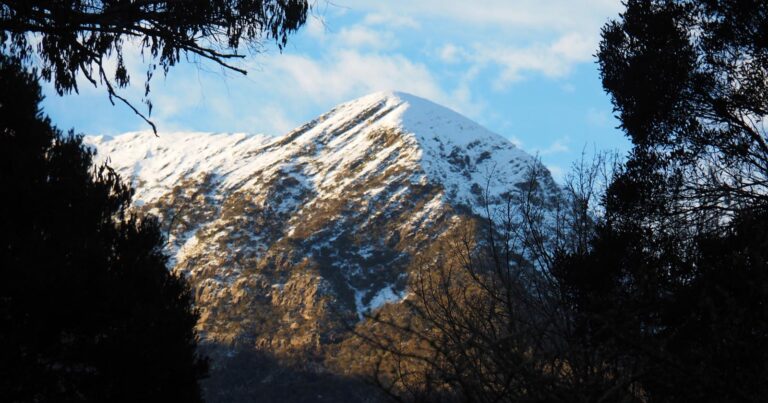
The Buller Stirling Loop offers a rewarding two day circuit through some of the most varied and atmospheric country in the Victorian Alps. Beginning at the foot of Mount Buller beside the Delatite River, the route climbs steadily from cool valley forest to the broad alpine ridges that link Buller, Howqua Gap and Mount Stirling. Over the course of thirty four kilometres the landscape shifts constantly, from towering mountain ash to twisted snow gums and finally to the open high plains that frame both summits. The descent along River Spur and the string of crossings on the Delatite bring a completely different feel on the second day, returning you to the valley through quiet forest and clear running water. It is a journey that captures the full character of this part of the high country, offering challenge, variety and the sense of travelling through a genuine mountain environment.
Stage 1: Mirimbah to Bluff Spur Hut via Mount Buller and Mount Stirling (18.5 km)
The Buller Stirling Loop begins quietly beside the Delatite River at Mirimbah, where the surrounding forest rises steeply toward the alpine country above. From the small carpark on Loch Street, near the toll gate entrance to the Mount Buller Resort, the Klingsporn Bridle Track slips into shadow as it climbs the northern flank of Mirimbah Spur. The grade is steady from the start, following the broad line of the spur through mature forest where the light filters softly through tall mountain ash and the understorey carries the cool scent of damp leaf litter.
As the track works its way upward it rises into a more defined ridge system, and the feeling of being held in a deep, sheltered valley gradually recedes. After several kilometres the trees thin and the trail crests onto McLaughlan Shoulder, a wide and reassuring saddle. Thank Christ Corner marks this point with a name that perfectly captures the relief many walkers feel when reaching it. The route remains true to the spur, climbing directly rather than diverting onto the lower side tracks that branch off here. The walking is honest and persistent, with the ridge drawing you upward at a natural pace that rarely feels forced but offers little opportunity for a real rest.
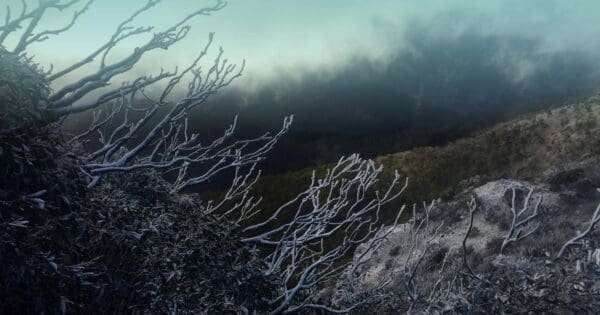
The character of the forest changes as you gain height. Mountain ash gives way to snow gums, their twisted forms shaped by decades of wind and winter storms. The air cools noticeably, and the ground begins to show the shallow, rocky soil typical of the high country. The spur remains clear and well defined, making navigation straightforward even as the trees thin further. As you approach the upper mountain the route merges with the higher resort trails and management tracks, gradually transitioning out of the enclosed forest into more open alpine terrain.
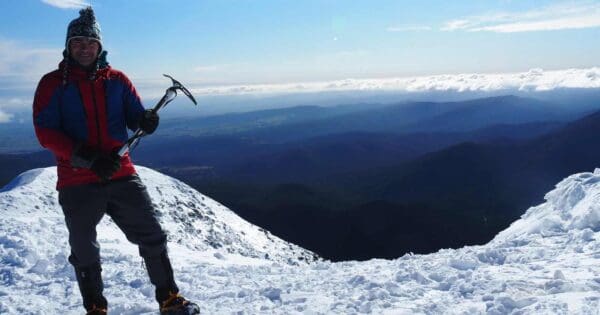
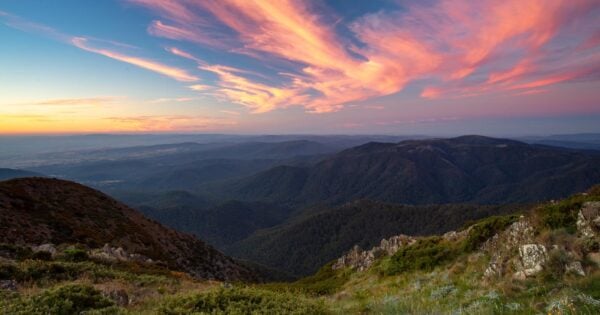
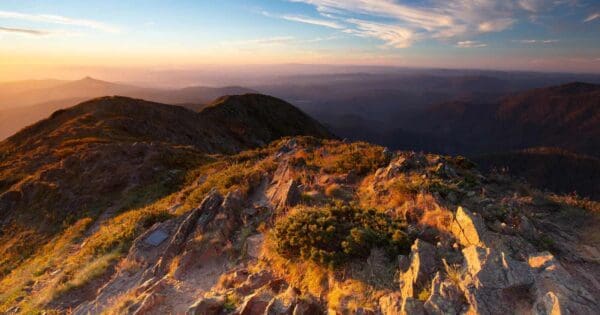
Nearing the summit, the start of the Summit Nature Walk is reached, where signage guides you toward Mount Buller’s highest point. This final climb is short but sharp, lifting you onto a broad, rocky crown marked by a trig station and cairn. The summit offers sweeping views across the Victorian Alps, with the Crosscut Saw, Mount Howitt, and the far ranges of the Alpine National Park visible on clear days. Even when cloud rolls through, the sense of height and exposure adds to the experience.
Descending from the summit, the trail drops toward the Buller Village, weaving between ski runs and infrastructure that feels strangely quiet outside winter. This is a handy place to refill water, take a short break, or shelter if conditions deteriorate. Leaving the village, the route swings south toward Howqua Gap Hut, following a mix of management tracks that undulate across the broad shoulders between the two mountains. The walking is easier here, with long stretches of gentle grade providing a welcome change after the steady climb up McLaughlan Shoulder.
From Howqua Gap Hut, the track to Mount Stirling climbs through snow gum woodland, a peaceful and atmospheric section where the forest opens just enough to give glimpses of the higher slopes ahead. The gradient is moderate but consistent as the trail wraps around Stirling’s flanks and eases onto the wide, rounded summit. Mount Stirling offers a different kind of alpine experience than Buller, more open and expansive, with broad snow plains and low vegetation that allow views in nearly every direction.
A final descent along the Bluff Spur Track leads to Bluff Spur Hut, a simple but welcoming shelter perched on the edge of the snow gum forest. Campsites surrounding the hut offer flat ground, shelter from the wind, and a sense of quiet that settles beautifully as evening arrives. It is an ideal overnight stop, with enough distance behind you to feel immersed in the high country but close enough to the next day’s descent to allow for a relaxed evening.
Stage 2: Bluff Spur Hut to Mirimbah via River Spur and the Delatite (15.5 km)
Leaving Bluff Spur Hut in the morning feels like stepping into a new landscape. The descent from the hut begins gently, following the old alignment of Stonefly Trail and the River Spur Track as it drifts away from the alpine zone and begins the long journey back to the valley. The track narrows quickly once you are off the main ridgeline, slipping between snow gums, fallen limbs, and patches of regrowth. The upper section has a mixture of open views and enclosed forest, and the sense of dropping away from the high country becomes more apparent with every turn.
Further down the spur the slope steepens and the forest becomes denser, with tall alpine ash replacing the snow gums. The air grows warmer and more humid, carrying the scent of damp soil and leaf litter. This middle stretch of the River Spur Track is a continuous descent, sometimes sharp, sometimes more relaxed, but always trending down toward the watercourses far below. The track eventually begins to follow the natural drainage lines, leading you toward the first crossings of the Delatite River.
The walk now shifts into a completely different rhythm as you settle into a series of crossings and river flats. The Delatite is shallow during normal conditions, though colder and swifter after rain or snowmelt, and it winds through a corridor of rich green forest that feels a world away from the exposed alpine ridges above. Each crossing along the Delatite River Trail offers another chance to pause and appreciate how quickly the environment changes in these mountains. The river provides numerous places to take short breaks and refill water if needed, though treatment is recommended.
The final kilometres follow the river closely as it carves a broadening valley toward Mirimbah. The trail becomes gentler, the forest softer, and the ground more level as you approach the picnic ground where the circuit began. The sound of the river remains constant until you step out at the edge of Mirimbah Park and return to the grassy clearing that marks the end of the loop. Looking back toward the high ridges, it is easy to appreciate the scale of the country you have covered and the varied landscapes you have passed through in just two days.
Howqua Gap Hut
Howqua Gap Hut dates to the late 1960s, when it was used as a base for logging operations on the flanks of Mount Stirling. Built as a simple and practical timber structure, it reflects the working history of the mountain at a time when forestry played a central role in the region. Although no longer connected with timber harvesting, the hut remains as the last surviving logging hut on Stirling and provides a sheltered rest point for walkers, skiers and mountain bikers travelling between Mount Buller and Mount Stirling.
Bluff Spur Hut
Bluff Spur Hut was constructed in the 1950s as a memorial to two skiers who lost their lives in severe weather on Mount Stirling. Its purpose has always been tied to safety and shelter rather than work or grazing, and it continues to serve as a reliable refuge on the exposed western slopes of the mountain. The hut sits among snow gums just below the summit, offering a calm and protected place for visitors to stop, regroup or camp while travelling through the alpine landscape.
Tips
- Start early each day to give yourself plenty of daylight for the long climbs on Stage 1 and the river-crossing sections on Stage 2.
- Check conditions before leaving, as snow, ice or high river levels can significantly affect travel time, especially during the shoulder seasons.
- Carry a detailed topographic map or GPS track, and do not rely solely on resort signage once you leave the Mount Buller Village area.
- Expect slow progress on River Spur, where the descent can be steep, uneven and slippery after rain.
- Pack for cold nights at Bluff Spur Hut, even in warmer months, as temperatures can drop quickly at altitude.
- Bring hiking poles, which are helpful both on the long ascent of McLaughlan Shoulder and during the many Delatite River crossings.
- There is no reliable water at Bluff Spur Hut, so carry enough for the evening, overnight use and the first part of the next day. The last dependable refill point is in the Buller Village area before climbing toward Mount Stirling. Water is available along the Delatite, but treat it before drinking.
- Avoid this route during or immediately after heavy rainfall, as the Delatite crossings may be unsafe.
- Carry sufficient food, layers and shelter, as the circuit passes through exposed alpine terrain where weather can change quickly.
- Inform someone of your plans, as mobile reception varies across the loop, particularly on the River Spur descent.
Track grade
Grade 4 (Hard) - Challenging Walks for Experienced Walkers: Grade 4 on the AWTGS signifies challenging walking tracks. Bushwalking experience is recommended for these tracks, which may be long, rough, and very steep. Directional signage may be limited, requiring a good sense of navigation. These walks are suited for experienced walkers who are comfortable with steeper inclines, rougher terrain, and potentially longer distances.
Walk map and GPX file
Max elevation: 1775 m
Min elevation: 673 m
Total climbing: 1877 m
Total descent: -1876 m
Content use
Please don’t copy GPX files or content from this site to AllTrails or other platforms. Each trail has been personally mapped, documented, and refined to support Australia’s bushwalking and hiking community. While some details come from land managers, every listing reflects significant personal effort. This is a free, community-driven initiative—your respect helps keep it that way.
Gallery
Got any photos from this hike? Your photos can help others plan. Share shots from along the trail so fellow hikers know what to expect.
Click to add your photos >>
Getting there
Getting to the trailhead: Alpine National Park.
From Melbourne, follow the Hume Freeway and take the exit toward the Maroondah Highway. Continue through Yea and Mansfield, then stay on Mount Buller Road (C320) as it winds toward the alpine resort. Just before the toll gate, turn right into Mirimbah and follow the short access road into the Mirimbah Picnic Ground. The hike begins opposite the picnic area, at a small carpark on Loch Street near the Mount Buller Resort toll gate, where you will find the start of the Klingsporn Bridle Track.
Need a rental car to get you to the hike? Find one here.
About the region
The Alpine National Park stretches across 646,000 hectares of rugged beauty in Victoria’s high country, northeast of Melbourne. It’s the largest national park in the state, encompassing much of the Great Dividing Range, including Victoria’s highest peak, Mount Bogong, which rises to 1,986 metres. The park’s northeastern edge meets the border of New South Wales, connecting with Kosciuszko National Park to form a vast and continuous alpine environment. These high plains, snow gum woodlands, and river valleys hold a rich mix of natural wonder, history, and cultural significance.
This is a place that rewards time and curiosity. Whether you’re hiking across windswept ridgelines, cycling along twisting mountain trails, or following old stock routes once used by cattlemen, the Alpine National Park offers experiences that feel deeply tied to the landscape. During the warmer months, the grassy plains burst with wildflowers and the cool air carries the scent of snow gums. In winter, the region transforms again, drawing backcountry skiers and snowshoers into a quieter, snow-covered world.
There are many ways to explore this country. The Falls to Hotham Alpine Crossing takes in some of the region’s most dramatic scenery, threading through river valleys and over exposed alpine ridges. For something equally rewarding, the Razorback Trail leads to Mount Feathertop, Victoria’s second-highest peak. The narrow ridge that leads there offers striking views across the high country and a sense of immersion in the landscape that’s hard to forget. Mount Bogong, the highest of them all, is a tough climb but a deeply rewarding one for experienced walkers.
Beyond the trails, the park also tells stories of the people who’ve called this place home for thousands of years. The Alpine National Park lies within the traditional lands of the Taungurung and Gunaikurnai Peoples. Their deep cultural connection to Country continues today, woven into the fabric of the landscape. Scattered throughout the high plains, you’ll also find huts once used by mountain cattlemen, many of which now offer shelter for hikers and skiers.
For those seeking more than hiking, the park has plenty to offer. Remote four-wheel drive tracks crisscross the region, with the Wonnangatta Valley offering one of the most iconic routes through steep, forested country. The Mitta Mitta River provides thrilling white-water rafting, while cross-country and downhill skiing draw visitors in the colder months. No matter how you travel through the park, there’s a sense of rawness and scale that makes each visit memorable.
The Alpine National Park isn’t a place to rush through. It’s a landscape shaped by time, weather, and tradition. Take the time to pause, breathe the cool mountain air, and absorb the silence. Whether you’re following a well-worn trail or forging your own path, this high country offers something both grounding and expansive.
Find a place to stay
Wondering where to stay near this hike? Find accommodation close to the trailhead — hotels, cabins and campgrounds nearby. Click the button to view the interactive map.
Closest towns to this walk: Barwite, Bonnie Doon, Goughs Bay, Jamieson, Kevington, Macs Cove, Maindample, Mansfield, Merrijig, Merton, Mount Buller, Mount Buller Village, Sawmill Settlement, Tolmie
Let someone know
Heading out? Fill in a trip intentions form so someone knows your plans. If things go wrong, they can raise the alarm fast, giving you peace of mind on the trail.
Similar walks nearby
Looking for more walks in or near Alpine National Park? Try these trails with a similar difficulty grade.
Suggest an edit
Notice something different about this trail? Whether it’s a new feature, a route change, or a closure, share your update so we can keep our info accurate and helpful for fellow hikers.
Click to suggest edits >>
Explore safe
Plan ahead and hike safely! Carry enough water, pack layers for changing conditions, and bring safety gear like a torch, PLB, and reliable communication device. Check official sources for trail updates, closures, and access requirements, and review local weather and bushfire advice. Most importantly, share your plans with someone before you go. Being prepared makes for a safer and more enjoyable hike! Stay Safe, Explore More, and Always #ExploreSafe.
Packing checklists
What you carry in your pack depends on factors like weather, terrain, and your adventure type. Not sure what to bring? My free planning, food, and packing checklists are a great starting point, covering day hikes, overnight trips, and multi-day adventures. Use them to customise your kit and always prioritise safety.
Acknowledgement of Country
Trail Hiking Australia acknowledges the Traditional Owners of the lands on which we hike and pay respects to their Elders, past and present, and we acknowledge the First Nations people of other communities who may be here today.