Sorry, no records were found. Please adjust your search criteria and try again.
Sorry, unable to load the Maps API.
Explore stunning hiking trails of Porongurup National Park
Discover the diverse trails of Porongurup National Park, Western Australia, offering hikes and walks for all skill levels and interests. Find your perfect adventure today.
Discover 5 hiking trails in Porongurup National Park






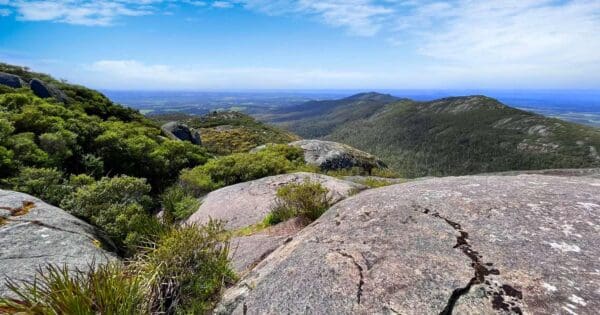
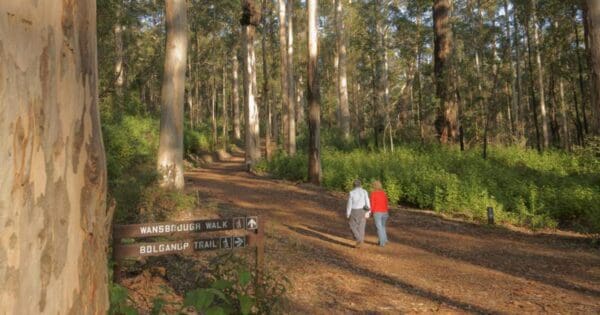
Ancient Granite and Karri Forest in the Porongurup Range
Overview
Porongurup National Park protects the main bulk of the Porongurup Range, a compact but striking mountain range in the Great Southern of Western Australia, about 48 kilometres north of Albany. The park covers roughly 2,621 hectares and rises to 670 metres at Devil’s Slide, standing out sharply from the cleared farmland around it. That contrast gives the range a strong sense of presence, with forested slopes and granite summits appearing almost as an island above the plains.
What makes the park feel so distinctive is the meeting of very old granite, cooler moist gullies and an unusual patch of tall karri forest far from the species’ main stronghold farther west. The range runs for about 12 kilometres, and its mix of rock outcrops, woodland and sheltered forest gives the park a character quite different from the surrounding lowlands.
Highlights
The big draw here is the range itself: a long chain of rounded granite domes, rocky slopes and elevated lookouts with wide views across the Great Southern. From higher points, the Stirling Range is visible to the north and, in clear conditions, the Southern Ocean can be seen to the south.
Scenically, Porongurup has a layered feel. Massive granite forms the backbone of the park, but the slopes below it carry tall forest, mossy gullies and dense understorey that make parts of the range feel cooler and greener than most inland spots in this part of the state. That combination of bare rock and lush vegetation is what gives the park its particular identity.
Best Time to Visit
Spring is one of the most rewarding times to be here, when wildflowers are at their best and the range shows off its rich plant life. It is also a good season for clear views and for seeing the contrast between flowering heath, woodland and the taller forested gullies.
The park also has a strong appeal through the cooler months, when the karri forest, lichen-covered granite and shaded slopes feel especially fresh and the greener side of the range stands out. In the hotter part of the year, the surrounding landscape can look quite dry, which only makes the park’s elevated, forested character more noticeable.
Plants and Animals
Porongurup National Park is known for its high plant diversity, with about 750 plant species recorded in the park, including around 55 orchid species. Granite rock communities, woodland and tall karri forest all occur within a relatively small area, which helps explain why the vegetation changes so noticeably from one part of the range to another.
The karri forest is especially notable because this is an outlying stand, separated from the main karri forests of the south-west. The range’s cooler, wetter conditions have allowed both plants and animals to persist here that are not typical of the surrounding farmland and lower country.
The park also supports a wide variety of native animals. Western grey kangaroos and brush wallabies are among the more familiar mammals, while birdlife includes species such as the rufous treecreeper, scarlet robin and western yellow robin. The cool gullies are also important for relict invertebrate species with ancient Gondwanan links.
Culture and Heritage
Porongurup National Park is recognised as being on Menang Country, and the range holds cultural significance for the Menang community. The place now known as Karri boya-k, formerly called Tree in the Rock, is identified as a culturally significant site within the Menang community’s heritage area.
Find more places to explore…
Help expand the trail collection!
Know of an official trail not listed on Trail Hiking Australia? I’m focused on showcasing the best tracks managed by land managers, and I’d love your help! Sharing a trail adds to our community and helps others discover safe, new adventures.
Submit your trail here

