Sorry, no records were found. Please adjust your search criteria and try again.
Sorry, unable to load the Maps API.
Explore stunning hiking trails of Mount Scoria Conservation Park
Discover the diverse trails of Mount Scoria Conservation Park, Queensland, offering hikes and walks for all skill levels and interests. Find your perfect adventure today.
Discover 1 hiking trail in Mount Scoria Conservation Park
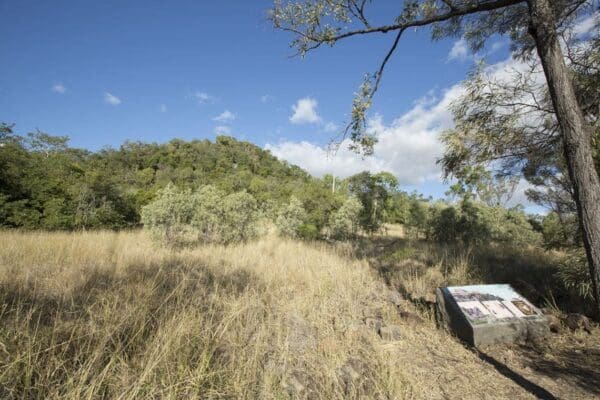

Queensland’s Talking Mountain of Basalt Columns
Overview
Mount Scoria Conservation Park protects a small but striking volcanic landmark in Central Queensland, south-east of Biloela. The park covers about 22ha, but the mountain itself has a strong presence, rising around 150m above the surrounding plain. What makes it memorable is not its size so much as its shape and geology, with steep faces of columnar basalt giving it a look quite unlike the country around it.
Mount Scoria formed when basalt lava intruded into the vent of a small volcano roughly 20 to 26 million years ago. As that lava cooled, it contracted into distinct columns and pillars, many of them angled rather than neatly upright, which gives the mountain much of its unusual character today.
Highlights
The defining feature here is the columnar basalt. The rock has cooled into tall five to eight-sided columns, creating a dramatic pattern across the mountain’s slopes. It is a rare bit of geological theatre in a very compact park, and the angled columns make the formation especially eye-catching.
The contrast between dark volcanic rock and the open rural plain around it also gives Mount Scoria a strong sense of place. Even from a distance, it stands out as an isolated volcanic plug rather than part of a larger range.
Best Time to Visit
The cooler months tend to be the most comfortable time to spend time around Mount Scoria, particularly from autumn through to spring, when Central Queensland days are generally milder. Clear light in these months also tends to bring out the texture and colour of the basalt columns well. Summer can be very hot in this part of Queensland, so the mountain is usually better appreciated outside the peak heat of the season.
Plants and Animals
Despite the park’s small size, the vegetation is varied. Woodland with poplar box and silver-leaved ironbark grows through the northern and eastern parts of the park, while lower slopes support small areas of brigalow with Queensland ebony and currant bush. On the eastern and southern slopes there is also an open semi-evergreen vine thicket, a vegetation type that is unusual in Central East Queensland.
Queensland bottle trees, broad-leaved bottle trees and native bauhinias are among the more noticeable plants recorded here. Wildlife records for the park list 117 species, showing that even a small reserve like this can support a fair range of birdlife and other native fauna.
Culture and Heritage
Mount Scoria Conservation Park lies on Gangulu Nation People’s traditional country. The mountain is known as Dangama Mungar, meaning Talking Mountain, and it is recognised as a culturally significant place along with other mountains in the surrounding area and Lake Victoria to the north-west of Biloela.
The heritage of the place sits alongside its volcanic story. Here, the mountain is not just a geological feature but a named and storied part of Country.
Find more places to explore…
Help expand the trail collection!
Know of an official trail not listed on Trail Hiking Australia? I’m focused on showcasing the best tracks managed by land managers, and I’d love your help! Sharing a trail adds to our community and helps others discover safe, new adventures.
Submit your trail here

