Sorry, no records were found. Please adjust your search criteria and try again.
Sorry, unable to load the Maps API.
Explore stunning hiking trails of Idalia National Park
Discover the diverse trails of Idalia National Park, Queensland, offering hikes and walks for all skill levels and interests. Find your perfect adventure today.
Discover 1 hiking trail in Idalia National Park
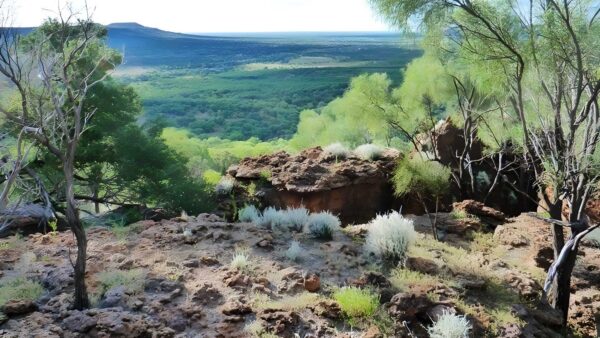

Gowan Range Country and the Mulga Lands at Idalia
Overview
Idalia National Park sits in the semi-arid heart of central-western Queensland, in the Gowan Range about 85km south-west of Blackall. It protects a large stretch of tableland, mesas, buttes, low hills and plains, with the headwaters of the Bulloo River rising here and other creeks draining towards the Barcoo system. At 144,196 hectares, it covers a big cross-section of the Mulga Lands and was set aside to conserve representative ecosystems from this part of inland Queensland.
This is a park known less for lush scenery than for space, stone and subtle change. The country shifts between range tops, escarpments, mulga woodlands and creek lines, and that mix gives the place much of its character. Idalia has also long been important as a research site, especially for understanding semi-arid landscapes and native wildlife.
Highlights
The defining feature here is the Gowan Range itself, an extensive tableland edged by mesas, buttes and rounded hills. That landform gives the park a strong sense of scale, with broad views across contrasting vegetation and drainage lines rather than one single landmark dominating the scene.
Much of Idalia’s scenic appeal comes from the way landform and plant communities change across short distances. Lookouts in the range reveal the relationship between escarpments, plains, creek systems and mulga country, while the park’s more sheltered pockets hold permanent waterholes and sharper shifts in vegetation. It is a dry inland landscape, but not a flat or monotonous one.
Best Time to Visit
The cooler months are the most comfortable time to spend time in Idalia. This is a semi-arid park, and summer conditions are typically harsh, so the period from late autumn to early spring generally suits walking, wildlife watching and simply taking in the country far better than the hotter part of the year.
Season also changes how the park looks. In drier periods the stony slopes, open plains and mulga communities feel spare and exposed, while after rain the creek lines and ground layer can soften the scene and bring more activity in the birdlife.
Plants and Animals
Idalia protects excellent examples of mulga and bendee communities typical of the northern Mulga Lands, along with silver-ironbark, poplar box, bendo and brigalow near the western edge of their natural range. Some lancewood and turpentine mulga communities found here are also significant because they occur at the extremes of their distribution. The park supports at least eight rare or threatened plant species, including vulnerable Rhaphidospora bonneyana and Xerothamnella parvifolia.
The park is especially noted for its yellow-footed rock-wallabies, with the northern Gowan Range providing strong habitat for them among the rocky country. Red kangaroos, eastern grey kangaroos, black-striped wallabies and common wallaroos are also present. Birdlife is particularly rich, with 138 species recorded, and the mix of habitats also supports a notably diverse bat fauna. Several sightings of koalas have been made around permanent waterholes as well.
Culture and Heritage
Stone arrangements, artefact scatters near natural waterholes and a stone quarry site show that Idalia holds Aboriginal cultural heritage. The management plan identifies the Iningai as the language group thought to have inhabited the local area, while also noting that the park’s cultural significance to Aboriginal people has not been fully identified.
There is also clear pastoral history across the park. Idalia was formed from two former grazing properties, and traces of that period remain in places such as Harvey’s stake stockyards from the 1920s, the ruins of Old Idalia, and the surviving Collabara homestead.
Find more places to explore…
Help expand the trail collection!
Know of an official trail not listed on Trail Hiking Australia? I’m focused on showcasing the best tracks managed by land managers, and I’d love your help! Sharing a trail adds to our community and helps others discover safe, new adventures.
Submit your trail here

