Sorry, no records were found. Please adjust your search criteria and try again.
Sorry, unable to load the Maps API.
Explore stunning hiking trails of Heathcote-Graytown National Park
Discover the diverse trails of Heathcote-Graytown National Park, Victoria, offering hikes and walks for all skill levels and interests. Find your perfect adventure today.
Discover 4 hiking trails in Heathcote-Graytown National Park

Box-Ironbark Country Between Heathcote and Graytown
Overview
Heathcote-Graytown National Park protects a long stretch of dry forest and woodland in north-central Victoria, about 110 km north of Melbourne. It runs between Heathcote and Graytown, with the park forming part of the broad band of Box-Ironbark country that lies inland from the Great Dividing Range. The landscape is narrow and elongated rather than compact, which gives it a very different feel from many other Victorian national parks. It is close to Heathcote, around 45 km east of Bendigo, and includes country that backs directly onto the township’s north-eastern edge.
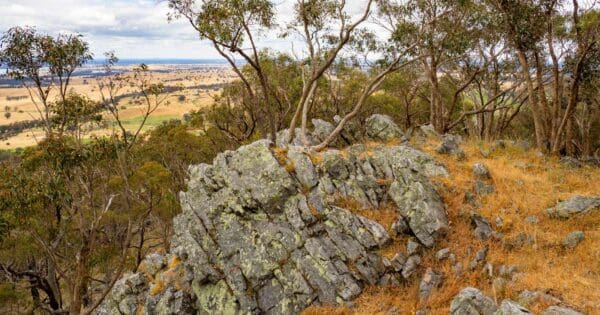
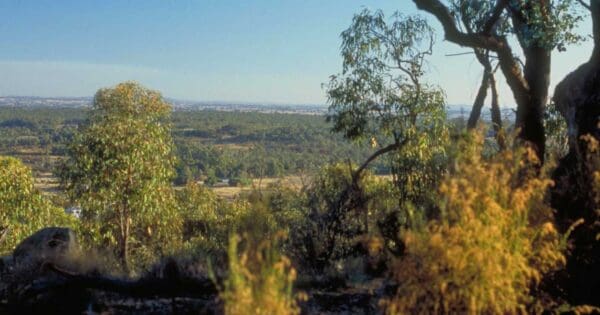
This is also part of the largest remaining contiguous Box-Ironbark forest in Victoria. That matters on the ground as much as it does on a map. The park feels expansive, dry, and open in places, then denser and more enclosed through the ironbark ridges and creekline woodlands, with a strong sense of the inland Goldfields landscape holding together across a much wider area.
Highlights
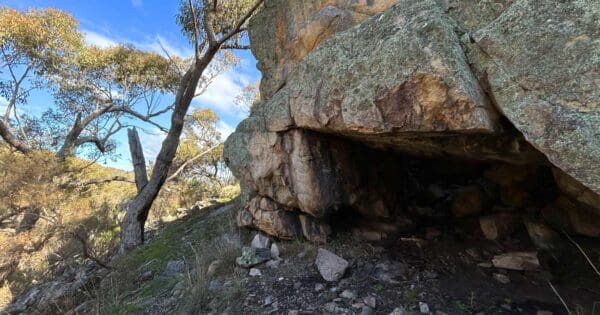
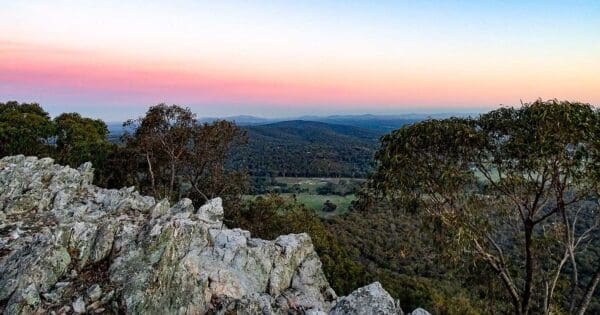
The character of the park comes from its ridges, low ranges and dry forested slopes rather than from a single dramatic landmark. The McIvor Range gives the park real topographic shape near Heathcote, while farther east the country around Mount Black stands above the more subdued surrounds. Around Mount Black and Mount Melville, the geology is especially visible, with granite intrusion and hardened metamorphic rock exposed after long erosion stripped away the overlying layers.
Scenically, this is a place of subtle variation. Ironbark forest, woodland, creek flats and folded sedimentary country all sit within the one park, so the landscape changes steadily as you move through it. That mix of ridges, open woodland and lower valleys is a big part of what makes the park memorable.
Best Time to Visit
Spring is usually the most rewarding time to be here. Wildflower appreciation is especially popular then, and the birdlife can be more noticeable through the warmer months. Autumn is another good option if you prefer milder conditions for walking. In the height of summer, the dry inland setting can feel harsher and some activities are less common.
Plants and Animals
Heathcote-Graytown is known for its Box-Ironbark vegetation, but it is not a single uniform forest type. Red Ironbark and Red Stringybark dominate some areas, while lower creekline country supports River Red Gum, Grey Box and Yellow Box. One of the park’s distinctive plants is the Grey Grass Tree, which forms striking stands in parts of the forest and can reach around three metres high.
The park supports at least 363 native vascular plant species, including nine threatened flora species. Its fauna is equally significant, with 26 threatened species recorded. Woodland birds are a strong part of that story, including species such as the Swift Parrot, Regent Honeyeater, Black-chinned Honeyeater, Hooded Robin and Diamond Firetail. Large old trees and hollow-bearing habitat are especially important here, supporting animals such as the Squirrel Glider, Powerful Owl and Brush-tailed Phascogale.
Find more places to explore…
Help expand the trail collection!
Know of an official trail not listed on Trail Hiking Australia? I’m focused on showcasing the best tracks managed by land managers, and I’d love your help! Sharing a trail adds to our community and helps others discover safe, new adventures.
Submit your trail here

