Sorry, no records were found. Please adjust your search criteria and try again.
Sorry, unable to load the Maps API.
Explore stunning hiking trails of Gold Coast Hinterland
Discover the diverse trails of Gold Coast Hinterland, Queensland, offering hikes and walks for all skill levels and interests. Find your perfect adventure today.
Discover 2 hiking trails in Gold Coast Hinterland

Along the Ancient Rim of the Tweed Volcano
Overview
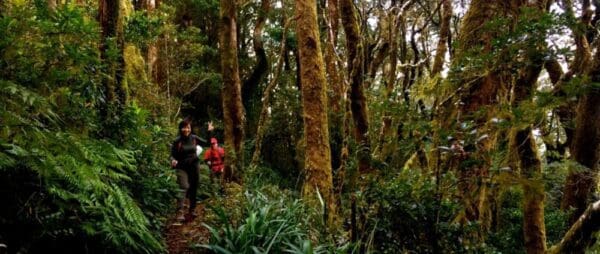
The Gold Coast Hinterland is where the coast gives way to high rainforest country, basalt plateaus and steep escarpments. Much of the region’s best-known protected landscape sits within Lamington and Springbrook national parks, linked by the Numinbah Valley and shaped by the long erosion of the ancient Tweed volcano. These parks lie roughly 100km south of Brisbane and form part of the Gondwana Rainforests of Australia World Heritage Area.
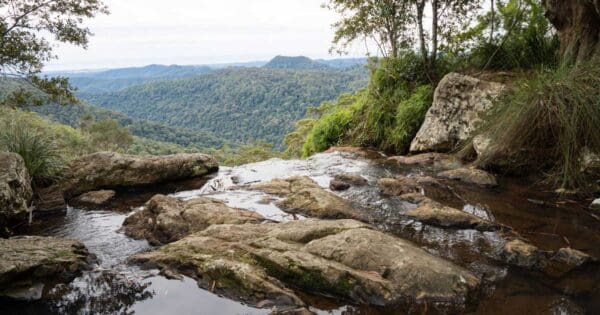
What stands out here is the contrast. One moment the country opens to broad views across south-east Queensland and northern New South Wales, and the next it closes in around creeks, dense subtropical rainforest and pockets of cool temperate forest. It is a compact region on the map, but the terrain feels big, layered and deeply cut by water.
Highlights
The scenery is defined by the old volcanic rim and the cliffs, valleys and waterfalls carved from it over millions of years. Around Lamington, the McPherson Range rises in long forested folds with lookouts set above the Gold Coast hinterland and across the border ranges. Springbrook adds another side to the picture, with a plateau landscape broken by sheer edges, deep gorges and well-known falls including Purling Brook, Twin Falls and Goomoolahra.
Natural Bridge gives the hinterland one of its most distinctive landforms, where Cave Creek has cut through the rock to form a bridge and cave system. Across the broader region, places like Best of All Lookout, the Natural Bridge section, the Springbrook plateau and the ridgelines of Lamington show how varied the country is without ever losing that strong sense of height, water and ancient geology.
Best Time to Visit
The cooler months from autumn to spring are usually the most comfortable time to spend in the Gold Coast Hinterland, especially on longer days out. Clearer air often makes the escarpment views stand out, while the rainforests stay green year-round because of the region’s high rainfall and elevation.
Summer has its own appeal, with the forests at their lushest and waterfalls often running strongly after rain, but it can also be warm and humid at lower elevations. Because the hinterland spans plateaus, valleys and exposed ridges, conditions can feel quite different from one part of the region to another.
Plants and Animals
This is one of the richest natural areas in south-east Queensland. The World Heritage rainforests here include the most extensive areas of subtropical rainforest in the world, along with large areas of warm temperate rainforest and nearly all of Australia’s remaining Antarctic beech cool temperate rainforest. In Springbrook alone, the forests range across subtropical, warm temperate and cool temperate rainforest, open eucalypt forest and heath.
The mix of altitude, moisture and ancient landforms has helped a wide variety of species persist here. The region protects many rare plants, animals and plant communities, and it is especially important for rainforest fauna, frogs and birdlife. At night, the Natural Bridge cave is also known for its glow-worm colony, adding another small but memorable part of the hinterland’s ecological character.
Culture and Heritage
The Gold Coast Hinterland includes places with long and continuing cultural connections for the Yugambeh people. In Lamington, the mountains known as Woonoongoora are described as sacred and spiritual places, and many park place names come from Yugambeh language. Springbrook is also on Yugambeh Country, with strong links to ancestral pathways, special places and cultural stories connected to the land, plants and animals.
Alongside its cultural significance, the region also holds an important conservation story. Lamington was declared a national park in 1915, helping secure protection for part of a rainforest landscape that is now recognised internationally for its geological history, evolutionary significance and biodiversity.
Find more places to explore…
Help expand the trail collection!
Know of an official trail not listed on Trail Hiking Australia? I’m focused on showcasing the best tracks managed by land managers, and I’d love your help! Sharing a trail adds to our community and helps others discover safe, new adventures.
Submit your trail here

