Sorry, no records were found. Please adjust your search criteria and try again.
Sorry, unable to load the Maps API.
Explore stunning hiking trails of Geikie Gorge National Park
Discover the diverse trails of Geikie Gorge National Park, Western Australia, offering hikes and walks for all skill levels and interests. Find your perfect adventure today.
Discover 4 hiking trails in Geikie Gorge National Park


Where an Ancient Reef Meets the Fitzroy River
Overview
Geikie Gorge National Park, now also known as Danggu National Park, sits near Fitzroy Crossing in the central Kimberley, about 20 kilometres from town. The park protects a striking section of the Fitzroy River where it cuts through the limestone of the Geikie Range, creating a gorge that feels both compact and immense once you are standing beside it.
What makes this place so distinctive is its geology. The gorge was carved through part of an ancient barrier reef formed in the Devonian period, when a tropical sea covered much of the north-west. Today that history is written into the pale limestone walls, the rounded reef forms and the polished rock faces along the river.
Highlights
The gorge itself is the centrepiece. Sheer white and grey limestone walls rise above the water, with rounded reef sections and patches of honeycomb weathering that give the rock a sculpted look. In the dry season the river runs quietly beneath the cliffs, while the height and shape of the gorge hint at the force of wet-season flows.
The scenery is especially memorable because it brings together several very different elements in one compact place: deep green river water, pale limestone, riverbank trees and the broad Kimberley light. It is one of those landscapes that makes its geological story easy to see, even without knowing the science behind it.
Best Time to Visit
The most rewarding time to visit is generally during the dry season, when conditions are milder and the river settles into a calmer flow beneath the cliffs. This is when the shape, colour and texture of the gorge are easiest to appreciate from the riverbank.
Seasonal change is a big part of the park’s character. In the wet season, the Fitzroy River can rise dramatically and reshape the look of the gorge, while the dry months reveal the contrast between still water, exposed banks and bright limestone walls.
Plants and Animals
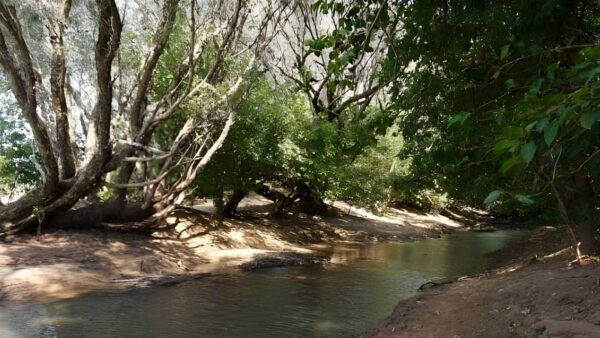
Despite the hard limestone setting, the river corridor supports thick vegetation. Paperbarked cajeputs and river gums line the banks, with freshwater mangroves, native figs and pandanus helping to hold the river edge together. Spinifex grows on the rocky gorge walls, showing how quickly the plant communities shift between the waterline and the drier stone above.
Wildlife is closely tied to the river. Freshwater crocodiles are part of the park, along with waterbirds such as white-bellied sea-eagles, little pied cormorants and kingfishers. Fruit bats gather in riverside trees, and the Fitzroy River supports fish and freshwater turtles as well as lizards and goannas in the surrounding rocky country.
Culture and Heritage
Danggu has a direct and continuing connection with Bunuba people, who are the Traditional Owners and joint managers of the park. The name Danggu refers to an area where the water is very deep under the cave, and the gorge and its water places hold strong cultural and spiritual significance.
The park’s cultural meaning is closely tied to land, water and wildlife. Bunuba people maintain cultural knowledge connected to the area and continue to care for country through ranger work and joint management. Stories associated with the gorge remain part of the place rather than something separate from its scenery.
Find more places to explore…
Help expand the trail collection!
Know of an official trail not listed on Trail Hiking Australia? I’m focused on showcasing the best tracks managed by land managers, and I’d love your help! Sharing a trail adds to our community and helps others discover safe, new adventures.
Submit your trail here