Sorry, no records were found. Please adjust your search criteria and try again.
Sorry, unable to load the Maps API.
Hikes and walks in Flinders Ranges
Here you’ll find every hike we list in Flinders Ranges, South Australia. Each listing has the distance, grade and time it takes, so you can pick one that suits you. You can also search hikes across Australia.
Discover 2 hiking trails in Flinders Ranges


Ancient Ridges and the Stone Bowl of Ikara
Overview
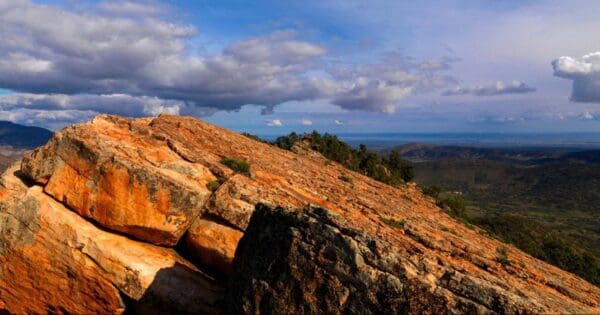
Flinders Ranges country has a scale that is hard to miss. About 400 kilometres north of Adelaide, the national park at its heart covers roughly 93,695 hectares of folded mountain country, gorges, plains and watercourses shaped by a very long geological history. This is where the better-known image of the region comes into focus: long serrated ridgelines, open semi-arid country and the immense natural amphitheatre of Ikara, also known as Wilpena Pound.
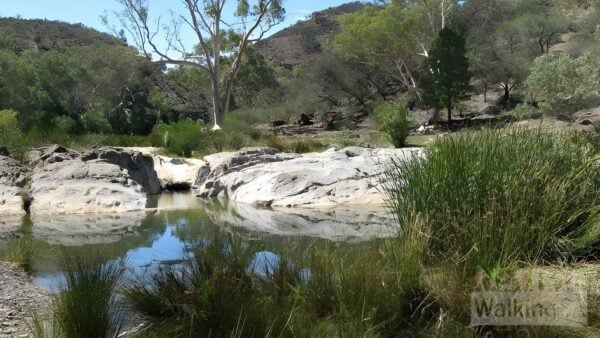
The landscape feels both rugged and spacious. Tree-lined creek beds cut through rocky ranges, while broad valleys and foothills open out between them. It is a place where geology is always close at hand, not just in the shape of the ranges themselves but in the exposed layers, eroded slopes and ancient rock formations that give the country its distinct character.
Highlights
The defining feature here is Ikara Wilpena Pound, a vast enclosed mountain basin created through the folding, uplift and erosion of sedimentary rocks. It is one of those landforms that changes character throughout the day, from soft light on the ridges in the morning to sharper shadows across the walls and creek lines later on.
Beyond the pound, the park takes in the Heysen Range along with Brachina Gorge and Bunyeroo Gorge, both of which show off the Flinders Ranges at their most dramatic. These gorges slice through the ranges and reveal the region’s layered geology in a way that makes the country feel raw, exposed and very old.
The area also contains geological and palaeontological features of global significance, including sites tied to the Ediacaran Period. That deep-time story adds another dimension to the scenery, because the ridges and creek beds are not just striking to look at, they are part of one of Australia’s most important ancient landscapes.
Best Time to Visit
The cooler months are generally the most comfortable time to spend in the Flinders Ranges, when mild days make it easier to appreciate the open country, rocky lookouts and gorges without the harsher heat of summer. Seasonal changes also make a noticeable difference to how the landscape looks and feels.
Spring is especially rewarding in years with good rain, when wildflowers spread across plains and foothills and the usually muted colours of the ranges pick up fresh greens and patches of colour. Even outside spring, the clear air and shifting light can make autumn and winter particularly appealing for soaking up the shape and scale of the country.
Plants and Animals
The park supports an unusually rich mix of life for a semi-arid landscape, with ephemeral streams and waterholes providing important refuge habitat. Plant communities range across alluvial plains, creek systems and grasslands, with river red gum communities among the notable vegetation in the park.
Wildlife is one of the quiet strengths of the Flinders Ranges. Yellow-footed rock-wallabies are one of the best known animals here, and the park also protects habitat for species such as the short-tailed grasswren, which is endemic to the Flinders and Gawler Ranges, as well as the Flinders worm-lizard and other rare or threatened fauna. In spring, the broader landscape is softened again by flowering plants across the plains and foothills.
Culture and Heritage
Ikara-Flinders Ranges National Park lies within the traditional lands of the Adnyamathanha people, who have co-managed the park since 2011. The name Ikara means meeting place, and the cultural meaning of the landscape remains central to how the park is understood.
This connection is deeply tied to landforms, waterplaces, plants and animals, and to Yura Muda, the Adnyamathanha belief of creation. The park also contains important cultural places, including rock paintings and engravings at sites such as Arkaroo Rock and Sacred Canyon, and the story of Akurra is directly connected to the form of Ikara Wilpena Pound itself.
Find more places to explore…
Help expand the trail collection!
Know of an official trail not listed on Trail Hiking Australia? I’m focused on showcasing the best tracks managed by land managers, and I’d love your help! Sharing a trail adds to our community and helps others discover safe, new adventures.
Submit your trail here