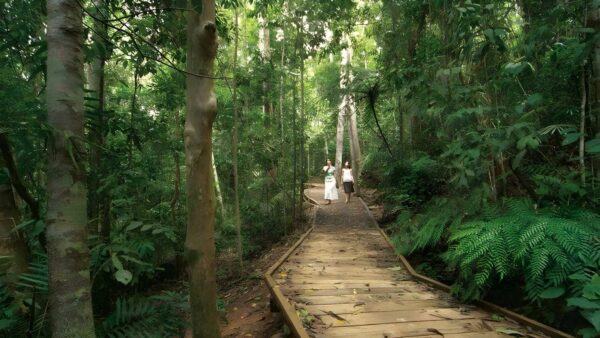
Rainforest Crater Lakes on the Atherton Tableland
Overview
Crater Lakes National Park protects two separate sections on the eastern Atherton Tableland, centred on Lake Eacham and Lake Barrine. Together they cover a compact but striking pocket of rainforest country where volcanic landforms and still freshwater lakes sit side by side. The park lies in the Wet Tropics World Heritage Area, inland from Cairns, and feels quite different from the coast despite being only about 68km up the range.
What makes this park distinctive is the combination of clear crater lakes and dense upland rainforest. These are not river lakes but water-filled volcanic maars, formed when rising lava met groundwater and left broad craters behind. Around them, the forest protects a rare rainforest type as well as species found only in the Wet Tropics.
Highlights
The scenery here is defined by two near-circular crater lakes ringed by thick green forest. Lake Eacham and Lake Barrine give the park its character, with calm water, steep-sided volcanic basins and a strong sense of enclosure created by the surrounding rainforest.
There is also a broader Tableland feel to the landscape, with rich volcanic soils, tall forest structure and patches of giant trees, including kauri pines. Even within a relatively small park, the mix of lake, crater rim and rainforest gives the area an unusually layered look.
Best Time to Visit
Crater Lakes National Park can be visited year-round, but the drier months from about May to October are usually the most comfortable for walking, with lower humidity and milder conditions on the Tableland. In the wetter months the rainforest is especially lush and green, though conditions are often more humid and changeable.
Plants and Animals
The park protects rainforest communities and wetland habitat within a small area, including natural lacustrine wetlands associated with the two crater lakes. It is part of a region known for high biodiversity, and many of the park’s plants and animals are restricted to the Wet Tropics.
Birdlife and rainforest mammals are a big part of the park’s character. The surrounding forests provide habitat for endemic Wet Tropics species, and the combination of water and dense vegetation supports a richer mix of wildlife than the park’s size might suggest.