Sorry, no records were found. Please adjust your search criteria and try again.
Sorry, unable to load the Maps API.
Explore stunning hiking trails of Burleigh Head National Park
Discover the diverse trails of Burleigh Head National Park, Queensland, offering hikes and walks for all skill levels and interests. Find your perfect adventure today.
Discover 2 hiking trails in Burleigh Head National Park


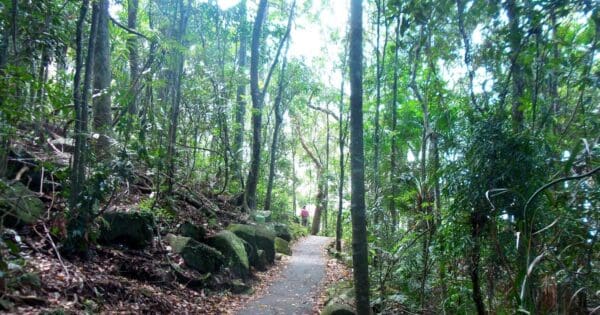

Where Ancient Basalt Meets the Gold Coast Shore
Overview
Burleigh Head National Park protects a small but striking piece of the Gold Coast, centred on the rocky headland at Burleigh Heads about 90km south of Brisbane. Despite covering only about 26 hectares, it packs a lot into a compact area, with subtropical coastal forest, rocky slopes and broad views over the ocean and Tallebudgera Creek.
What makes the park feel different from the developed coastline around it is the way the headland still holds together as a natural landform. It preserves a remnant of lowland coastal vegetation that has become scarce elsewhere in the region, giving this stretch of coast a much older, wilder character than the surrounding suburbs.
Highlights
The defining feature here is the headland itself, formed from lava linked to the ancient Tweed Volcano. Slow cooling created the six-sided basalt columns still visible today, and ocean erosion has exposed huge boulders along the seaward edge. It gives the park a rugged, dark-rock character that stands out on a coast better known for sand and surf.
There is also a strong contrast in scenery across a very short distance. On one side you have the open sweep of the Pacific and the rocky shoreline below the cliffs. On the other, the headland drops towards Tallebudgera Creek, with calmer water and a greener, more sheltered outlook. In winter and spring, the ocean side can also be a good place to spot passing humpback whales and dolphins.
Best Time to Visit
Burleigh Head National Park can be visited year-round, but the more comfortable months are usually the cooler, drier part of the year from autumn to spring. Clear winter days are especially good for long coastal views, and the migration season through winter and spring adds the chance of seeing humpback whales offshore.
Summer brings the park’s lush subtropical growth into its own, though it can feel hotter and more humid. After rain, the contrast between rainforest, open forest and exposed rocky slopes is especially noticeable.
Plants and Animals
This is one of the park’s real strengths. The headland supports littoral rainforest, a dry form of rainforest that grows beside the sea, on rich dark soils derived from basalt. It sits alongside open eucalypt forest on older, poorer sedimentary soils, so the change in vegetation is closely tied to the underlying geology.
Brush box, ironbark, bloodwood and forest red gum grow in the open forest, while exposed slopes carry pandanus that can handle wind, heat and salt spray. There is also a small pocket of coastal heath above Sandy Cove. For such a small park, that mix of plant communities gives it unusual ecological variety.
The headland remains an important refuge for wildlife on this heavily developed part of the coast. It provides a feeding and resting area for migrating birds, while white-bellied sea-eagles, brahminy kites, whistling kites and ospreys hunt along the creek and shore. Brush-turkeys are regular residents, and reptiles such as carpet pythons and eastern water dragons are also found here.
Culture and Heritage
Burleigh headland and Tallebudgera Creek are sacred sites of cultural significance to the Traditional Owners, with a continuing connection to Country that reaches back countless generations. That living cultural presence is part of what gives the place its depth, and it sits alongside the headland’s importance as a long-protected piece of the Gold Coast shoreline.
The park also has a long history of formal protection. The headland was reserved for public purposes in 1886 and later gazetted as a national park in 1947, helping preserve a prominent coastal landmark that might otherwise have been lost to subdivision and clearing.
Find more places to explore…
Help expand the trail collection!
Know of an official trail not listed on Trail Hiking Australia? I’m focused on showcasing the best tracks managed by land managers, and I’d love your help! Sharing a trail adds to our community and helps others discover safe, new adventures.
Submit your trail here

