Blisters are often blamed on rubbing. In reality, they are mechanical injuries that occur within the skin. Understanding exactly how they form allows hikers to prevent them more effectively and treat them more intelligently.
This article forms part of the broader Foot Health for Hikers guide, which explains how load, moisture, friction and terrain interact to affect foot health on the trail.
Blisters are predictable. They occur when internal skin stress exceeds tissue tolerance.
Friction vs Shear: The Critical Distinction
Most people imagine blisters as surface burns caused by rubbing. The injury actually occurs deeper.
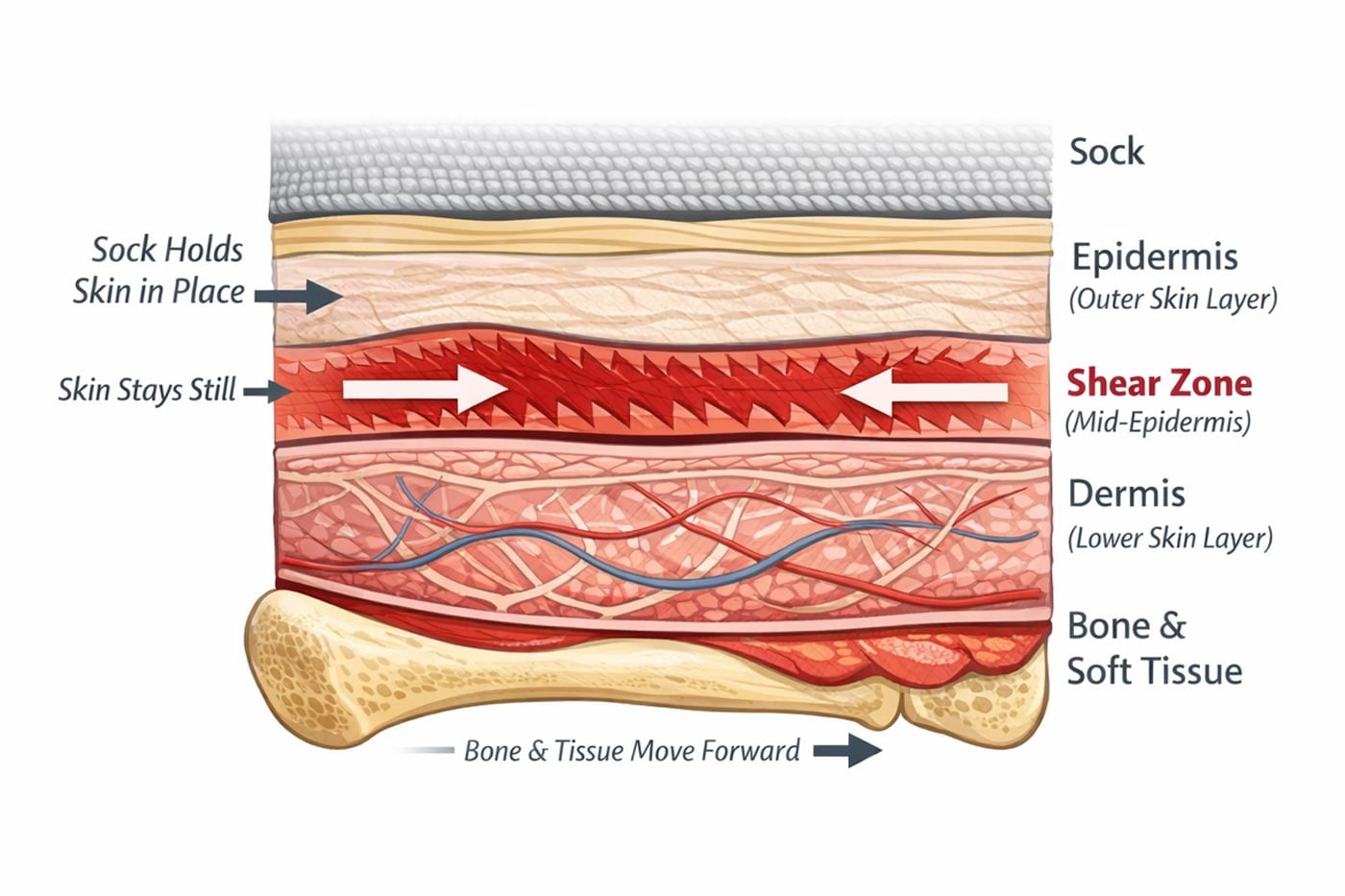
When your foot moves inside your boot, the outer layer of skin grips the sock while deeper layers move with the underlying tissue and bone. This creates opposing forces within the skin.
This force is called shear.
When shear exceeds tolerance:
- The mid-layers of the epidermis begin to separate
- Microscopic gaps form between cells
- Fluid fills the space
- A blister develops
The separation typically occurs within the mid-epidermis, where cells are structured to resist stress but can fail under repeated deformation.
Surface friction contributes to shear, but the damage happens inside the skin.
Key point: Blisters are internal shear injuries, not surface abrasions.
Visualising Shear
To understand shear, imagine this simplified model:
- Your bones and deeper tissues move forward
- Your sock grips the outer skin
- The skin is pulled in two directions at once
That internal stretching causes separation.
This is often the moment hikers understand why simple rubbing explanations fall short.
The Role of Load
Shear force increases with load.
Heavier packs, steep terrain, long descents and cumulative distance all increase the force transmitted through the foot.
As load increases:
- Tissue deformation increases
- Internal stress rises
- Shear threshold is reached sooner
This is why blisters are more common on multi-day hikes or long alpine descents.
Load includes:
- Pack weight
- Elevation change
- Repetition
- Duration
- Fatigue
For broader discussion of cumulative load and tissue tolerance, see:
Foot Fatigue and Load Management for Hikers
Heat and Skin Vulnerability
Warm skin deforms more easily. As foot temperature rises:
- Sweat production increases
- Skin softens
- Resistance to shear decreases
In Australian conditions, heat stress can be extreme. In the Northern Territory or on coastal beach walks, radiant heat from sand or rock increases internal foot temperature significantly.
This radiant heat does not just make you thirsty. It accelerates moisture build-up inside socks and softens skin more rapidly, lowering the shear threshold.
Hot ground effectively amplifies blister risk even if distance remains unchanged.
Moisture and Maceration
Moisture changes skin mechanics dramatically.
When skin becomes saturated:
- It softens
- It stretches more easily
- It tolerates less internal deformation
This process is called maceration.
Macerated skin fails under lower shear force. That is why creek crossings, humid conditions and prolonged sweating increase blister risk.
For broader moisture management strategies, see:
Moisture Management for Hikers: Wet Feet, Fabric Systems and Risk
Lubricants vs Moisture: An Important Distinction
This is where confusion often occurs.
Water and sweat soften the skin and increase vulnerability. Lubricants do something different.
Silicone or wax-based friction reducers create a thin barrier that reduces grip between surfaces. By reducing grip, they allow slight slip at the interface, which decreases internal skin stretching.
In simple terms:
- Macerating moisture weakens the skin
- Lubricants reduce the grip that causes shear
They are not the same.
Why the Double-Sock System Works
The double-sock system is often misunderstood.
Scientifically, it works because it shifts the shear interface. Instead of shear occurring between layers of skin, it occurs between the two layers of fabric. The outer sock moves against the inner sock. The inner sock moves with the skin.
This moves internal stretching away from your epidermis and into the fabric layers, where damage is harmless. That is why, when fitted correctly, a double-sock system can significantly reduce blister formation on long hikes.
Downhill Forces and Toe Blisters
Descending increases braking forces. The foot slides slightly forward inside the boot. This increases:
- Forefoot pressure
- Toe friction
- Internal shear at the ball of the foot
Repeated downhill steps create cumulative micro-trauma. Poor lacing or inadequate toe box space amplifies these forces.
For downhill mechanics and toe protection strategies, see:
Toe Protection and Downhill Impact Management for Hikers
Why Blisters Form Late in the Day
Blisters rarely appear in the first hour. They develop after cumulative exposure.
This is due to:
- Repeated shear cycles
- Rising temperature
- Increasing moisture
- Muscular fatigue
As intrinsic foot muscles tire, movement inside the boot may increase slightly. That amplifies shear further. Blisters are therefore the result of cumulative mechanical stress over time.
Applying the Science: Why Prevention Works
Understanding shear clarifies why prevention strategies are effective.
Proper Fit: Reduces unwanted movement and limits internal stretching.
Stable Lacing: Prevents forward slide during descents.
Friction Reduction: Moves shear to fabric layers or lowers grip between surfaces.
Early Hotspot Intervention: Prevents microscopic separation from progressing.
Prevention strategies do not eliminate force. They redistribute it or reduce internal deformation.
When Shear Becomes Injury
Once epidermal layers separate and fluid accumulates, prevention shifts to management.
For practical field treatment and infection risk guidance, see:
Blister Treatment for Hikers: Field Management and Infection Risk
A Simple Blister Formation Model
Blister risk increases when these four variables rise together:
- Load
- Heat
- Moisture
- Repetition
Reduce any one variable and risk falls. Reduce several and blister likelihood drops significantly. Blisters are mechanical problems. Mechanical problems respond to mechanical solutions.
The Bottom Line
Blisters form when internal shear in the mid-layers of the skin exceeds tissue tolerance. Load, heat, moisture and repetition amplify this stress. Understanding the science removes guesswork. It allows hikers to intervene early, choose appropriate prevention strategies and reduce injury risk across long and multi-day hikes.
Blisters are not random. They are predictable responses to mechanical stress.




What’s your go-to trick for preventing blisters on long hikes? Any products you swear by?
Injinji toe socks liners underneath normal hiking crew socks.
Rob Margono my wife used to wear them. I found them really uncomfortable but that might just be my feet were not compatible
Trail Hiking Australia switched to this system four/five years ago and can’t recall a blister episode since then.
I agree everyone will have different preferences, etc., and that’s why it’s key to try different things 🙂
Rob Margono great to hear this works for you. Definitely worth trying out.
Rub paw paw ointment generously into feet before putting socks on. Keep feet cool with good socks (my feet love Bridgedale socks) and wear correctly fitting shoes/boots. Works every time.
Deb Kahn great tip. I’ve never tried that, but I’m lucky I don’t seem to have blister problems. Touch wood.
Deb Kahn I’ll have to start using that now, just in case.
Silverlight socks!!! No blisters, feels like a glove on your feet! And they don’t smell! I wore them for 9 days without a wash or a rince, let them aerate and no smell!
Hikers wool. Just pop a blob against the hotspot, pull your sock over it and Bob’s your uncle!
Marama Gornitsky I have that too. Have only every used it a few times when I was field testing it. I was wearing new boots that I had not broken in (on purpose) and as soon as I felt a hotspot, did exactly what you said, and no blister at all.
Trail Hiking Australia I used to be an ultra trail runner and would wrap my toes in it before putting my feet in toe socks pre event. Not a single blister. That’s how I know this stuff works when nothing else did. And yet I just can’t convince some hiking folk of the efficacy of Mother Nature’s own gift!
Marama Gornitsky oh well. At least you try. Sometimes you can lead a horse to water but can’t make it drink.
I’ve never had a blister in my life , I don’t wear shoes most of the time I put peppermint cream in my feet beginning and end of walk. I’m fanatical about socks I wear anatomically correct ones and a thin wool ones if it’s winter.
Sue Evans sounds like that’s working well for you. Nice one.
Trail Hiking Australia I did the bloody long walk twice in 2 weeks in different states and the state of peoples feet the socks they were wearing and their footwear shocked me , it’s like just buy known brand footwear and that’s all you do